Best Budget Power Rack for Small Spaces: Mikolo Wins
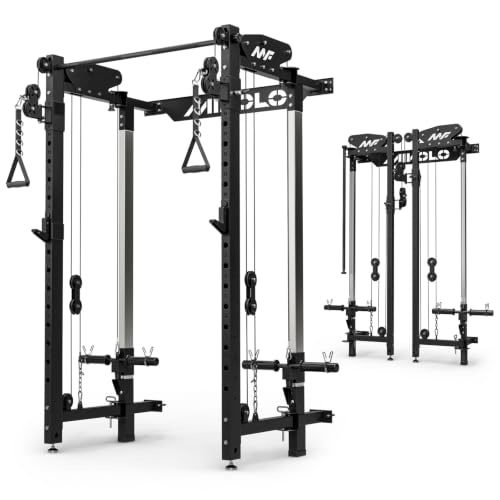
Wall depth, not footprint, is what separates a rack that fits a spare bedroom from one that eats it. Five power cages compared on published depth, weight, warranty and mounting method.

By Lauren RossUpdated 14 min read
On this page
- Best budget power rack for small spaces at a glance
- How I screened these five racks and what the weights ruled out
- Why depth beats footprint in a small room
- 1. Mikolo Folding Squat Rack — Best overall
- 2. CAP Barbell FM-8000F Deluxe Power Rack — Best budget pick
- 3. Mikolo 2" x 2" Folding Wall Mounted Squat Rack — Best warranty
- 4. SunHome Power Cage Squat Rack — Most versatile
- 5. Mdeam Folding Squat Rack — Best for families
- Wall-mounted or freestanding: which suits your space?
- What more money buys in a folding power rack
- What the listings do not tell you about small spaces
- The verdict
- FAQ
The best budget power rack for small spaces is the Mikolo Folding Squat Rack, because it folds against the wall and still carries a 150 lb frame with a published depth of 30 in. If you cannot drill into studs, the CAP Barbell FM-8000F Deluxe Power Rack is the freestanding answer, though it needs a 61.4 in by 45.6 in patch of permanent floor. The specification that splits this field is not width. It's depth, and how much of it survives when the rack is folded flat.
Best budget power rack for small spaces at a glance
| Pick | Depth | Folds flat? | Price |
|---|---|---|---|
Best overall Mikolo Folding Squat Rack |
30 in | Yes, to 3 sq ft claim | Check Price |
Best budget pick CAP Barbell FM-8000F Deluxe Power Rack |
45.7 in | No, freestanding cage | Check Price |
Best warranty Mikolo 2" x 2" Folding Wall Mounted Squat Rack |
22 in | Yes, wall mounted | Check Price |
Most versatile SunHome Power Cage Squat Rack |
42.4 in | No, half cage | Check Price |
Best for families Mdeam Folding Squat Rack |
Not published | Yes, wall mounted | Check Price |


How I screened these five racks and what the weights ruled out
I weighted three criteria and ignored everything else. Depth came first at roughly half the decision, because depth is what a spare bedroom runs out of. Published shipping weight came second, as a rough proxy for how much steel is in the frame. Warranty length came third.
Here's how the five sorted on those criteria:
- Depth. 22 in for the smaller Mikolo, 30 in for the Cheetah, 42.4 in for the SunHome, 45.7 in for the CAP. The Mdeam publishes a 42.4 in length figure but no depth at all.
- Frame weight. 150 lb for the Cheetah, 115 lb for the SunHome, 97 lb for the CAP, 80 lb for the Mikolo QJ01. The Mdeam publishes no weight.
- Warranty. Two years on the Mikolo QJ01, one year on the Cheetah, the SunHome and the Mdeam, and 30 days on the CAP.
Those numbers cut two claims immediately. The CAP is the cheapest of the five and also the deepest, which means the cheapest rack here costs you the most floor. And the Mdeam publishes so little that I could not place it on two of the three criteria, which pushed it to the bottom of the order regardless of what its feature bullets promise.
One honest caveat before you go further. Amazon's results for this search do not filter by room size, so "small spaces" is a judgment you have to make with a tape measure, not something any of these five listings certifies. I've used published depth as the closest available stand-in.
Why depth beats footprint in a small room
Most power rack guides compare total footprint in square feet. That number misleads in a small room, because a rack does not just occupy floor. It occupies the corridor you walk through to reach the bed.
Depth is the figure that decides whether a rack fits. The CAP Barbell FM-8000F is 45.7 in deep, which is nearly four feet of permanent intrusion into the room. The Mikolo 2" x 2" folding rack is 22 in deep. That is less than half. In a 10 ft room, the difference between those two figures is the difference between a gym you can also use as a bedroom and a bedroom you can no longer walk across.
Height matters second. Four of these five sit between 84.9 in and 86 in tall, so a standard 8 ft ceiling clears them with a couple of inches spare. Measure before you order. A basement with ducting overhead often loses six inches you did not account for.
Width is the criterion I'd worry about least, since 45 in to 47 in covers four of the five and a barbell overhangs any of them anyway.
1. Mikolo Folding Squat Rack — Best overall
The best budget power rack for small spaces is this one, because 150 lb of frame and a 30 in depth is the strongest trade between rigidity and room you'll find in this set.
Best for: a wall you can drill into and a 30 in depth limit Skip it if: you rent and cannot mount into studs
At 86 x 45 x 30 in and 150 lb, the Cheetah is the heaviest frame in this group by 35 lb. That weight is the point. Wall-mounted racks live or die on how little they flex under load, and more steel in the uprights is the crude but reliable indicator.
What separates it inside this set is the cable work. Mikolo says the unit integrates a power rack, dual cable crossover, lat pulldown and pull-up bar into one frame, with a single-handed adjustable pulley offering 15 height options and five function modes. The listing puts the folded footprint at 3 sq ft against 9.5 sq ft open, and rates the 2x2 in 14-gauge steel and screw-in wall mounts to handle heavy loading. Only one other pick here offers cables from a folding frame, and that one publishes almost no measurements.
The trade-off is real. It's the most expensive pick here, it needs solid wall anchoring, and its 30 in depth is 8 in more than the shallower Mikolo. Its one-year cover is half what the QJ01 carries.
Pros:
- Heaviest frame in this set at 150 lb
- Dual cable crossover and lat pulldown in one unit
- 15 pulley height options claimed
- Folds to 3 sq ft per the listing
- 86 in height clears a standard 8 ft ceiling
Cons:
- The most expensive pick here
- 30 in deep, 8 in more than the shallowest option
- One-year cover, half the QJ01's warranty
- Requires drilling into a structural wall
- Only one seller lists it
2. CAP Barbell FM-8000F Deluxe Power Rack — Best budget pick
The cheapest of the five and the only full four-post cage, which makes it the safest way to bench alone if you have the floor to give it.

Best for: a garage or basement with floor space to spare Skip it if: your room is under 62 in wide
This is the structural outlier. Every other pick here is a half rack or a wall-mounted folder. The CAP is a genuine enclosed cage at 85 x 45.7 x 61.4 in, which means you're inside the frame with safety catches on both sides when you bench. That geometry is worth more than any attachment list.
It also sells faster than anything else in this group, which tells you something about how many people reach the same conclusion. CAP lists 12- and 14-gauge steel, gussets for reinforced support, a three-step powder coat and capped frame ends. The hardware count is generous for the price position: two plate posts, three band posts per side, two J-cup catches, two safety catches, a pull-up bar and bar holders with ABS sleeves.
Now the cost. At 45.7 in deep and 61.4 in wide it's the largest footprint here, and none of it folds. The 30-day manufacturer warranty is by far the shortest in this set, and at 97 lb it's lighter than the SunHome half rack.
Pros:
- Cheapest of the five picks
- Only full four-post cage in this set
- Two safety catches plus six band posts
- Sells faster than the rest of this group
- Two plate posts and bar holders included
Cons:
- Largest footprint here at 45.7 x 61.4 in
- 30-day warranty, shortest in this set
- Nothing folds or stows away
- No bench included
- Lighter frame than the SunHome at 97 lb
3. Mikolo 2" x 2" Folding Wall Mounted Squat Rack — Best warranty
At 22 in deep with a two-year warranty, this is the pick for the tightest room in the house.

Best for: the tightest depth at 22 in, and the longest cover Skip it if: you want cable work from the same frame
Two numbers make this pick. It's 22 in deep, which is 8 in shallower than the Cheetah and less than half the CAP's 45.7 in. And it carries a 2 Year warranty, the only pick here that goes past twelve months.
If you're working in a hallway, a narrow basement bay or against the wall of a bedroom that still needs a bed in it, 22 in is the number that makes the room work. The frame runs 47 x 86 x 22 in at 80 lb. Mikolo lists 1000 lb capacity with safety catches, J hooks with UHMW facing, a quick-attach pull-up bar reaching 89 in off the ground, and a landmine attachment. The listing also says stringers and metal studs are included, so the mounting hardware is in the box.
The 80 lb weight is the lightest here, and lighter frames give up rigidity under heavy load. There's no cable system, so pulldowns and crossovers need separate kit. That is the price of the shallowest depth in the group.
Pros:
- Shallowest depth in this set at 22 in
- Two-year warranty, longest here
- Landmine attachment included
- Pull-up bar reaches 89 in off the ground
- Mounting stringers and studs supplied
Cons:
- Lightest frame here at 80 lb
- No cable or pulley system
- Needs a structural wall to anchor into
- Only one seller lists it
4. SunHome Power Cage Squat Rack — Most versatile
A half cage that swallows your plates and bar inside its own footprint, which is the space trick most small-room buyers miss.

Best for: storing plates and a bar inside the frame footprint Skip it if: you need the rack out of the way between sessions
Storage is the argument here. Plates on the floor are the real space thief in a small home gym, and the SunHome carries four plate posts and two barbell hooks on the frame itself. SunHome frames that as clutter control and trip prevention, and in a tight room that's not marketing fluff. It's the practical difference between a walkable floor and an obstacle course.
The frame is 84.9 x 46.9 x 42.4 in at 115 lb, the second-heaviest here, and it's the second-cheapest of the five. SunHome claims 1500 lb maximum capacity from testing and 28 adjustable positions for the J hooks and spotter arms, plus dip handles. That adjustment range is the widest claim in this group, which matters if two people of different heights share it.
Against the folders, it loses on depth. 42.4 in is nearly twice the shallower Mikolo's 22 in, and none of it collapses. No model number is published either, which makes tracking replacement parts harder.
Pros:
- Second-cheapest pick in this set
- Four plate posts and two bar hooks built in
- 28 adjustment positions claimed
- Second-heaviest frame at 115 lb
- Dip handles included
Cons:
- 42.4 in deep and does not fold
- No published model number
- Half cage, not a full four-post enclosure
- Bench sold separately
5. Mdeam Folding Squat Rack — Best for families
Seven adjustable angles and a 360-degree landmine make it flexible for shared use, but this listing publishes less than any other pick here.

Best for: shared use where angles get changed constantially Skip it if: you need published weight and depth figures before buying
The pitch is adjustability for a household. Mdeam lists seven adjustable angles, a dual cable pulley system with a 1:1 ratio for independent crossover work, a multi-grip pull-up bar and a 360-degree landmine. If two or three people of different sizes use one frame, angle range and grip options save arguments.
The construction claims read like the Cheetah's: 2x2 in 14-gauge steel, screw-in wall mounts, four adjustable ground support feet, 1000 lb capacity. It folds against the wall after use, and it carries a 1 YEAR warranty.
Here's the problem, and it's the reason this sits last. The only measurement published is a 42.4 in length. No depth, no height, no weight. In a category where depth is the deciding number, buying without it is guesswork. It's also the slowest seller of the five, so there's less accumulated buyer feedback to fall back on and only one seller lists it. It's the second-most expensive pick here while publishing the least.
Pros:
- Seven adjustable angles for shared use
- 1:1 dual cable pulley system claimed
- 360-degree landmine included
- Folds flat against the wall after use
Cons:
- No published depth, height or weight
- Slowest seller of the five
- Second-highest price position with the thinnest specification list
- One-year cover, half the QJ01's warranty
Wall-mounted or freestanding: which suits your space?
This is the first fork in the decision, and it comes before any product choice.
Wall-mounted folders are the Mikolo Cheetah, the Mikolo QJ01 and the Mdeam. All three claim 2x2 in 14-gauge steel and screw-in mounts. All three need studs or masonry you can anchor into, and all three leave holes when they come down. Renters, read your lease.
Freestanding is the CAP cage and the SunHome half rack. No drilling, no holes, no landlord conversation. The cost is depth: 45.7 in and 42.4 in respectively, permanently.
The honest split works like this:
- Own the space and have a stud wall? Fold. The depth saving is 16 to 24 in.
- Renting, or facing a hollow wall? Freestanding, and plan the floor around it.
- Ceiling under 88 in? Measure against the 84.9 in to 86 in heights here before anything else.
- Sharing the room with a bed or a car? Depth under 30 in is the threshold.
One thing folding does not solve: the barbell. A 7 ft bar needs somewhere to live when the rack is flat against the wall.
What more money buys in a folding power rack
Across these five price positions, the pattern is not simply more steel.
The cheapest pick, the CAP, buys you the most rack by volume and the fewest attachments beyond the basics, with a 30-day warranty. Move up one step to the SunHome and you gain integrated plate storage, dip handles, 28 adjustment positions and a full year of cover, for 18 lb more frame weight.
The mid position, the Mikolo QJ01, buys something different: it buys back floor. You're paying for a 22 in depth and a two-year warranty rather than for more hardware, since there's no cable system at all.
At the top, the two premium picks both add cables. The Cheetah backs that with the heaviest frame here at 150 lb and full published dimensions. The Mdeam charges nearly as much and publishes a single length figure.
So money buys attachments at the bottom, floor space in the middle, and cable work at the top. What it does not reliably buy is documentation.
What the listings do not tell you about small spaces
Four gaps sit in this data, and each one costs money if you miss it.
Working clearance is not in any depth figure. A 22 in rack still needs you to stand behind it and a bar to travel past it. Add at least 36 in of clear floor in front of any of these.
Wall construction is your problem. Three picks mount to a wall. None of the listings knows whether your wall is 16 in stud framing, steel studs, brick or plasterboard over furring. Find your studs before you order.
Assembly time is never stated. A 150 lb frame arriving in one box is not a solo afternoon.
Attachment compatibility across brands is unlisted. J-cups and safety arms are sized to the upright, and 2x2 in uprights with a specific hole spacing do not automatically accept third-party parts.
The fix is a tape measure and a stud finder, used before checkout rather than after delivery.
The verdict
If you own your space and have a stud wall, the Mikolo Folding Squat Rack is the best budget power rack for small spaces. It's 30 in deep, folds to a claimed 3 sq ft, carries 150 lb of frame, and it's the only pick here that pairs cable crossover and lat pulldown work with a folding body and a full set of published dimensions.
If you rent, or your wall won't take anchors, the CAP Barbell FM-8000F is the pick. It's the cheapest of the five, it's the only genuine four-post cage, and being inside the frame with two safety catches is the real safety advantage when you bench without a spotter. The price is 45.7 in of permanent depth and a 30-day warranty.
The cutoff is 30 in of depth. Below that threshold, folding is the only way to get there and the Mikolo QJ01 at 22 in is the extreme case, with the longest warranty here at two years as compensation for having no cables. Above 40 in, freestanding costs you nothing extra in floor and the SunHome's four plate posts and 28 adjustment positions become the better value. The Mdeam's flexibility is genuine, but I can't recommend a rack for a small room when its depth is not published.
FAQ
Is a budget power rack for small spaces worth it over a squat stand?
A budget power rack for small spaces is worth it when you lift alone, because safety catches are the whole argument. The CAP cage gives you two catches plus a full four-post frame. A squat stand gives you neither. The folding picks here go one better in a tight room, since the QJ01 collapses to 22 in of depth between sessions.
What is the cheapest power rack in this comparison?
The cheapest power rack here is the CAP Barbell FM-8000F Deluxe Power Rack, which sits at the entry price position and also sells faster than the other four. It carries 12- and 14-gauge steel, two safety catches, two J-cups, six band posts and a pull-up bar. The catch is a 30-day manufacturer warranty and a 45.7 in depth that never shrinks.
How much ceiling height does a power rack need?
Ceiling height needs to clear the frame plus your pull-up clearance. Four of these five publish heights between 84.9 in and 86 in, so a standard 96 in ceiling leaves room. Basements are the risk. Ducting, joists and light fittings routinely steal six inches. Measure to the lowest obstruction directly above where the rack will stand, not to the ceiling itself.
Mikolo Cheetah or Mikolo QJ01: which folding rack should I choose?
Choose between them on depth and cables. The Cheetah is 30 in deep, weighs 150 lb, and adds dual cable crossover with lat pulldown and 15 pulley heights. The QJ01 is 22 in deep, weighs 80 lb, has no cables, and carries a two-year warranty against the Cheetah's one. Tightest rooms take the QJ01. Everyone else takes the Cheetah.
What mistake do first-time power rack buyers make?
The mistake is comparing total footprint instead of depth and forgetting working clearance. A rack sold as compact can still be 45.7 in deep, and you need roughly 36 in of clear floor in front of it to load plates and step under the bar. Check your wall construction too, since three of these five need anchoring into structural studs.
Start with a tape measure against the wall you have in mind, and write down two numbers: depth available, and height to the lowest thing overhead. Those two numbers pick your rack faster than any specification list. If your depth allowance lands under 30 in, the Mikolo Folding Squat Rack is the default because it's the only pick that keeps a heavy 150 lb frame and cable work inside a folding footprint. If you can't drill, the CAP cage stops being a compromise and starts being the right answer, since a full four-post frame is worth more than any attachment count.