Best Cable Machine for Seniors at Home
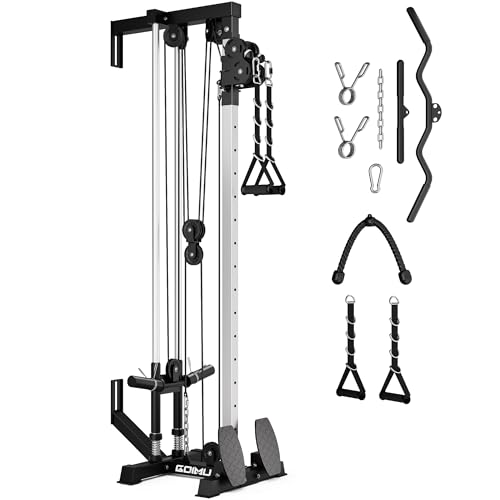
Five cable setups compared on the specification that actually matters for older lifters: how many pulley heights you get, and how low the lowest one sits.

By Lauren RossUpdated 15 min read
On this page
- Best cable machine for seniors at a glance
- How I screened these five listings
- Why pulley position count decides a best cable machine for seniors
- 1. Goimu Wall Mount Cable Station — Best overall
- 2. Mikolo Wall Mount Cable Station — Best for beginners
- 3. VEVOR LAT Pull Down Machine — Best for heavy use
- 4. GOIMU LAT Pulldown Machines — Best premium
- 5. Mikolo Fitness LAT and Lift Pulley System — Best budget pick
- Do any of these actually suit older lifters?
- What you need on the wall before it arrives
- Goimu WM1 vs Mikolo G3: which wall station wins?
- The verdict
- FAQ
The best cable machine for seniors is the Goimu Wall Mount Cable Station, because its 17 pulley positions across a 78.7-inch frame let you set the cable at chest height, hip height or ankle height without ever reaching overhead. If you want to sit down and pull rather than stand, the GOIMU LAT Pulldown Machines with a three-height padded seat is the better buy.
Here's the specification that splits this field: pulley adjustment range. Everything else is frame steel and marketing. A cable you can only anchor high forces overhead work. A cable you can drop to ankle level opens up rows, presses and leg work from a seated or standing position you control.
Best cable machine for seniors at a glance
| Pick | Pulley positions | Frame height | Price |
|---|---|---|---|
Best overall Goimu Wall Mount Cable Station |
17 | 78.7 in | Check Price |
Best for beginners Mikolo Wall Mount Cable Station |
19 | 82 in | Check Price |
Best for heavy use VEVOR LAT Pull Down Machine |
18 | 79.3 in | Check Price |
Best premium GOIMU LAT Pulldown Machines |
2 stations, high and low | 83.5 in | Check Price |
Best budget pick Mikolo Fitness LAT and Lift Pulley System |
2 modes, pull down and lift | 11 in unit | Check Price |


How I screened these five listings
I started from what the published specifications actually let me compare, which in this category is dimensions, frame weight, warranty term and pulley adjustment count. Everything else on these listings is manufacturer copy.
Three screens shaped the shortlist:
- Published dimensions. A cable station that doesn't state its height is unusable in a basement or a garage with a low ceiling. All five publish theirs, from a 11-inch pulley unit up to an 83.5-inch tower.
- A stated adjustment range. Four of the five publish either a position count or a two-station high-low layout. That number is what determines whether you can train without lifting your arms above shoulder level.
- Wall or rack requirement declared. Three of the five are wall-mounted. One is a freestanding tower. One hangs from an existing frame. That distinction changes the buying decision more than any spec on the box.
What got cut: anything without published dimensions, and anything sold as a bare attachment with no stated cable length or mounting method. The five that survived cover a genuine spread of price positions, from the cheapest of the set to the most expensive.
Why pulley position count decides a best cable machine for seniors
Most guides to the best cable machine for seniors compare frame steel gauge. That's the wrong number. Steel gauge tells you whether the frame survives; it tells you nothing about whether you can use it comfortably.
The number that matters is how many heights the pulley stops at, and how low the lowest stop sits. Here's why. Shoulder mobility narrows with age for most people, and overhead pulling is the first movement to become uncomfortable. A cable anchored only at the top of an 82-inch frame gives you lat pulldowns and not much else. A cable that stops every few inches down the upright gives you chest-height presses, hip-height rows, and low pulls you can do from a chair.
Count the stops on this set: 19 on the Mikolo G3, 18 on the VEVOR, 17 on the Goimu WM1. Those are close enough that the deciding factor becomes what the frame lets you do at the bottom of the range.
- 17 to 19 positions means roughly one stop every 4 inches on a 79-inch upright. Enough granularity to fine-tune elbow angle.
- Two fixed stations means high and low only. Simpler, cheaper, and it rules out mid-height work.
- A single hanging pulley gives you two modes and one anchor point.
The second criterion, and I'd weight it nearly as heavily, is whether you can sit. A padded seat at a fixed height removes balance from the equation entirely.
1. Goimu Wall Mount Cable Station — Best overall
Seventeen pulley positions on a 78.7-inch frame make this the most adjustable low-profile option here, and it's the shortest of the three wall stations.
Best for: someone with solid wall studs who wants the widest range of pulley heights Skip it if: you have no wall you can drill into
Within this set, the WM1's advantage is height. At 78.7 inches tall it's the shortest of the three wall-mounted stations, sitting 3.3 inches under the Mikolo G3. In a basement or a garage with pipework running along the ceiling, that clearance decides whether the thing goes up at all. Depth is 24.8 inches, the slimmest here, so it protrudes less into a walkway.
Goimu describes a dual pulley system that switches between a 1:1 and a 2:1 ratio using a cable adaptor. If that works as described, it's genuinely useful for anyone building back from a long layoff: the 2:1 setting halves the load you feel at the handle, letting you use plates you already own at a weight you can control. The listing also claims a removable footplate, which matters for seated rows and for getting a wheelchair or chair close to the uprights.
The warranty is stated at 2 years, matching the longest here. Model is the WM1.
The trade-off against the rest of this set: it's the third-cheapest of five, and unlike the VEVOR listing it publishes no weight capacity figure, so you're buying on frame description rather than a stated number.
Pros:
- 17 pulley positions across the upright
- Shortest wall station here at 78.7 in
- Slimmest depth in the set, 24.8 in
- 2-year warranty, matching the longest
- Removable footplate claimed for seated work
Cons:
- No published weight capacity figure
- Requires structural wall studs, no freestanding option
- Only one seller lists it
- Two fewer positions than the Mikolo G3
2. Mikolo Wall Mount Cable Station — Best for beginners
Nineteen adjustable positions and a stated 400 lb capacity make this the most specified wall station here, with a large footboard for seated rows.

Best for: a first-time cable user who wants seated rows from a proper footboard Skip it if: your ceiling clearance is under 82 inches
The G3 publishes the most complete spec sheet of any wall station here, and that's the beginner's advantage: fewer unknowns. Frame weight is listed at 400 lb, dimensions at 82 x 26.9 x 25.6 inches, warranty at 2 years, model M-G3. Nineteen height positions is the highest count in this roundup.
Mikolo's listing describes a commercial-grade 14-gauge powder-coated steel frame, nylon-coated cables rated at 2,200 lb tensile strength, and a 400 lb maximum. It also describes weight pegs angled upward at 10 degrees to stop plates sliding off. That last detail is small and genuinely thoughtful. Loading and unloading plates is where most home-gym mishaps happen, and a pegged plate that stays put is one less thing to manage with a full hand.
The large footboard is the other beginner-friendly piece. Seated cable rows need somewhere firm to brace your feet, and bracing against a plate rather than the wall keeps your spine in a better position.
Against the rest of the set: at 82 inches it's the second-tallest here and the most expensive of the wall stations, so you pay a premium over the Goimu WM1 for two extra pulley stops and a published capacity figure.
Pros:
- 19 pulley positions, the most in this set
- Published 400 lb capacity
- Angled weight pegs to stop plate slipping
- Large footboard for seated rows
- 2-year warranty stated
Cons:
- Tallest wall station here at 82 in
- Most expensive of the three wall stations
- Only one seller lists it
- 25.6 in depth, deeper than the Goimu WM1
3. VEVOR LAT Pull Down Machine — Best for heavy use
A stated 500 lb capacity and five included attachments at the second-cheapest position in this set.

Best for: a household where two or three people share the frame Skip it if: you want dual crossover pulleys
The VEVOR is the value story here, and the number that carries it is the stated 500 lb capacity, the highest published figure in this roundup and 100 lb above the Mikolo G3. VEVOR describes 50 x 50 mm tubing in 1.5 mm carbon steel. It's the second-cheapest of the five.
Five attachments come included per the listing: a lat bar, tricep rope, ankle strap, straight bar and D-handles. Count that against the others and it's the fullest accessory kit here. The ankle strap is the one I'd point out for older users specifically, because it turns the low pulley into a hip and leg station you can work while holding the frame for balance.
Eighteen height settings, an ab-crunch function, and a dual-size plate holder that VEVOR says takes both 2-inch and 1-inch plates without adapters. If you own an older 1-inch plate set from decades back, that saves you buying new iron.
Dimensions are 79.3 x 30.5 x 29.9 inches, frame weight 70.6 lb, warranty 2 years, model HM2905B.
The trade-off: at 29.9 inches deep it's the bulkiest wall unit here, projecting roughly 5 inches further into the room than the Goimu WM1. It's also the slowest seller of the five, and it's a high-low pulley layout rather than the dual crossover arrangement the two cable stations use.
Pros:
- Highest published capacity here, 500 lb
- Five attachments included per listing
- Takes 1-inch and 2-inch plates without adapters
- 18 height settings
- Second-cheapest of the five
Cons:
- Deepest wall unit here at 29.9 in
- Slowest seller of the five
- High-low pulleys, not dual crossover
- Only one seller lists it
4. GOIMU LAT Pulldown Machines — Best premium
The only pick here with a padded seat that adjusts to three heights, and the only freestanding tower in the set.

Best for: anyone who wants to train sitting down on a padded, height-adjustable seat Skip it if: you need to reclaim the floor between sessions
This is the pick I'd point at first for anyone who doesn't want to stand while training, and it's the only one in this set that makes that possible out of the box. Goimu describes a padded seat with three height settings, sized for users from 5'2" upward. Sitting down removes balance from the exercise, and for a lot of people that's the difference between training twice a week and not training at all.
It's also the only freestanding unit here. No studs, no drilling, no landlord conversation. Frame weight is 80 lb and the footprint is 83.5 x 59 x 23.4 inches, so it needs 59 inches of width where the wall stations need under 31.
Three pulley stations are described: high for pulldowns and overhead work, low, and an additional cable pulley. Included attachments per the listing are a lat bar, a cable bar and two more handles. Goimu describes 2 mm steel tubing.
The costs are real. It's the most expensive pick here and carries a 1-year warranty, the shortest term in this roundup and half what the Goimu WM1, Mikolo G3 and VEVOR state. No capacity figure is published either. You're paying the top price for the seat and the freestanding frame, not for a longer guarantee.
Pros:
- Padded seat with three height settings
- Only freestanding pick, no wall mounting needed
- Three pulley stations including an extra cable pulley
- Four attachments included per listing
Cons:
- Shortest warranty in the set at 1 year
- Most expensive pick here
- Needs 59 in of floor width
- No published weight capacity
- Tallest unit at 83.5 in
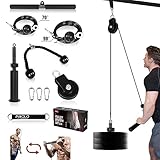
5. Mikolo Fitness LAT and Lift Pulley System — Best budget pick
At 6.28 lb and 10 x 10 x 11 inches, this is a hanging pulley you can put in a cupboard, and the cheapest pick here.

Best for: someone testing whether cable work suits them before committing Skip it if: you have no rack or beam to hang it from
This isn't a machine, and I want to be clear about that before anything else. It's a pulley, two cables and a loading pin, sold as an attachment. It hangs from a rack, a beam or a door frame you already own. Which is exactly why it earns a place: it's the cheapest of the five and it lets you find out whether cable training suits you before you commit to drilling anything.
The dimensions tell the story. The whole unit is 10 x 10 x 11 inches and weighs 6.28 lb. Compare that to 400 lb for the Mikolo G3. You can carry this outside, hang it from a garden frame in good weather, and bring it in afterwards.
Mikolo lists two cables, one at 70 inches and one at 90 inches, and describes two exercise modes, pull down and lift, selected by rerouting the cable through the buckle. The loading pin threads through the centre hole of a standard plate. Three sellers list it, the widest availability in this set. Model is QJB2.0.
Honest losses: there's no frame, no seat, no footplate, no published warranty and no stated capacity. You supply the anchor point and the plates. Cable height is whatever your anchor is, so the fine adjustment the three wall stations offer simply isn't there.
Pros:
- Cheapest pick in this roundup
- 6.28 lb and stores in a drawer
- Two cable lengths, 70 in and 90 in
- Several sellers stock it, unlike the rest
- No drilling or wall mounting
Cons:
- Needs an existing rack, beam or frame
- No published warranty
- No adjustable pulley heights
- No seat, footplate or frame
- No stated weight capacity
Do any of these actually suit older lifters?
Straight answer: none of these five listings is marketed for older users, and none publishes a specification aimed at them. There's no low-impact certification, no grip-size figure, no seat-height range stated in a form you could match against a chair you already sit in comfortably.
So the honest framing is this. When you're choosing a cable machine for seniors, you're judging general home-gym equipment against your own requirements, and the published specs only get you part of the way. Here's what I'd check before buying, and none of it comes off the listing:
- Can you reach the highest pulley position you'd actually use? Measure your comfortable overhead reach against the frame height. On an 82-inch upright, the top stop is near the top.
- Can you load a plate onto the peg at that height? Angled pegs help. Lifting a 25 lb plate to chest height does not.
- Is there something to hold while you set up? A seated unit answers this. A standing wall station does not.
- Who assembles it? A 400 lb frame going onto studs is not a solo afternoon.
If the answer to two or more of those is no, the freestanding seated tower is the one to look at, and a physiotherapist or trainer is a better source than any spec sheet on which movements suit you.
What you need on the wall before it arrives
Three of these five bolt to a wall, and that's the constraint people discover too late. Wall stations need studs, and drywall alone will not hold a 400 lb frame under load.
Measure three things first:
- Ceiling height. The frames run 78.7 to 82 inches. Add a few inches of working clearance above.
- Stud spacing and material. Wood studs at standard spacing are the assumption. Masonry needs different fixings. Metal studs need a professional opinion.
- Depth into the room. These project 24.8 to 29.9 inches from the wall. Then add the space you need to stand back from the pulleys.
The seated tower sidesteps all of it. Freestanding, 80 lb, needing 59 inches of width and 23.4 inches of depth. If you rent, or if you can't confirm what's behind your drywall, that's the pick. The hanging pulley sidesteps it differently: it needs no wall at all, just an anchor you already trust.
Goimu WM1 vs Mikolo G3: which wall station wins?
These two are the closest comparison in the set, and the numbers are tight. Both are wall-mounted dual-pulley cable stations. Both state a 2-year warranty. The G3 has 19 positions, the WM1 has 17.
Where they separate is size and disclosure.
| Goimu WM1 | Mikolo G3 | |
|---|---|---|
| Height | 78.7 in | 82 in |
| Depth | 24.8 in | 25.6 in |
| Positions | 17 | 19 |
| Capacity | not published | 400 lb |
The WM1 is 3.3 inches shorter and 0.8 inches slimmer, and it's cheaper. The G3 publishes a capacity figure and two extra pulley stops, plus an angled-peg design and a footboard.
My read: the WM1 wins on the constraint most home buyers hit, which is ceiling and walkway clearance, and it wins on price. The G3 wins if you want the fuller spec sheet and the seated-row footboard. Two extra stops on a 79-inch upright is a difference of a couple of inches per position, and I wouldn't buy on it alone.
The verdict
If your ceiling is under 82 inches and you have confirmed studs, the Goimu Wall Mount Cable Station is the pick. Its 17 pulley positions across a 78.7-inch frame give you cable heights from overhead down to ankle level, it's the slimmest wall unit here at 24.8 inches deep, and it carries a 2-year warranty at the middle of this price range. Nothing else in the set combines that adjustment range with that little intrusion into the room.
If you'd rather sit than stand, the GOIMU LAT Pulldown Machines is the pick instead, and the cutoff is whether you can safely hold a standing position under load for a full set. It's the only unit here with a padded seat adjusting to three heights, and the only freestanding frame, so no drilling and no stud hunt. You pay the top price and accept a 1-year warranty for those two things.
The Mikolo G3's exact advantage over the winner is disclosure: a published 400 lb capacity and 19 positions where the WM1 states neither number nor claims a limit. If a stated capacity figure is what lets you buy with confidence, spend the extra and take the 82-inch height.
FAQ
Is a cable machine for seniors worth the money?
A cable machine for seniors is worth it if you'll use the low and mid pulley positions, not just the top one. Cables give you smooth resistance with no bar to drop and no plate to catch. If you'd only do lat pulldowns, a resistance band costs a fraction. If you want rows, presses and hip work at fixed heights, the frame earns its keep.
Which of these is the cheapest way to start cable training?
The cheapest way to start is the Mikolo Fitness LAT and Lift Pulley System, the lowest price position of the five. It's 6.28 lb, measures 10 x 10 x 11 inches, and includes 70-inch and 90-inch cables plus a loading pin. You supply the anchor point and the plates. It tells you whether cable work suits you before you drill a wall.
What ceiling height do these cable machines need?
Ceiling height requirements run from 78.7 inches for the Goimu WM1 up to 83.5 inches for the GOIMU freestanding tower. The Mikolo G3 stands 82 inches and the VEVOR 79.3 inches. Measure your clearance before ordering, and add a few inches above the frame so you can work the top pulley position without knuckling the ceiling.
Goimu WM1 or Mikolo G3 for a small garage?
For a small garage, the Goimu WM1 is the better fit. It stands 78.7 inches tall against 82 inches for the Mikolo G3, and projects 24.8 inches from the wall against 25.6 inches. That's 3.3 inches of ceiling clearance and nearly an inch of walkway back. The G3 answers with a published 400 lb capacity and 19 pulley positions.
What mistake do first-time buyers make in this category?
The mistake first-time buyers make is choosing on frame steel and ignoring pulley adjustment range. Steel gauge decides whether the frame lasts; the number and spread of pulley stops decides which exercises you can actually perform. A station that only anchors high forces overhead pulling. Check the lowest stop position, not the tubing thickness, before you commit.
Measure your ceiling, find your studs, then order the Goimu Wall Mount Cable Station. Those two measurements take ten minutes and they eliminate the single most common return in this category, which is a frame that physically won't go up where you planned to put it. If the studs aren't there, or you're renting, go straight to the GOIMU tower and put it on the floor instead. The WM1 remains my default because it asks the least of your room: 78.7 inches of height, 24.8 inches of depth, and 17 pulley heights inside that envelope.