Best Cable Machine for Small Spaces: Wall or Fold

Five compact cable stations compared on published footprint, pulley positions, height and load capacity, with the Goimu WM1 leading and clear rules for when a foldable freestanding unit beats a wall mount.

By Lauren RossUpdated 14 min read
On this page
- Best cable machine for small spaces at a glance
- How I cut a long list of cable stations down to five
- Wall mount or foldable frame: which suits your room?
- 1. Goimu Wall Mount Cable Station — Best overall
- 2. Mikolo Wall Mount Cable Station — Best premium
- 3. TOUSAINS Cable Machine Home Gym CR63 — Runner-up
- 4. YOLEO 2-in-1 Adjustable Rowing & LAT Pulldown Station — Best for beginners
- 5. MARCHMARS Cable Machine Home Gym — Best budget pick
- Will it fit under an 8-foot ceiling?
- What the listings don't tell you about installation
- When a different pick wins
- The verdict
- FAQ
The best cable machine for small spaces is the Goimu Wall Mount Cable Station, because its 78.7 x 28.1 x 24.8 in frame bolts to the wall and gives back the floor entirely, with 17 pulley positions and a 2 YEAR warranty behind it. If drilling isn't an option, the TOUSAINS CR63 folds flat instead and stands only 62.99 in tall.
Some people should walk away from this whole category. If your ceiling clears 8 feet and you have a garage bay to spare, a full two-tower crossover gives you a wider stance and more range than anything here, and you'd be paying compact-design money for constraints you don't have. These five picks exist for the opposite reader: one wall, one corner, and a landlord or a spouse watching.
Best cable machine for small spaces at a glance
| Pick | Footprint style | Pulley positions | Price |
|---|---|---|---|
Best overall Goimu Wall Mount Cable Station |
Wall-mounted 3.28 sq ft claim |
17 | Check Price |
Best premium Mikolo Wall Mount Cable Station |
Wall-mounted 82 x 26.9 in |
19 | Check Price |
Runner-up TOUSAINS Cable Machine Home Gym CR63 |
Freestanding, folds 2.92 sq ft claim |
Single tower, 62.99 in tall | Check Price |
Best for beginners YOLEO 2-in-1 Rowing & LAT Pulldown Station |
Freestanding, folds vertically 74 x 82 x 24 in |
13 tower, 9 seat | Check Price |
Best budget pick MARCHMARS Cable Machine Home Gym |
Wall track 4 x 31.5 x 3.5 in |
5 resistance levels, 10–50 lbs claim | Check Price |



How I cut a long list of cable stations down to five
Three things got listings cut before I compared anything else.
First, published dimensions. A listing that describes itself as compact without stating height, width and depth is useless to someone measuring a wall, and plenty do exactly that. Every pick here publishes at least a full dimension set.
Second, height. Anything taller than a standard ceiling is a non-starter in the rooms this article is about, so I read the height figure first and the marketing second.
Third, resistance source. Cable machines that ship with a fixed weight stack are heavy, deep and expensive to move. Every pick here loads plates or dumbbells you already own, or uses a built-in resistance mechanism, which is why the shipping weights range from 9.35 lb to 400 lb.
What survived splits neatly into two designs: wall mounts that surrender zero floor, and freestanding frames that fold. That split is the real decision, and it's the reason I didn't rank purely by capability.
One note on the phrase "small spaces". Amazon's search doesn't verify it, and the listings use it loosely. Manufacturer footprint claims like 3.28 sq ft and 2.92 sq ft describe the base only, not the swing arc of the arms or the space you need to stand and press. Measure both.
Wall mount or foldable frame: which suits your room?
This is the fork in the road for anyone shopping for the best cable machine for small spaces, and it has almost nothing to do with training quality.
Wall mounts give back the floor completely. The Goimu and the Mikolo both bolt to studs and both publish frames near 80 in tall. Nothing stands in your room when you're done. The cost is permanence: holes, a stud layout that has to cooperate, and a landlord who may not.
Foldable freestanding frames ask for floor space while you train and give most of it back afterward. The TOUSAINS CR63 folds and slides against a wall. The YOLEO folds vertically. Neither needs a drill.
Here's the trick with foldables that catalogue copy skips: the folded footprint is not the same as the stored footprint. A 12.4 in deep folded frame still needs somewhere to lean, and it still needs to be pulled out and set up every session. That friction is small, but it's real, and it's the reason wall mounts win when drilling is allowed.
- Own the property, solid stud wall: wall mount.
- Renting, deposit at risk: foldable.
- Shared room used for other things: foldable.
- Garage or basement with a spare wall: wall mount.
1. Goimu Wall Mount Cable Station — Best overall
The Goimu WM1 is the pick I'd default to, because it combines 17 pulley positions with a wall-mounted frame that leaves the floor completely clear.
Best for: a garage or spare room with a solid stud wall to bolt into Skip it if: you rent and can't drill into the wall
Among the five, this is the one buyers choose most often, and the specification sheet explains why. At 78.7 x 28.1 x 24.8 in it clears a standard 8-foot ceiling with room over the top pulley, and the 81.4 lb shipping weight tells you it's steel without being a two-person permanent installation nightmare. Goimu claims a 3.28 sq ft footprint and 14-gauge steel construction.
The differentiator inside this set is the cable adaptor. Goimu says you can switch between a 1:1 ratio for heavy work and a 2:1 ratio for lighter, higher-rep sets. No other pick here publishes a switchable ratio, and it matters in a small setup because it stretches one modest plate collection across both strength and volume work. The removable footplate is the other detail worth noting for seated rows.
The trade-off against the Mikolo is pulley count and published load: 17 positions against 19, and no stated maximum weight. It also sits in the more expensive half of this group.
Pros:
- 17 pulley positions from a wall-mounted frame
- Switchable 1:1 and 2:1 cable ratio claimed
- 78.7 in height clears standard 8-foot ceilings
- Removable footplate for seated row work
- 2 YEAR warranty published
Cons:
- Requires drilling into studs, so renters are out
- No published maximum load rating
- Two fewer pulley positions than the Mikolo
- Only one seller lists it
2. Mikolo Wall Mount Cable Station — Best premium
The Mikolo M-G3 is the strongest wall mount here on paper, with 19 pulley heights and a published 400 lb maximum.

Best for: lifters loading heavy plates who want 19 pulley heights Skip it if: your wall framing is questionable
This is the most expensive pick here, and the published numbers back the position. Mikolo lists a 400 lb figure and describes a 14-gauge powder-coated steel frame with nylon-coated cables rated at 2,200 lb tensile strength. The 82 x 26.9 x 25.6 in frame is the tallest of the two wall mounts, so measure before you commit: that's 6 ft 10 in of steel going up your wall.
Nineteen height positions is the most in this group, and the practical benefit is fine-tuning rather than headline versatility. Small increments matter for face pulls, low-to-high flyes and anything where an inch of pulley height changes the line of pull. Mikolo also specifies weight pegs angled upward at 10 degrees to stop plates sliding off, plus a large footboard for seated rows.
Against the Goimu, you gain two pulley positions and a stated load ceiling but lose the switchable cable ratio. You also need genuinely sound framing, because a wall carrying this much loaded steel is doing structural work.
Pros:
- 19 adjustable pulley positions, most in this set
- 400 lb maximum load published
- Cables rated at 2,200 lb tensile strength per Mikolo
- Angled weight pegs to prevent plate slip
- 2 Year warranty stated
Cons:
- The most expensive pick here
- Tallest frame at 82 in, tight under low ceilings
- No switchable cable ratio, unlike the Goimu
- Permanent installation with no fold-away option
3. TOUSAINS Cable Machine Home Gym CR63 — Runner-up
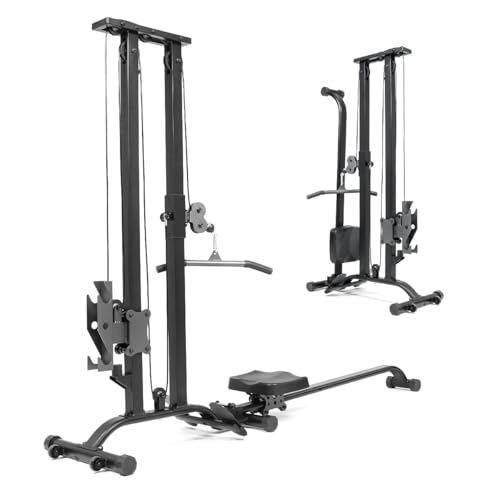
The CR63 is the pick for renters, because it folds instead of bolting and stands just 62.99 in tall.
Best for: apartment dwellers with a 7-foot ceiling and no drilling allowed Skip it if: you want true crossover work from two towers
That height figure is the whole argument. At 62.99 in, the CR63 is over 15 in shorter than the Goimu and nearly 20 in shorter than the Mikolo, and TOUSAINS specifically pitches it at standard 7-foot ceilings. If you've been ruled out of this category by a low basement or a converted attic, start here.
The full frame measures 63 x 82.7 x 12.4 in and weighs 50.7 lb, the second lightest pick in the group. TOUSAINS claims a folded footprint of 2.92 sq ft, the smallest stated figure here, and says the unit slides behind a door or into a closet corner. It also doubles as a rowing machine, and the listing claims you can load two dumbbells at once for up to 400 lbs of resistance.
The compromise is geometry. A single low tower can't reproduce a wide crossover arc, so chest flyes and high-to-low patterns are limited compared with either wall mount. That 12.4 in depth also means less base to resist a hard pull.
Pros:
- Lowest height in the set at 62.99 in
- Folds to a claimed 2.92 sq ft
- 50.7 lb, movable by one person
- Rowing function built into the same frame
- 2 Year Warranty published
Cons:
- Single tower limits true crossover movements
- Narrow 12.4 in depth when folded needs a leaning spot
- Requires setup and pack-down every session
- Resistance depends on plates or dumbbells you supply
4. YOLEO 2-in-1 Adjustable Rowing & LAT Pulldown Station — Best for beginners
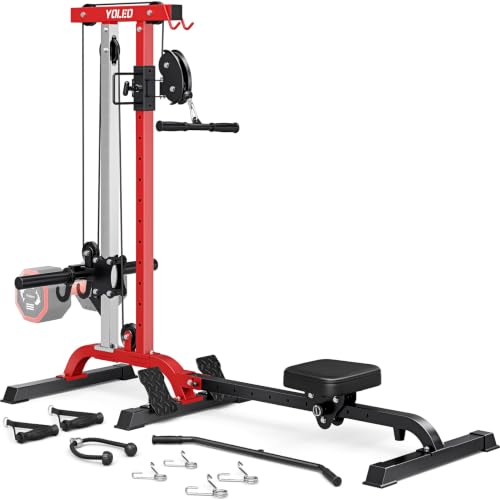
The YOLEO covers rowing and pulldowns in one folding frame, which makes it the easiest first purchase here.
Best for: a first home setup covering rowing and pulldowns together Skip it if: you need published weight and warranty depth
Beginners overspend on capability they won't reach for a year. What they actually need is a frame that supports the basic pulling patterns without a decision tree, and the YOLEO delivers that. The listing specifies 6 attachments included, 13 height positions on the main tower and 9 on the horizontal seat, plus support for 450 lbs of plates and dumbbells.
The 74 x 82 x 24 in frame is the deepest here at 24 in, which is a fair trade for a freestanding unit that has to stay upright under load. YOLEO describes 2-inch commercial-grade steel tubing and a vertical fold-away design, along with a slide-lock seat knob that either fixes the seat for heavy seated rows or releases it to slide for rowing.
Two gaps: the listing publishes no shipping weight, so plan for help on delivery day, and the warranty is 1 Year, the shortest of the five. It's also the only pick with more than one seller listing it, which is worth a glance before you buy.
Pros:
- 6 attachments included out of the box
- 13 tower positions plus 9 seat positions
- Supports 450 lbs of plates and dumbbells per YOLEO
- Slide-lock seat switches between rowing and fixed rows
- Vertical fold for storage without drilling
Cons:
- 1 Year warranty, shortest in this set
- No published product weight
- Deepest frame at 24 in, so it eats floor space in use
- Not a crossover machine, so no wide flye work
5. MARCHMARS Cable Machine Home Gym — Best budget pick
The MARCHMARS is a 9.35 lb wall track rather than a cable tower, and that's exactly why it fits rooms nothing else will.

Best for: a bedroom or dorm wall where nothing heavy can be stored Skip it if: you already pull more than 50 lbs on a cable
Set aside the category name and read the dimensions: 4 x 31.5 x 3.5 in, and 9.35 lb. That's a slim track, not a station, and it's the cheapest of the five by a clear margin. It projects three and a half inches from the wall, which no other pick here comes close to matching.
MARCHMARS claims 5 adjustable resistance levels from 10 to 50 lbs, 30+ exercises with one bar and 50+ with two, and a pulley system tuned for quiet motion. For someone doing rehab work, upper-body accessory sets or general conditioning in a bedroom, that range is workable and the wall stays usable for everything else.
The honest limit is that 50 lbs ceiling. If you're already doing lat pulldowns with three plates, you'll outgrow this in weeks, and there's no plate loading path to grow into. The listing also publishes no warranty and no height figure, only overall dimensions, so mounting position is on you to plan.
Pros:
- The cheapest of the five
- Just 3.5 in deep against the wall
- 9.35 lb, mountable single-handed
- 5 resistance levels claimed from 10 to 50 lbs
- No plates or dumbbells to buy separately
Cons:
- 50 lbs claimed ceiling caps serious strength work
- No published warranty, unlike four other picks
- No pulley height positions listed, only resistance levels
- Slowest seller of the five
Will it fit under an 8-foot ceiling?
Height is the specification that quietly disqualifies most of this category, so measure before you shortlist. Here's the order I'd check things in.
- Measure floor to ceiling at the exact spot you plan to mount or stand the unit. Basements and garages often lose several inches to ducting or joists.
- Compare against the frame height. The Mikolo is tallest at 82 in, the Goimu next at 78.7 in, the YOLEO at 82 in overall, and the CR63 lowest at 62.99 in.
- Add clearance above the top pulley. You need room to reach the highest setting and to seat a pin, not just to slide the frame in.
- Check your arm swing width. The Goimu is 28.1 in wide and the Mikolo 26.9 in, but your arms extend well past the frame in a flye.
- Confirm the floor is level for the freestanding picks. A folding frame on an uneven garage slab rocks under load.
A standard 8-foot ceiling is 96 in, which leaves genuine room for the two wall mounts. A 7-foot ceiling at 84 in is where the CR63 earns its place, and it's the only pick in this set marketed for that constraint.
What the listings don't tell you about installation
Product pages are silent on the parts that decide whether a compact cable station actually works in your room.
Stud spacing. Both wall mounts assume you can hit framing at the spacing the bracket needs. Metal studs, plaster over brick, or a garage wall with no continuous backing all change the job, and none of the listings state what they require.
Wall type ratings. The Mikolo publishes 400 lb and 2,200 lb tensile cables, but those describe the machine, not your drywall. Load transfers into the structure behind it.
Weight plates. The CR63, the YOLEO and both wall mounts use plates or dumbbells you supply. Budget for those and for the floor space they occupy, because a rack of plates beside a compact machine can undo the space you saved.
Assembly time. No listing here states it. The 81.4 lb Goimu and the 400 lb Mikolo are clearly bigger jobs than the 9.35 lb MARCHMARS track.
Noise. MARCHMARS claims quiet, friction-free motion, and Goimu claims a smooth patent-pending pulley system. Both are manufacturer claims. Plate clank on a shared wall is a real consideration in an apartment.
When a different pick wins
The best cable machine for small spaces isn't the same machine for every small space. Three conditions flip my recommendation outright.
- Your ceiling is under 84 in. Take the TOUSAINS CR63 at 62.99 in. The wall mounts don't fit, and no amount of clever mounting fixes that.
- You can't drill, at all. Skip both wall mounts. The CR63 and the YOLEO fold and free-stand, so nothing touches the structure.
- You already load 300 lbs or more. Go to the Mikolo for its published 400 lb ceiling and 19 positions, and accept the permanent install.
Two softer flips. If you want cardio and strength from one frame, the CR63 rows and the YOLEO rows, while neither wall mount does. And if the room is a shared bedroom where even a folded frame is unwelcome, the MARCHMARS track at 3.5 in deep is the only pick that genuinely disappears.
The verdict
If you own your space and have a stud wall to work with, buy the Goimu WM1. Seventeen pulley positions, a 78.7 in frame that fits under a standard ceiling, a switchable 1:1 and 2:1 cable ratio and a 2 YEAR warranty add up to the most complete compact cable setup in this group, and it gives back every square foot of floor.
If you rent, or your ceiling is under 7 feet, buy the TOUSAINS CR63 instead. At 62.99 in tall and 50.7 lb it folds to a claimed 2.92 sq ft, and it adds rowing, which no wall mount here does.
The cutoff between them is your ceiling height and your freedom to drill. Above 90 in of clearance with permission to mount, the Goimu wins on pulley range and stance width every time. Below 84 in, or under a lease that forbids holes, the CR63 is the only sensible pick and it isn't a consolation prize.
The Mikolo's exact advantage over the Goimu is measurable and narrow: two extra pulley heights and a published 400 lb ceiling. Worth the premium only if you're loading genuinely heavy plates.
FAQ
Is a cable machine for small spaces worth the money?
A cable machine for small spaces is worth it if you'll use it more than twice a week, because constant resistance through a full range of motion is hard to replicate with free weights alone. The compact designs here trade stance width and pulley range for footprint. If you already own plates, the incremental cost is just the frame.
What's the cheapest way into this category?
The cheapest way in is the MARCHMARS wall track, at 4 x 31.5 x 3.5 in and 9.35 lb. It needs no plates, claims 5 resistance levels from 10 to 50 lbs, and mounts with basic tools. The catch is that claimed 50 lbs ceiling, which caps back and chest work well below what a plate-loaded tower handles.
Goimu WM1 or Mikolo M-G3: which wall mount should I pick?
Between the Goimu WM1 and Mikolo M-G3, pick the Goimu unless you load heavy. The Goimu's switchable 1:1 and 2:1 cable ratio stretches a small plate collection further, and its 78.7 in height leaves more ceiling clearance. The Mikolo answers with 19 pulley positions against 17 and a published 400 lb maximum, for more money.
Will a wall-mount cable station fit a 7-foot ceiling?
A wall-mount cable station will not fit comfortably under a 7-foot ceiling. At 84 in of clearance, the Goimu's 78.7 in frame leaves barely five inches and the Mikolo's 82 in leaves two, with no room to reach the top pulley. The TOUSAINS CR63 at 62.99 in is the pick designed for that height.
What mistake do first-time buyers make here?
The mistake first-time buyers make is measuring only the machine's footprint and forgetting the training space around it. A claimed 3.28 sq ft base still needs several feet of clear floor for flyes, plus somewhere for plates. Measure the room you'll stand and move in, not just the wall the frame occupies.
Start with a tape measure and a stud finder before you open a single product page. Ceiling height decides whether the Goimu WM1 is even available to you, and stud layout decides whether it's practical. Get both answers first and the choice makes itself in about a minute.
What makes the Goimu the right default isn't the position count or the steel gauge. It's that a wall-mounted station has no pack-down step, so the machine is ready the moment you walk in. In a small room, that removed friction is what turns equipment into training.