Best Compact Plyo Box by Height Range and Footprint

A footprint-first look at six plyo boxes, from a 3 lb foam flip block to a 43 lb steel trapezoid. Which one actually fits a spare bedroom, and which one you should walk past.

By Lauren RossUpdated 17 min read
On this page
- Best compact plyo box for small spaces at a glance
- How I ranked these six, and what the criteria weigh
- 1. BalanceFrom 3-in-1 Foam Plyo Jump Box for Home Gym — Best overall
- 2. GYMAX Plyometric Jump Box — Best budget pick
- 3. GoSports Fitness Launch Box 3-in-1 Adjustable Height Wood — Best upgrade
- 4. STMHOM Jump Boxes, Heavy-duty Steel Plyometric Jump Box — Most versatile
- 5. Power Systems Step Bench & Weight Bench — Best for families
- 6. Stamina X 12" to 24" Adjustable Height Plyo Step Up — Best premium
- Does a plyo box footprint shrink in a small room?
- Foam, wood or steel: which suits a tight floor?
- What each price step actually buys here
- Storage, stacking and the space nobody measures
- The verdict
- FAQ
The best compact plyo box for small spaces is the BalanceFrom 3-in-1 Foam Plyo Jump Box, a 20 x 24 x 16 in flip block rated to 350 lbs that gives you three jump heights from one 10 lb piece of foam. If you need a rigid landing surface instead of foam, the GoSports Fitness Launch Box covers 16 in, 20 in and 24 in in sanded wood. The gap between these six is not quality. It is how much floor each one steals when you are not training.
Best compact plyo box for small spaces at a glance
| Pick | Height options | Footprint / weight | Price |
|---|---|---|---|
Best overall BalanceFrom 3-in-1 Foam Plyo Jump Box |
3 via flip 16 / 20 / 24 in |
20 x 24 x 16 in 10 lbs |
Check Price |
Best budget pick GYMAX Plyometric Jump Box |
3 via flip 16 x 14 x 12 in |
16 x 14 x 12 in 3 lb |
Check Price |
Best upgrade GoSports Fitness Launch Box |
3 via rotation 16 / 20 / 24 in claim |
Wood cube weight not listed |
Check Price |
Most versatile STMHOM Steel Plyometric Jump Box |
3 via rotation 12 / 18 / 24 in |
25.2 x 25.2 in base 43 lb |
Check Price |
Best for families Power Systems Step Bench |
8 in step, 14 in plyo claim | 13 x 48 x 8 in 30.8 lb |
Check Price |
Best premium Stamina X Adjustable Plyo Box |
4 locked 12 / 16 / 20 / 24 in |
24 x 27 x 18 in 40 lb |
Check Price |



How I ranked these six, and what the criteria weigh
I lined up the published specifications side by side and weighted them in a fixed order, because a plyo box in a spare bedroom is judged on different terms than one in a garage.
- Footprint, at 40%. The published length and width of the base decide whether the box lives in your training space or blocks a doorway. A 25.2 x 25.2 in steel base and a 16 x 14 in foam block are not the same purchase.
- Height range, at 25%. A single 12 in step is a warm-up. A box that reaches 24 in grows with you for years, which matters more when you can only own one.
- Load rating, at 20%. The published ceilings here run from 220 lbs to 500 lbs. Your bodyweight plus a dumbbell plus landing force needs headroom.
- Weight and portability, at 15%. You will move this thing every session. 3 lb and 43 lb are different relationships.
Those weights are deliberate. When you have limited floor, the box you actually use is the one you can shove aside in four seconds. Height range sits second because buying twice costs you more space than buying once. Load rating sits third only because every pick here clears typical bodyweight with room, so it separates the field less than the numbers suggest.
Nothing was cut for build quality. The order below is footprint and range doing the work.
1. BalanceFrom 3-in-1 Foam Plyo Jump Box for Home Gym — Best overall
The best compact plyo box for small spaces here, because 10 lbs of foam moves out of the way faster than anything else that still reaches 24 in.
Best for: apartment lifters who need one block for jumps, step-ups and push-ups Skip it if: you weigh near the 350 lb ceiling and want a rigid landing
The specification that decides this pick is the weight. At 10 lbs, this is the only box in the set that reaches a 24 in face and still lifts with one hand. Compare that to the 43 lb steel frame or the 40 lb Stamina X. In a room where the box has to leave the floor between sessions, that difference is the whole decision.
The block measures 20 x 24 x 16 in, and the flip design turns those three dimensions into three training heights. BalanceFrom states a 350 lbs support figure, which is the second-highest published ceiling of the six. The listing describes high-density shock-absorbing foam under a PVC exterior with a textured non-slip surface, and calls out box jumps, push-ups and split squats as intended uses.
Foam is the trade-off. A soft landing forgives a missed jump, and it also gives slightly under a heavy step-up, which some lifters dislike. The published dimensions are also larger than the GYMAX block, so this is not the smallest footprint in the set. It is the smallest footprint that still gets you to 24 in.
Pros:
- 10 lbs, the lightest box here that reaches 24 in
- Three heights from 20 x 24 x 16 in dimensions
- 350 lbs support figure, second-highest published ceiling
- Foam construction claimed to reduce joint impact
- Textured PVC surface for traction on jumps
Cons:
- Foam compresses slightly under load compared to wood or steel
- No published warranty term
- Larger base than the GYMAX budget block
- Only one seller lists it
2. GYMAX Plyometric Jump Box — Best budget pick
At 3 lb and 16 x 14 x 12 in, this is the smallest and lightest option in the set by a wide margin.

Best for: beginners starting at 12 in step-ups in a very tight room Skip it if: you plan real box jumps above 16 in
This is the cheapest of the six and the lightest by a factor of three. The listed size is 16 x 14 x 12 inch, so the tallest face here is 16 in. That is a real ceiling. If your goal is progressive box jumping, you will outgrow this within months.
What you get for that limitation is a genuine footprint advantage. Nothing else in the set tucks behind a door or under a bed the way a 3 lb, 14 in-wide block does. GYMAX cites selected EPE foam and a 220 lbs weight capacity, which is the lowest published ceiling of the six. The PU cover is described as waterproof and anti-slip, and the listing notes no installation is required. A 90-day warranty is stated, which puts it ahead of the BalanceFrom on that one point.
The honest read: this is a step-up and push-up platform that happens to be marketed for plyometrics. For deep squats, tricep work and low-box step-ups in a room with almost no clear floor, it does the job cheaply.
Pros:
- 3 lb, the lightest pick in this comparison
- 16 x 14 x 12 inch size, smallest published footprint here
- 90-day warranty stated, unlike the top pick
- No assembly required per the listing
- Cheapest of the six
Cons:
- 220 lbs capacity claim is the lowest ceiling in the set
- 16 in maximum height caps your progression
- Slowest seller of the six
- Only one seller lists it
3. GoSports Fitness Launch Box 3-in-1 Adjustable Height Wood — Best upgrade
A rigid wooden cube marked at 16 in, 20 in and 24 in, for lifters who want a firm landing without stepping up to a steel frame.

Best for: lifters who want a rigid 16, 20 and 24 in wood box Skip it if: you have no room to assemble or store a hollow wooden cube
Wood behaves differently from foam under your feet. It does not compress, so a step-up feels like a stair rather than a cushion, and the top edge stays sharp and predictable for tall jumps. GoSports marks the faces at 16 in, 20 in and 24 in, matching the BalanceFrom's range on a rigid surface.
The construction described is a puzzle box design with an internal brace and sanded edges. The kit ships with a drill bit, an allen key and the assembly screws, so this is the pick that requires a workbench moment before your first session. Note that the listing offers Small, Standard and XL sizes, so the height figures apply to the version you select. P&P Imports states a six-month defect warranty from delivery, with the original receipt required.
Here is where the data thins out. This listing publishes no weight and no usable dimension figures, so I cannot tell you what it weighs or how large the base is. For a small-space buyer, that is the exact number you most want. Assume a hollow 24 in cube and plan storage accordingly.
Pros:
- Rigid wood surface, no compression under step-ups
- Three marked heights at 16, 20 and 24 in
- Internal brace and sanded edges per the listing
- Six-month defect warranty stated by the manufacturer
- Multiple size options including Small
Cons:
- No published weight or base dimensions
- Assembly required with screws and a drill bit
- Warranty needs the original delivery receipt
- Hollow cube shape does not flatten for storage
4. STMHOM Jump Boxes, Heavy-duty Steel Plyometric Jump Box — Most versatile
The 500-pound load claim and a 12, 18 and 24 in range make this the widest-capability pick, at 43 lb.

Best for: heavier athletes who want 12, 18 and 24 in from one steel frame Skip it if: you cannot lift or reposition 43 lb between sets
STMHOM publishes a 500-pound load figure, the highest in this set by 150 pounds. Combine that with a 12, 18 and 24 in height range and you have the pick that suits the widest range of body weights and skill levels. A 12 in face is a genuine beginner height, and the 18 in middle step is a smaller jump in progression than the 16-to-20 in gap on the wood and foam boxes.
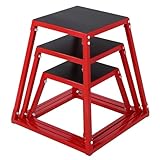
The base measures 25.2 x 25.2 in, the largest square footprint here. The listing describes a stable trapezoidal design with four rubber pads underneath and a non-slip rubber top, plus assembly in three steps. Heavy-duty steel tubes are cited as the frame material.
Then there is the 43 lb figure, which is the heaviest of the six. A steel box that weighs 43 lb does not get nudged aside with your foot. It stays where you put it, which is a virtue mid-set and a problem in a shared living room. The stated warranty is 30 days from the manufacturer, the shortest term published in the set.
Pros:
- 500-pound load claim, highest published ceiling here
- Three heights at 12, 18 and 24 in
- Rubber pads underneath plus non-slip rubber top
- Steel tube frame with trapezoidal base
- Three-step assembly per the listing
Cons:
- 43 lb, heaviest pick in this comparison
- 25.2 x 25.2 in base is the largest square footprint
- 30-day warranty is the shortest term published here
- Steel edges are unforgiving on a missed jump
5. Power Systems Step Bench & Weight Bench — Best for families
A 48 in adjustable deck that doubles as a step platform and an incline bench, which is a different tool from a jump box.
Best for: households sharing one deck for step aerobics and bench work Skip it if: you want a true 24 in jump target
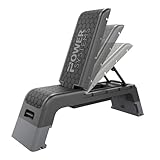
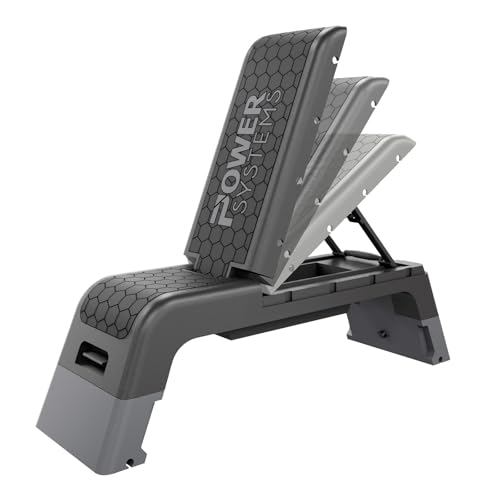
This is the outlier in the group, and it earns its slot for households rather than solo lifters. Power Systems describes the deck as an 8-inch aerobic step that raises to 14 inches for plyometric work, and it also functions as an inclined or declined bench. The listing cites more than a dozen positions, release levers on the legs, resistance band clips and internal storage for small items.
The shape is the story. At 13 x 48 x 8 in, this is long and low rather than tall and square. That suits step routines, glute bridges, dumbbell pressing and rows, and it suits two people working at different heights on one piece of gear. The published weight is 30.8 lb, and the deck claim is 330 lbs of supported weight with rubber feet at the highest setting. Power Systems also states that the deck locks flat and stacks, which is the only stacking claim in the set.
For jumps, though, 14 inches is the top. Anyone chasing a 24 in box will find this deck ceiling out fast, and 48 in of length eats more wall space than any other pick here.
Pros:
- More than a dozen positions per the listing
- Doubles as an incline and decline bench
- Locks flat and stacks for storage
- Internal storage compartment for small items
- Resistance band clips built in
Cons:
- 14 in claimed plyo height, lowest jump ceiling here
- 48 in length demands the most wall space
- 330 lbs deck claim trails the steel and foam picks
- 90-day warranty on a premium-position product
6. Stamina X 12" to 24" Adjustable Height Plyo Step Up — Best premium
Four locked heights at 12, 16, 20 and 24 in, plus the only warranty here that runs a full year on the frame.

Best for: someone who wants four locked heights and a frame warranty Skip it if: your training space is under a few square feet of clear floor
Every other pick changes height by flipping or rotating. Stamina X adjusts, and it offers four steps rather than three: 12, 16, 20 and 24 inches. That extra rung means smaller jumps between progressions, which is how you actually build to a 24 in box without a scary gap in the middle.
Published dimensions are 24 x 27 x 18 in at 40 lb, so this is a large, heavy piece of steel. The listing describes heavy-duty steel construction, a non-slip top platform and assembly-free setup, and mentions a workout guide plus muuv support with no subscription required. The stated warranty covers 1 year on the frame and 90 days on parts, the longest frame term in this comparison.
It is also the most expensive pick here and the second-heaviest. In footprint terms, 24 x 27 in is wider than the STMHOM base in one direction. If your whole training area is a rug between a sofa and a wall, the extra height rung is not worth the floor it costs.
Pros:
- Four heights at 12, 16, 20 and 24 in
- 1 year frame warranty, longest term in this set
- Assembly-free per the listing
- Non-slip top platform on a steel frame
- Includes a workout guide and muuv access
Cons:
- Most expensive pick in this comparison
- 40 lb and 24 x 27 x 18 in, second-largest footprint
- Adjustable legs add moving parts to check
- Parts coverage runs only 90 days
Does a plyo box footprint shrink in a small room?
No, and this is where the best compact plyo box for small spaces question gets slippery. Amazon's search does not filter for how much room you have. It returned a 48 in deck and a 43 lb steel frame alongside a 3 lb foam block, so "compact" is something you have to judge yourself from the numbers.
Here is what to measure before you buy anything:
- Clear landing zone. You need floor in front of the box, not just under it. A 24 in jump needs a run-up and a landing area, so add depth on both sides of the base figure.
- Ceiling height. Jumping onto a 24 in box means your head rises roughly 24 in plus your jump height. Low basements rule out the tall settings regardless of footprint.
- Storage position. Measure where the box lives between sessions. A 20 x 24 x 16 in foam block goes vertical against a wall. A 25.2 x 25.2 in steel base does not.
- Carry path. If the box has to travel through a doorway, the widest published dimension matters more than the base area.
Run those four checks and the field sorts itself quickly. The 3 lb GYMAX and the 10 lbs BalanceFrom clear all four in most rooms. The 40 lb Stamina X and the 30.8 lb Power Systems deck need a dedicated spot.
Foam, wood or steel: which suits a tight floor?
Material is the real deciding criterion in this category, and it gets less attention than height. Height range tells you what you can eventually train. Material tells you whether the box stays in your room.
Foam is the small-space default. The BalanceFrom weighs 10 lbs and the GYMAX weighs 3 lb, so both move with one hand. Foam also absorbs a shin scrape, which matters when you are learning jumps in a room with furniture nearby. The cost is a surface that gives slightly, and load ceilings of 350 lbs and 220 lbs respectively.
Wood is the middle ground. The GoSports Launch Box gives you a rigid 24 in landing with an internal brace, and it requires assembly with the supplied drill bit and allen key. A hollow cube does not compress and does not flatten, so plan a corner for it.
Steel is the commitment. The STMHOM claims 500-pound support at 43 lb, and the Stamina X claims heavy-duty steel with four heights at 40 lb. Both are stable to the point of being immovable, which is exactly what a heavier athlete wants and exactly what a renter with one room does not.
My read: pick foam under 400 square feet of living space, wood if you have a dedicated corner, steel if you have a garage.
What each price step actually buys here
The spread across these six is instructive, because more money does not buy more compactness. It buys rigidity, warranty length and height rungs.
At the cheapest end, the GYMAX gives you a 3 lb block with a 220 lbs claim and a 16 in ceiling. Step up slightly to the BalanceFrom and the same flip mechanism reaches 24 in with a 350 lbs figure, for 7 more pounds of foam. That is the biggest capability jump per step in the set, and it is why the BalanceFrom takes the top slot.
The middle positions buy rigidity. The GoSports wood box and the STMHOM steel frame both trade lightness for a surface that does not compress, and the STMHOM adds the 500-pound claim.
At the top, the two most expensive picks buy something else entirely. The Power Systems deck buys multi-use: bench positions, band clips, stacking. The Stamina X buys height granularity and a 1 year frame warranty. Neither buys you floor space back. Both are larger and heavier than the winner.
If your constraint is room rather than budget, the money is better spent on the second-cheapest pick here than the most expensive.
Storage, stacking and the space nobody measures
Every listing tells you the training height. None of them tells you how the box behaves for the 23 hours a day you are not using it. That gap is where small-space buyers get burned.
Three storage patterns show up across these picks:
- Stand it on end. Foam blocks do this well. The BalanceFrom at 10 lbs and the GYMAX at 3 lb both go vertical against a wall without a wall anchor or a worry about tipping onto a pet.
- Lock and stack. Only the Power Systems deck claims this. The listing says you set the deck to its lowest position and stack them, no racks or shelving needed. That is genuinely useful if you own two.
- Leave it. The 43 lb STMHOM and the 40 lb Stamina X are staying put. Treat them as furniture and choose their spot before you order.
One more thing the listings skip: what sits on top when you are not training. A flat-topped box becomes a laundry shelf, a plant stand or a laptop desk in a studio apartment. The angled trapezoid and the multi-position deck are less convenient that way. It sounds trivial until it is the reason the box lives in a closet and never comes out.
The verdict
Two tracks, and the cutoff is your maximum jump height.
If you want to jump onto something and you have limited floor, the BalanceFrom 3-in-1 Foam Plyo Jump Box is the pick. It is the only box here that reaches 24 in at 10 lbs, so you get the full progression range in a piece of gear you can move with one hand. The 350 lbs figure covers most lifters with headroom, the flip design needs no assembly, and 20 x 24 x 16 in stands against a wall between sessions. Foam gives a little under a heavy step-up, and there is no published warranty term. Those are the concessions.
If your ceiling is 16 in or lower, either because you are starting out or because your room genuinely cannot take more, the GYMAX Plyometric Jump Box wins on the numbers that matter to you. 3 lb and a 16 x 14 x 12 inch size make it the most storable object in the set, and it costs the least. Its exact advantage over the winner is the footprint: nothing else here disappears as completely.
For heavier athletes, the STMHOM's 500-pound claim outranks everything, and 43 lb is the price of that rating.
FAQ
Is a compact plyo box worth buying over a step platform?
A compact plyo box is worth buying if your goal includes jumping. The Power Systems deck tops out at a claimed 14 inches, while the BalanceFrom, GoSports and STMHOM all reach 24 in. Step platforms win on bench versatility and stacking. Jump boxes win on height and load ceilings, with claims up to 500 pounds here.
What is the best compact plyo box for small spaces on a tight budget?
The best compact plyo box for small spaces on a tight budget is the GYMAX at 3 lb and 16 x 14 x 12 inch, the cheapest and smallest pick in this comparison. Accept the 220 lbs capacity claim and the 16 in ceiling. For roughly one step up in price, the BalanceFrom reaches 24 in with a 350 lbs figure.
How much floor space does a plyo box actually need?
Floor space for a plyo box means the base plus a landing zone. Published bases here run from 16 x 14 in on the GYMAX to 25.2 x 25.2 in on the STMHOM and 24 x 27 in on the Stamina X. Add clear floor in front for the approach and landing, then measure the storage spot separately.
BalanceFrom or Stamina X: which suits a spare bedroom?
BalanceFrom or Stamina X comes down to weight against height rungs. The BalanceFrom is 10 lbs, moves one-handed and covers 16, 20 and 24 in by flipping. The Stamina X is 40 lb at 24 x 27 x 18 in, adds a 12 in rung and carries a 1 year frame warranty. For a spare bedroom, foam wins.
What mistake do first-time plyo box buyers make?
The mistake first-time plyo box buyers make is choosing by maximum height alone. A 24 in steel box weighing 43 lb sits unused if you cannot move it. Check the published weight and base dimensions against your storage spot first, then check the load rating, then worry about whether the tallest face reaches 24 in.
Start with your tape measure, not your shopping cart. Measure the clear floor where you would train, the spot where the box will live afterward, and the doorway between them. Then match those three numbers to the published dimensions above. For most people training in a bedroom, a living room corner or a small basement, the BalanceFrom 3-in-1 Foam Plyo Jump Box is the sensible default: it is the only pick that gives you a full 16, 20 and 24 in progression in something you can pick up with one hand and stand behind a door when you are done.