Best Extra Thick Yoga Mat for Strength by Cushion

Six extra thick mats compared on cushion, floor coverage and weight, with a clear winner for anyone lifting at home and a budget pick that undercuts the field.

By Lauren RossUpdated 14 min read
On this page
- Best extra thick yoga mat for strength training at a glance
- Why 'strength training' isn't a spec you can buy
- 1. Sensu Large Exercise Mat — Best overall
- 2. Amazon Basics 1/2 Inch Extra Thick Yoga Mat — Best budget pick
- 3. CAP Barbell Folding Exercise Mat — Best for beginners
- 4. Retrospec Solana 1" Extra Thick Yoga Mat — Best for heavy use
- 5. Stepwaver Extra Large Exercise Mat — Best for families
- 6. Gruper Yoga Mat Non Slip — Best compact
- How I screened these six mats down
- Thickness versus floor coverage: which matters more?
- What does an extra thick mat cost you elsewhere?
- When does a different pick win?
- The verdict
- FAQ
The best extra thick yoga mat for strength training is the Sensu Large Exercise Mat, an 8.5mm, 7' x 5' surface that gives you room to move without stepping onto bare floor. If you want padding for less, the Amazon Basics 1/2 Inch mat drops to 2.2 lb and a 74" x 24" footprint. Here's the honest part: "strength training" is not something a mat listing can promise. It cushions joints, and that's the whole job. What splits this field is how you weigh cushion against floor coverage.
Best extra thick yoga mat for strength training at a glance
| Pick | Thickness | Footprint | Price |
|---|---|---|---|
Best overall Sensu Large Exercise Mat |
8.5mm | 7' x 5' | Check Price |
Best budget pick Amazon Basics 1/2 Inch Extra Thick Yoga Mat |
0.5 in | 73.2 x 24.3 in | Check Price |
Best for beginners CAP Barbell Folding Exercise Mat |
2.0 in | 72 x 24 in | Check Price |
Best for heavy use Retrospec Solana 1" Extra Thick Yoga Mat |
1 in | 72 x 24 in | Check Price |
Best for families Stepwaver Extra Large Exercise Mat |
6mm | 84 x 60 in | Check Price |
Best compact Gruper Yoga Mat Non Slip |
0.24 in | 72.1 x 24 in | Check Price |



Why 'strength training' isn't a spec you can buy
A search for the best extra thick yoga mat for strength training turns up mats built for stretching, tumbling and floor work. None of them list a weight-bearing rating, a rack-stability figure, or anything that proves they hold up under a loaded barbell. So treat "strength training" as your judgment call, not a promise printed on the box.
What a thick mat actually does for lifting is simple:
- Cushions your knees, hips and spine during floor presses and glute bridges.
- Gives your feet a stable, non-slip base for goblet squats and lunges.
- Absorbs the shock when a light dumbbell touches down.
What it does not do is turn into a platform for heavy loaded lifts. The high-density foam in these mats compresses under a squat rack, and a wobbly rack is dangerous. If you deadlift or squat with serious weight, you want horse-stall mats or plywood, not foam.
So the real question is coverage plus cushion for bodyweight and dumbbell work. That's where these six differ, and that's what the rest of this guide sorts out.
1. Sensu Large Exercise Mat — Best overall
The Sensu is the pick for anyone who wants firm joint cushion and enough floor to move on without stepping off the edge.
Best for: home lifters who want floor coverage and firm cushion Skip it if: you carry the mat to a studio
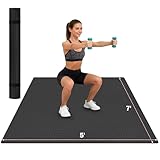
The Sensu wins on the two things that actually matter for a strength routine at home: a big 7' x 5' footprint and a firm 8.5mm deck. That combination is rare. Most extra thick mats are single-person strips 24 inches wide, so a lunge or a lateral step lands you on hard floor. Here you get five feet of width to work across.
Sensu says the 8.5mm high-density surface cushions joints and supports balance, and lists a non-slip top and bottom for control during cardio. The company also cites 16P-ECO foam that's latex-free and phthalate-free. Storage is handled by an included zippered case and shoulder strap.
At 13.9 lb it's easily the heaviest here, more than six times the 2.2 lb Amazon Basics mat. That weight is the trade-off for the coverage. This is a mat you unroll and leave down, not one you tote to a class. It's also the most expensive pick in this set, and only two sellers list it.
Pros:
- Largest footprint here at 7' x 5'
- Firm 8.5mm cushion for joints
- Non-slip claim on both faces
- Zippered case and shoulder strap included
- Latex-free, phthalate-free foam per Sensu
Cons:
- Heaviest at 13.9 lb, not portable
- Most expensive pick in this set
- Only two sellers list it
- No published warranty
2. Amazon Basics 1/2 Inch Extra Thick Yoga Mat — Best budget pick
This is the mat to buy first if you want half-inch padding without spending up.

Best for: first-time buyers who want padding without spending much Skip it if: you need coverage wider than 24 inches
The Amazon Basics mat is the cheapest of the six and the one buyers choose most often here. It gives you a 0.5-inch cushion on a 73.2 x 24.3-inch strip, and at 2.2 lb it rolls up small. For core work, planks and light dumbbell circuits, that half inch is enough to spare your spine and elbows.
Amazon says the foam is extra thick and cushy, that the half-inch thickness offers padded support and shock absorption, and that the textured surface adds traction. There's an elastic strap for rolled storage and over-the-shoulder carrying. It wipes clean, per the listing.
The limit is width. At just over 24 inches, this is a single-lane mat, so any move that spreads your feet or shifts you sideways runs off the edge. It's also the thinnest of the true half-inch-plus picks once you compare it to the two-inch CAP or the one-inch Retrospec. As a low-cost entry into extra thick padding, though, it's hard to fault.
Pros:
- Cheapest pick in this set
- The one buyers choose most often here
- Light at 2.2 lb for easy storage
- Elastic carry strap included
- Textured surface for traction per Amazon
Cons:
- Narrow 24.3-inch width limits movement
- Thinner than the CAP and Retrospec picks
- No published warranty
- Single-person footprint only
3. CAP Barbell Folding Exercise Mat — Best for beginners
Two inches of foam and a fold-flat design make this the easiest starting point for nervous knees.

Best for: people who want thick padding and fold-flat storage Skip it if: you want a flat surface with no seam
The CAP is the thickest mat here by a wide margin. At 2.0 inches of high-density foam, it dwarfs the 0.5-inch Amazon Basics and the 0.24-inch Gruper. If your knees complain during kneeling presses or your tailbone hurts on floor work, this is the softest landing in the group.
CAP says the two-inch high-density foam is engineered for cushioning and impact absorption, and calls it suitable for tumbling, karate, stretching and strength workouts. The listing describes nylon handles for transport, hook-and-loop closures to connect multiple mats, and materials free of 10 harmful phthalates, lead and mercury. It weighs 4.08 lb.
The catch is the fold. This mat is built to bend in sections, so there are seams across the surface. For balance-heavy or standing dumbbell work, a seam under one foot can feel uneven. It's a superb cushion for floor and kneeling exercises, less ideal as a stable standing base. Only one seller lists it.
Pros:
- Deepest cushion in the set at 2.0 inches
- Folds flat with built-in handles
- Connectable to other CAP mats
- Free of 10 named phthalates per CAP
- Light for its bulk at 4.08 lb
Cons:
- Seams from the folding panels
- Uneven base for standing work
- Only one seller lists it
- No published warranty
4. Retrospec Solana 1" Extra Thick Yoga Mat — Best for heavy use
A firm one-inch deck that Retrospec pitches for everyday intensity, whatever the workout.

Best for: daily users who want a firm one-inch surface Skip it if: you need more than a single-person width
The Solana sits between the thin strips and the thick foam blocks at a firm 1 inch. Retrospec describes it as a firm mat that eases stress on joints, hips, hands and knees, which matches how a denser one-inch surface behaves: enough give to protect you, firm enough to stay stable when you shift weight. It's the only pick here offered in a colour other than black, ocean blue.
Retrospec says the non-slip material keeps you steady and stays put on the floor, and calls the mat durable enough for everyday use regardless of intensity. The materials are free of phthalate, heavy metals and latex per the listing, which also notes a possible initial odour that airs out. A mat strap is included, and at 2.2 lb it's still portable.
The width is the familiar limit at 72 x 24 inches, so it's a one-person lane. The listing explicitly states there's no warranty. As a firm, seamless daily driver for a single user, though, it's the pick that reads built for repetition.
Pros:
- Firm one-inch surface, no seams
- Only non-black colour option here
- Light at 2.2 lb with strap included
- Free of phthalate, heavy metals, latex per Retrospec
Cons:
- Narrow 24-inch single-user width
- Warranty explicitly listed as none
- May release an initial odour per Retrospec
- Less cushion than the two-inch CAP
5. Stepwaver Extra Large Exercise Mat — Best for families
The biggest floor here, sized for two people or one person who ranges wide.
Best for: households sharing one big floor space Skip it if: you want deep cushion under your knees
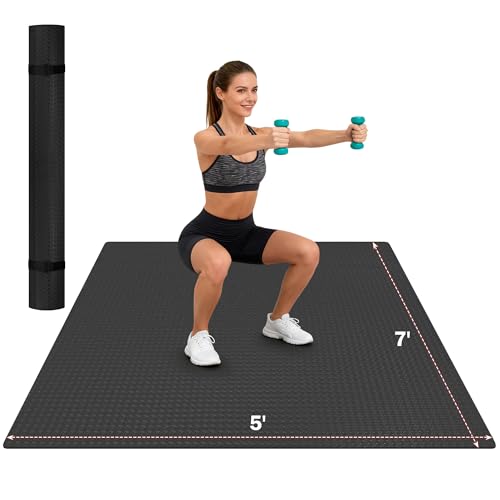
The Stepwaver matches the Sensu on footprint with an 84 x 60-inch surface, which is a full 7' x 5' spread. That's room for two people to stretch side by side, or for one person to move through a circuit without watching the edges. At 9.3 lb it's the second-heaviest here, lighter than the Sensu's 13.9 lb.
Stepwaver says the 6mm high-density foam offers shock absorption and joint protection, and describes a double-sided non-slip design with a textured top and a grip pattern underneath. The listing also calls it water-resistant and sweat-proof, built for use in shoes or bare feet, and tear-resistant. Several sellers stock it.
The compromise is depth. At 6mm, it's thinner than the Sensu's 8.5mm and far thinner than the two-inch CAP or the one-inch Retrospec. You get area, not deep padding, so kneeling work is less forgiving than on the thicker picks. For a shared home space where coverage beats cushion, it's the natural choice, and it's the cheaper of the two large mats.
Pros:
- Full 7' x 5' shared footprint
- Double-sided non-slip design per Stepwaver
- Water-resistant, sweat-proof per listing
- Several sellers stock it
- Lighter than the Sensu at 9.3 lb
Cons:
- Thinner 6mm cushion for its size
- Less padding under knees than thick picks
- Heavy to move at 9.3 lb
- No published warranty
6. Gruper Yoga Mat Non Slip — Best compact
The lightest, thinnest mat here, made for carrying rather than cushioning.

Best for: commuters who fold a mat into a bag Skip it if: you kneel or drop weight often
The Gruper is the featherweight of the group at 1.65 lb, and the second-cheapest pick. At 0.24 inches it's the thinnest mat here, which makes it the odd one out in an extra thick roundup. Include it because portability is a real need: if your training moves between home, gym and a friend's place, this is the one that disappears into a bag.
Gruper says the mat uses an upgraded eco-friendly material that's softer and safer than standard PVC or EVA, with a sticky non-slip texture on both sides that resists tearing and deformation. A carry strap and storage bag come included, and the listing notes a thicker 0.32-inch version is also offered. Care is a damp cloth or mild detergent, air-dried flat.
For strength training specifically, this is the weakest fit. A quarter inch of foam won't spare your knees on a kneeling press or absorb a dropped dumbbell. Treat it as a travel and light-mobility mat, not your lifting surface. As a grab-and-go option, its 1.65 lb weight is unbeaten in this set.
Pros:
- Lightest here at 1.65 lb
- Second-cheapest pick in this set
- Carry strap and storage bag included
- Non-slip texture both sides per Gruper
Cons:
- Thinnest at 0.24 inches, minimal cushion
- Poor fit for kneeling or dropped weight
- Narrow single-user width
- No published warranty
How I screened these six mats down
I started from the listing data and cut on reasons, not gut feel. Three things knocked candidates out before I looked at anything else.
- No published thickness or footprint. A mat that doesn't state its dimensions can't be compared, so it was out. Every pick here lists both.
- Wrong job entirely. Puzzle-tile flooring and yoga towels came off the list. They don't cushion a single continuous workout surface.
- No usable strength-training angle. Even where a listing didn't promise the modifier, I kept only mats whose thickness and grip claims plausibly serve floor and dumbbell work.
What survived splits into three shapes. Two big mats, the Sensu and the Stepwaver, cover 7' x 5' of floor. Three single-user strips, the Amazon Basics, Retrospec and Gruper, run 72 x 24 inches at different thicknesses. One outlier, the CAP, is a folding two-inch block.
I then ranked on the deciding pair: cushion depth and floor coverage, weighted toward whichever a home lifter reaches for first. Weight and portability broke ties. That's how the Sensu, which is heavy and pricey but big and firm, still finished first.
Thickness versus floor coverage: which matters more?
This is the trade every buyer here faces, because no single mat maxes both. The CAP gives you two inches of foam on a narrow 24-inch strip. The Stepwaver gives you a 60-inch width at just 6mm. You pick your priority.
Coverage matters more if:
- You do standing dumbbell work, lunges or lateral moves.
- You share the space with a partner or a kid.
- You hate stepping half-on, half-off during a set.
Thickness matters more if:
- Your knees, hips or spine hurt on the floor.
- You do a lot of kneeling and floor-press work.
- You occasionally set a light dumbbell down hard.
The Sensu is the one mat that refuses to fully choose. Its 8.5mm is firmer than the Stepwaver's 6mm, and its 7' x 5' spread matches the biggest here. It won't out-cushion the two-inch CAP, and nothing will out-cover a mat that isn't 60 inches wide. But it's the most balanced answer to a question that usually forces a compromise.
What does an extra thick mat cost you elsewhere?
Thickness and size aren't free. Every gain shows up as weight, price or portability somewhere in this set, and it's worth knowing the pattern before you buy.
- Weight. The Sensu at 13.9 lb and the Stepwaver at 9.3 lb are the two you leave in place. The three strips and the Gruper all sit at or below 2.2 lb.
- Price position. The two premium picks are the large mats. The cheapest, the Amazon Basics, is a thin single-user strip. You're largely paying for square footage, not foam depth.
- Seams. Only the CAP folds, and folding means seams. Every other mat is one flat piece.
- Colour. Five of the six are black. The Retrospec Solana is the only ocean-blue option, if that matters to you.
Warranty is the quiet gap across the board. The Retrospec listing states outright there's no warranty, and none of the others publish one either. So don't buy any of these expecting formal coverage. Buy on the specs you can see: thickness, footprint, weight and the grip claims each brand makes.
When does a different pick win?
The Sensu is the default, but three specific situations flip the answer. Here's the threshold for each.
- If your budget is the constraint, the Amazon Basics wins. It's the cheapest here, gives you a real 0.5-inch cushion, and weighs just 2.2 lb. Below the price of the big mats, it's the sane starting point.
- If your knees are the constraint, the CAP wins. Two inches of foam beats everything else here for kneeling and floor work. Accept the seams as the price of that cushion.
- If portability is the constraint, the Gruper wins. At 1.65 lb it packs smallest. You give up cushion, so keep it for travel and mobility, not lifting.
One more: if two people train together, the Stepwaver's 84 x 60-inch footprint matches the Sensu's coverage for less money, at the cost of thinner 6mm foam.
The verdict
If you're setting up one home strength space and want a mat you'll leave down, buy the Sensu Large Exercise Mat. Its 8.5mm firm deck and 7' x 5' footprint answer both halves of the problem, cushion and coverage, better than anything else here. That's why it's the best extra thick yoga mat for strength training in this group, even as the heaviest and most expensive pick.
The cutoff is how much floor you need. If your training fits inside a 24-inch lane and you want to spend less, the Amazon Basics 1/2 Inch mat is the better buy, with a real 0.5-inch cushion at 2.2 lb and the lowest price here. If you share the space with a partner, the Stepwaver matches the Sensu's 7' x 5' area for less, trading down to 6mm of foam.
Remember what none of these do: none is a platform for heavy loaded barbell work. They cushion joints and steady your feet for bodyweight and dumbbell training. Buy for that job, match the thickness and footprint to your body and your room, and the Sensu is the safest default.
FAQ
Is an extra thick yoga mat worth it for strength training?
An extra thick yoga mat is worth it for strength training if you do floor and kneeling work, where the added foam spares your knees, hips and spine. The Sensu's 8.5mm and the CAP's two inches both deliver that. It's not worth buying one as a base for heavy loaded lifts, since foam compresses and destabilizes a rack.
Which extra thick yoga mat for strength training gives the most cushion?
The extra thick yoga mat for strength training with the most cushion here is the CAP Barbell Folding mat at 2.0 inches of high-density foam, more than double the Sensu's 8.5mm. That depth suits kneeling presses and floor work. The trade-off is the folding seams, which can feel uneven under one foot during standing or balance exercises.
How does the Sensu compare to the Stepwaver head-to-head?
The Sensu compares to the Stepwaver on footprint and firmness. Both cover a full 7' x 5', but the Sensu's 8.5mm foam is firmer than the Stepwaver's 6mm, giving better joint support. The Stepwaver is lighter at 9.3 lb versus 13.9 lb and costs less. Pick the Sensu for cushion, the Stepwaver for shared value.
What thickness of yoga mat is best for lifting weights?
The thickness best for lifting weights depends on the lift. For bodyweight and dumbbell floor work, 8.5mm to two inches cushions joints well, as the Sensu and CAP show. For standing dumbbell work, a firmer surface like the Retrospec's 1 inch stays stable. For heavy loaded barbell lifts, skip foam mats entirely and use a solid platform.
Can I use a thin mat like the Gruper for strength workouts?
You can use a thin mat like the Gruper for strength workouts that stay standing, such as light dumbbell circuits, but its 0.24-inch foam offers little protection for kneeling moves or dropped weights. At 1.65 lb it's built for travel and mobility, not cushioning. For home strength sessions, a thicker pick like the Sensu serves better.
Start by measuring your training space and deciding whether you kneel more than you range. That single answer points you at the right mat faster than any spec sheet. If the floor is yours and the room allows it, the Sensu's mix of a firm 8.5mm deck and a 7' x 5' spread is the pick that stops forcing a choice between cushion and coverage. Everyone else has a clear fallback here, from the budget Amazon Basics to the deep-cushion CAP. Match the mat to the body and the room, and you won't second-guess it.