Best Heavy Duty Gym Flooring When Space Is Tight

Seven interlocking tiles and rubber rolls compared on thickness, coverage and top layer, with a named winner, three flip conditions and the profiles each pick actually suits.

By Lauren RossUpdated 19 min read
On this page
- Best heavy duty gym flooring for men at a glance
- Who each pick is actually for
- Does thickness or the top layer decide it?
- 1. AIRHOP 0.56in Thick 48 Sq Ft Exercise Equipment Mats — Best overall
- 2. Dalmbox 0.56" Thick Rubber Gym Floor Mats 12 Tiles 48 Sq — Runner-up
- 3. SUPERJARE 1" Extra-Thick Rubber Top Exercise Mat — Best minimal setup
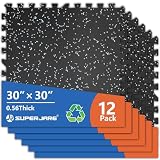
- 4. SUPERJARE 30" x 30" Larger Rubber Top Exercise Equipment — Best for pros
- 5. Baselayer Performance Series Interlocking Floor Tiles — Best premium
- 6. IncStores Traxxon Rubber Gym Flooring Roll — Best upgrade
- 7. ProsourceFit Exercise Puzzle Mat ½-inch — Best budget pick
- How much floor do you really need to cover?
- Tiles or a roll for heavy duty gym flooring?
- What the listings do not tell you
- The verdict
- FAQ
The best heavy duty gym flooring for men is the AIRHOP 0.56in Thick 48 Sq Ft Exercise Equipment Mats set, because it pairs a recycled rubber top with a high-density EVA base across 48 sq ft in 24 x 24 in tiles. If you want a seamless surface instead of seams, the IncStores Traxxon roll gives you a single 120 x 48 in sheet at 0.25 in thick. Short on time? AIRHOP for a rack corner, SUPERJARE's 1 in tiles for an apartment, ProsourceFit's 9.3 lb foam set for cardio and machines.
Best heavy duty gym flooring for men at a glance
| Pick | Thickness | Coverage | Price |
|---|---|---|---|
| 0.56 in | 48 sq ft 12 tiles |
Check Price | |
| 0.56 in | 48 sq ft 12 tiles |
Check Price | |
Best minimal setup SUPERJARE 1" Extra-Thick Rubber Top Exercise Mat |
1 in | 48 sq ft 12 tiles |
Check Price |
| 0.56 in | 75 sq ft 12 tiles |
Check Price | |
| 0.5 in | 30 sq ft 12 tiles |
Check Price | |
Best upgrade IncStores Traxxon Rubber Gym Flooring Roll |
0.25 in | 40 sq ft 1 roll |
Check Price |
Best budget pick ProsourceFit Exercise Puzzle Mat ½-inch |
0.5 in | 48 sq ft 12 tiles |
Check Price |




Who each pick is actually for
I screened these seven by the buyer standing in the room, not by a spec sheet ranking. Seven picks, seven different rooms.
The garage lifter with a rack and bumper plates wants a rubber top layer over foam. That is AIRHOP, Dalmbox and both SUPERJARE sets. The apartment lifter on an upper floor cares about one number above all others: total thickness. SUPERJARE's 1 in tiles are twice as thick as the ProsourceFit and Baselayer options at 0.5 in.
The finished-basement owner has a different worry, which is smell. Baselayer's listing states TPE construction with no odour, and it is the only pick in this set making that specific claim.
Then there are two buyers who are not lifting heavy at all. One runs a treadmill and does bodyweight circuits: ProsourceFit's 9.3 lb EVA set covers 48 sq ft and is the lightest thing here by a wide margin. The other wants a single continuous strip under one machine, no seams to catch a wheel, and that is the IncStores Traxxon roll at 120 x 48 in.
A word on the keyword. Nothing in these listings is built or sized for men specifically. Body weight and the load you drop matter; the label on the box does not. Read "heavy duty" as the real filter and ignore the rest.
Does thickness or the top layer decide it?
Most guides to heavy duty gym flooring for men rank on thickness alone. That is only half the answer, and it is the half that misleads.
Two tiles can both measure 0.56 in and behave nothing alike. What separates them is what sits on top. AIRHOP, Dalmbox and both SUPERJARE tiles are described as dual-layer: a rubber surface bonded to a high-density EVA foam base. ProsourceFit is EVA foam through and through, and its own listing notes that foam may compress slightly under heavy objects. That is the honest line in the whole set.
So run the decision in this order:
- Top layer first. Rubber or TPE over foam resists gouging from plate edges and rack feet. Pure foam takes a permanent dent.
- Total thickness second. More thickness means more shock absorbed downward. SUPERJARE's 1 in build leads here; the Traxxon roll at 0.25 in trails it.
- Coverage third. 30, 40, 48 or 75 sq ft. Match the footprint, do not buy area you will never stand on.
- Format last. Tiles cut and expand. A roll lies flat and stays put.
Here's the trick with dual-layer tiles. The rubber earns its keep on the top face where plates land, and the foam does the quiet work underneath. A thick foam-only tile feels plush the day it arrives and then permanently records the shape of your rack.
1. AIRHOP 0.56in Thick 48 Sq Ft Exercise Equipment Mats — Best overall
A recycled rubber top over high-density EVA foam, 48 sq ft at 0.56 in thick, and the pick buyers choose most often among the rubber-topped sets here.
Best for: a garage rack and bumper plates on 48 sq ft Skip it if: you need a single seamless surface
The AIRHOP set wins because of what it gets right at both ends of the sandwich. AIRHOP says the tiles use a recycled rubber top over a high-density EVA foam base, so the face that meets a plate edge is not the same material doing the cushioning. At 0.56 in total it sits in the middle of this group for thickness, above the 0.5 in tiles and below SUPERJARE's 1 in build.
The numbers are unusually complete for this category. Twelve tiles at 24 x 24 in, 48 sq ft covered, and a stated 29 lb for the pack. That last figure matters more than it looks: it is roughly three times the weight of the ProsourceFit foam set at the same coverage, which tells you how much material is actually in each tile.
The layout is 8 x 6 ft, which suits a rack against one wall with room to step out and press. AIRHOP describes upgraded larger interlocking teeth to stop tiles separating during use, which is the failure mode that ruins a cheap puzzle floor.
The trade-off against the Traxxon roll is seams. Twelve tiles means dozens of joints, and joints can creep under a treadmill's vibration. Against SUPERJARE's 1 in tiles it gives up roughly half the total thickness.
Pros:
- Rubber top over high-density EVA foam base
- 48 sq ft coverage from 12 tiles
- 29 lb pack weight signals real material density
- Larger interlocking teeth claimed to resist separation
- Chosen more often than the other rubber-topped picks here
Cons:
- Dozens of seams under vibrating cardio equipment
- Half the total thickness of the 1 in SUPERJARE tiles
- No published warranty term
- Only two sellers list it
2. Dalmbox 0.56" Thick Rubber Gym Floor Mats 12 Tiles 48 Sq — Runner-up
Matches the winner's 0.56 in thickness and 48 sq ft coverage as the second-cheapest pick here, with a thinner spec sheet behind it.

Best for: matching the winner's format for less outlay Skip it if: you want published weight and warranty figures
On paper the Dalmbox set shadows the AIRHOP pick almost exactly: 12 tiles, 24 x 24 in, 48 sq ft, 0.56 in thick. It is the second-cheapest of the seven, which makes it the value play if you want a rubber surface rather than bare foam.
Dalmbox describes dense shock-absorbing rubber, a textured non-slip face and a non-porous surface that resists sweat and odour. Those are the right claims for a garage where you sweat onto the floor and then walk away. It also claims resistance to tearing and cracking under heavy weights and repetitive use.
Where it falls short of the winner is documentation. There is no published pack weight, so you cannot compare material density against AIRHOP's 29 lb figure, and no stated warranty. For a floor you expect to keep for a decade, that gap is worth something. Colour is black only, which is fine for a garage and less so if you wanted the two-tone look for a spare room.
The other quiet cost is availability. Only one seller lists it, which narrows your options if a tile arrives damaged. Against the winner you get the same format and thickness, and less information about what you are actually buying.
Pros:
- Second-cheapest of the seven picks
- Same 0.56 in thickness as the overall winner
- 48 sq ft from 12 standard 24 x 24 in tiles
- Non-porous surface claimed to resist sweat and odour
Cons:
- No published pack weight to judge density
- No stated warranty
- Black only, no colour choice
- Only one seller lists it
3. SUPERJARE 1" Extra-Thick Rubber Top Exercise Mat — Best minimal setup
At a full 1 in thick, this is the deepest floor here, and the one to buy if impact noise travelling downward is your real problem.

Best for: apartment lifting where impact noise matters most Skip it if: your door clearance is already tight
This is the only 1 in pick in the group, and thickness is the single thing it is selling. SUPERJARE pairs a high-density EVA foam base with an EPDM rubber top, and says the thicker rubber layer absorbs shock and reduces impact noise so you can train without complaints from downstairs.
Do the arithmetic against the rest of the set and the gap is stark. It is 0.44 in deeper than the 0.56 in tiles and twice the depth of the 0.5 in Baselayer and ProsourceFit tiles. Four times the Traxxon roll at 0.25 in. If you live above someone, that is the number that decides your purchase.
Coverage is the familiar 48 sq ft from 12 tiles at 24 x 24 in, so you get standard footprint planning with more depth. SUPERJARE describes a matte non-slip rubber surface for traction while squatting and deadlifting, and interlocking edges so you can extend or relocate the layout.
The costs are real. It sits in the most expensive tier here, and 1 in of floor eats door clearance, changes the step up into your gym area, and raises the height of every rack and bench sitting on it. There is no published pack weight either, and a 1 in dual-layer tile is not light. If you are laying this in a garage with a roll-up door, measure before you order.
Pros:
- 1 in total thickness, the deepest pick here
- EPDM rubber top over high-density EVA base
- 48 sq ft coverage from 12 tiles
- Matte non-slip surface for barbell work
Cons:
- Priciest tier in this set
- 1 in build can foul door clearance
- Raises rack and bench height noticeably
- No published pack weight or warranty term
- Only one seller lists it
4. SUPERJARE 30" x 30" Larger Rubber Top Exercise Equipment — Best for pros
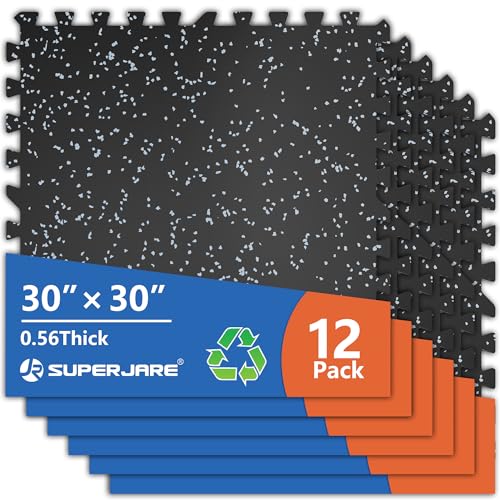
Seventy-five square feet from the same 12 tiles, because each one measures 29.5 x 29.5 in instead of 24 x 24 in.
Best for: covering a full rack-and-platform footprint Skip it if: your room needs 24 in tiles to cut cleanly
Coverage is where this pick separates itself. Twelve tiles at 29.5 x 29.5 in deliver 75 sq ft, which is 27 sq ft more than every 48 sq ft set here and 45 sq ft more than the Baselayer pack. If you are flooring a rack, a bench and a walkway rather than one corner, that is the difference between one order and two.
Construction follows the same dual-layer recipe as its 24 in sibling: a rubber top over high-quality EVA foam, at 0.56 in thick. SUPERJARE claims the thick rubber layer cuts noise by 30% to 50% against thinner mats, and describes a textured anti-slip, waterproof surface that wipes clean.
Fewer seams is the underrated benefit. Larger tiles mean fewer joints per square foot, and joints are where a puzzle floor fails first.
The catch is geometry. Tiles at 29.5 in do not divide neatly into most room dimensions, so you will be trimming more often and wasting more offcut than with a 24 in module. It also sits in the most expensive tier here, and there is no published pack weight or warranty. Against the AIRHOP winner you gain 27 sq ft and lose the documented 29 lb figure and the lower price position.
Pros:
- 75 sq ft coverage, the largest here
- Oversized 29.5 x 29.5 in tiles mean fewer seams
- Rubber top over EVA foam at 0.56 in
- Textured waterproof surface, wipes clean
Cons:
- 29.5 in module trims awkwardly in most rooms
- Sits in the most expensive tier
- No published weight or warranty
- Thinner than the 1 in SUPERJARE option
5. Baselayer Performance Series Interlocking Floor Tiles — Best premium
TPE rather than foam or bonded rubber, made in the USA, with cord channels underneath and a firmer density that suits heavy lifting.

Best for: an odour-free finished basement gym Skip it if: you want maximum coverage per pack
Baselayer takes a different route to heavy duty gym flooring for men. Instead of gluing rubber to foam, the tiles are injection molded from TPE, a thermoplastic elastomer that Baselayer describes as non-toxic, no-slip textured and free of odour. That last point is the reason to choose it. A rubber-topped tile in a closed basement can smell for weeks; this is the only pick in the set specifically claiming no odour.
Baselayer calls it a firmer density cushioned surface aimed at heavy weights and high-impact training. Firmer is what you want under a barbell, because a soft floor lets a rack rock. The tiles measure 19 x 19 in at 0.5 in thick, 12 per pack for 30 sq ft, and it is made in the USA.
One detail nobody else offers: electrical cord channels moulded into the underside, so a fan or treadmill cable runs beneath the floor instead of across it.
Now the costs. It is the most expensive pick here and covers the least ground at 30 sq ft, so per square foot the gap widens further. Edges and corners are sold separately, which means the polished perimeter is an extra purchase. At 0.5 in it is also thinner than the winner and half the depth of the 1 in SUPERJARE set.
Pros:
- Injection molded TPE, no odour claimed
- Firmer density aimed at heavy weights
- Cord channels underneath for cable routing
- Made in the USA
- Precision locking tabs for minimal gapping
Cons:
- Most expensive pick and the smallest coverage at 30 sq ft
- Edges and corners cost extra
- 0.5 in thickness trails most of the set
- 19 in tiles need more pieces per square foot
6. IncStores Traxxon Rubber Gym Flooring Roll — Best upgrade
One seamless 120 x 48 in sheet of recycled rubber, 60 lb of it, and the only pick here with a stated 5 year warranty.

Best for: a seamless strip under a rack or treadmill Skip it if: you have to carry it upstairs alone
Everything else here is a puzzle. This is a floor. The Traxxon roll arrives as a single 120 x 48 in sheet covering 40 sq ft, at 0.25 in thick and 60 lb, and it is made in the USA from recycled rubber. No seams means nothing to creep apart under a treadmill or work loose when you drag a rack sideways.
It is also the only pick in this set with a published warranty term at 5 years, which for a floor you plan to keep is genuinely useful information. IncStores positions it under weight benches, machines and heavy deadlifts, and describes moisture-resistant protection for the subfloor beneath.
The weight cuts both ways. Sixty pounds of rubber in one roll stays flat and stays put, which is exactly what you want. It also means a two-person carry up a flight of stairs, and a roll that wants to curl back on itself for the first few days after unrolling.
Then there is thickness. At 0.25 in it is the thinnest pick in this group, a quarter of the 1 in SUPERJARE build. That is fine as a durable protective layer under equipment, and it is not the choice for absorbing dropped bumper plates in an upstairs room. Buy it for coverage integrity, not for cushioning.
Pros:
- Single seamless 120 x 48 in sheet
- 5 year warranty, the only stated term here
- 60 lb of recycled rubber stays flat
- Made in the USA
- Moisture-resistant subfloor protection
Cons:
- Thinnest pick at 0.25 in
- 60 lb roll is awkward to move alone
- Tends to curl after unrolling
- 40 sq ft, less coverage than the 48 sq ft tile sets
- Only one seller lists it
7. ProsourceFit Exercise Puzzle Mat ½-inch — Best budget pick
The cheapest of the seven, 48 sq ft at 9.3 lb, with a limited lifetime warranty against manufacturer defects and pure EVA foam construction.
Best for: bodyweight work, cardio and machine footprints Skip it if: you drop loaded barbells
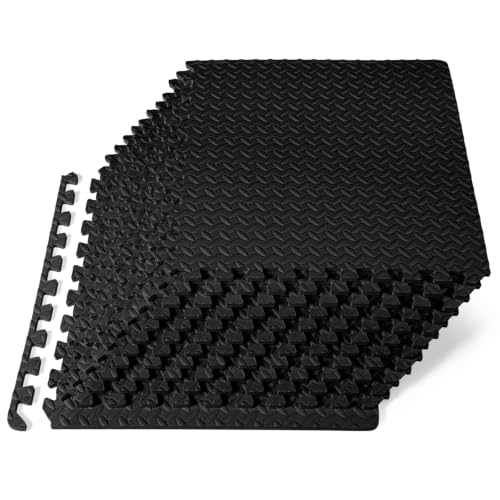
This is the cheapest pick here and the one buyers choose most often across the whole set, and it is honest about what it is. High-density EVA foam, 0.5 in thick, 12 tiles at 24 x 24 in for 48 sq ft, and just 9.3 lb for the pack. ProsourceFit calls it an alternative to rubber gym mats and states no toxic phthalates.
Nine point three pounds tells the story. The AIRHOP set covers the same 48 sq ft at 29 lb. That is roughly three times the material, and it is why one of these floors takes bumper plates and the other does not. ProsourceFit's own listing says foam may compress slightly under heavy objects, which I read as the accurate description it is.
So use it where foam belongs. Bodyweight circuits, stretching, kettlebell work with control, a treadmill or bike footprint, kids' play areas. It includes end borders for a finished edge, it is water-resistant and it disassembles fast for storage, which matters if the gym is also the living room.
It also carries the most generous stated cover here, a limited lifetime warranty on manufacturer defects. The trade-off against every rubber-topped pick in this guide is straightforward: no rubber surface, half the thickness of the SUPERJARE 1 in tiles, and permanent dents where a rack foot sits.
Pros:
- Cheapest pick in the set
- 48 sq ft coverage for only 9.3 lb
- Limited lifetime warranty on manufacturer defects
- End borders included for finished edges
- Disassembles fast for storage
Cons:
- Pure EVA foam, no rubber top layer
- Listing states foam may compress under heavy objects
- 0.5 in thickness, half the deepest pick here
- Rack and bench feet leave permanent dents
How much floor do you really need to cover?
Buying too much area is the most common overspend in this category. Measure before you shop, because these packs are not interchangeable.
Coverage across the seven runs 30, 40, 48 and 75 sq ft. Here is how those map to real spaces:
- 30 sq ft (Baselayer): one rack footprint, or a bench and dumbbell corner. Roughly 5 x 6 ft.
- 40 sq ft (Traxxon roll): a 4 x 10 ft strip, which fits a rack plus standing room or a single cardio machine.
- 48 sq ft (AIRHOP, Dalmbox, both 24 in tile sets, ProsourceFit): 8 x 6 ft, the standard home gym corner.
- 75 sq ft (SUPERJARE 30 in): a rack, a bench and a walkway, or most of a single garage bay.
Tile size changes your waste. A 24 in module divides cleanly into most rooms, so you cut fewer tiles. Baselayer's 19 in tiles and SUPERJARE's 29.5 in tiles both leave odd strips at the wall, and Baselayer sells edges and corners separately on top of that.
Most shoppers miss the vertical dimension. A 1 in floor changes your door swing, your step height and the working height of a bench press. Check the gap under your garage door before you commit to the thickest option.
Tiles or a roll for heavy duty gym flooring?
Six of these seven are interlocking tiles. One is a roll. The format decides more about daily life with the floor than the material does.
Tiles win on logistics. They arrive in a manageable box, one person carries them, and you can expand the area later by buying another pack. Take a tile out to clean under it. Move house and the floor comes with you in a car boot. The AIRHOP, Dalmbox and SUPERJARE sets all describe interlocking edges built for repeated assembly.
Rolls win on integrity. The Traxxon sheet at 120 x 48 in has no joints, so nothing separates when you shove a rack across it or run a treadmill on it for an hour. That single 60 lb mass also resists sliding in a way a light tile cannot.
Skip this format question if your answer is obvious: upstairs and alone, buy tiles. Ground floor with a helper and a fixed layout, the roll is the better long-term floor.
What the listings do not tell you
Reading seven listings side by side, the gaps are as informative as the specifications. Three things nobody publishes.
Pack weight. Only three of the seven state it: AIRHOP at 29 lb, Traxxon at 60 lb, ProsourceFit at 9.3 lb. Weight is the closest proxy you have to material density, and four listings leave it blank. When it is missing, thickness and stated construction are all you have to go on.
Warranty. Two picks publish a term. IncStores states 5 years, ProsourceFit states a limited lifetime warranty on manufacturer defects. The other five say nothing about cover at all, which is worth weighing when the price positions are close.
Compression under load. Every listing promises durability. Only ProsourceFit admits foam may compress slightly under heavy objects, and that candour applies to any foam-only tile, not just theirs. Assume a rack foot on 0.5 in EVA will leave a mark.
Add one practical unknown: none of these listings tells you how the surface behaves with chalk, sweat pooling or a dropped dumbbell corner. Dalmbox and SUPERJARE both describe non-porous, wipe-clean surfaces, which is the closest anyone comes to answering it.
The verdict
The AIRHOP 0.56in Thick 48 Sq Ft Exercise Equipment Mats set is the right default for heavy duty gym flooring for men, and I would start there. It gets the two things that matter right: a recycled rubber top where plates land, and a high-density EVA base at 0.56 in doing the cushioning. Twelve tiles cover 48 sq ft in an 8 x 6 ft layout, and the 29 lb pack weight is real evidence of material density rather than a marketing line.
Three conditions flip it. If you train above someone else's ceiling, buy the SUPERJARE 1" Extra-Thick set instead, because 1 in of dual-layer floor is nearly double the winner's depth and impact noise is your actual problem. If you need to cover a rack, a bench and a walkway in one order, the SUPERJARE 30" x 30" set delivers 75 sq ft from the same 12 tiles. And if seams are the thing you cannot live with under a treadmill, the IncStores Traxxon roll gives you a single 120 x 48 in sheet plus a stated 5 year warranty.
The runner-up's exact advantage is price. Dalmbox matches the winner's 0.56 in thickness and 48 sq ft coverage as the second-cheapest pick here. What you give up is documentation: no published pack weight, no warranty term.
FAQ
Is heavy duty gym flooring for men worth it over cheap foam tiles?
Heavy duty gym flooring is worth it the moment metal touches the floor. A rubber-topped tile like the AIRHOP set at 0.56 in resists gouging from plate edges and rack feet. Pure foam takes permanent dents, and ProsourceFit's own listing notes foam may compress under heavy objects. For bodyweight work and cardio, cheap foam is genuinely fine.
How thick should gym flooring be for dropping weights?
How thick your flooring should be depends on what is below you. On a concrete garage slab, 0.56 in with a rubber top handles bumper plates well, which covers AIRHOP, Dalmbox and the SUPERJARE 30 in set. On an upper floor with neighbours underneath, go to the 1 in SUPERJARE tiles. Thicker absorbs more downward impact.
What is the cheapest way to floor a home gym?
The cheapest way to floor a home gym here is the ProsourceFit Exercise Puzzle Mat, the lowest price position of these seven at 48 sq ft. Its limits are honest: 0.5 in EVA foam, no rubber top, 9.3 lb total. Use it under cardio machines and for bodyweight training. Step up to a rubber-topped tile before you start dropping loaded barbells.
AIRHOP or SUPERJARE 1 inch tiles: which should I buy?
AIRHOP or SUPERJARE comes down to your ceiling. Both cover 48 sq ft from 12 tiles at 24 x 24 in with a rubber-over-foam build. AIRHOP is 0.56 in and sits at a lower price position with a published 29 lb pack weight. SUPERJARE is 1 in thick for noise control upstairs, at the cost of door clearance and a higher price tier.
Will interlocking tiles come apart under a squat rack?
Interlocking tiles come apart when the locking teeth are undersized and the tiles are light. AIRHOP specifically describes upgraded larger interlocking locks to prevent separation, and Baselayer claims precision locking tabs with minimal gapping. If a rack will be dragged rather than lifted, the seamless IncStores Traxxon roll at 60 lb removes the risk entirely.
Start by measuring the footprint you actually train in, then check your door clearance, then buy the thinnest rubber-topped floor that solves your noise problem. The AIRHOP set is the right default because it does not force a compromise: rubber where it counts, foam where it counts, 48 sq ft in a layout that fits most garage corners, and a published pack weight so you know what arrived. Everything else in this guide exists for a specific room. If yours is an upstairs apartment, a smell-sensitive basement, or a bay wide enough to need 75 sq ft, buy for that instead.