Best Interlocking Gym Flooring for Thin-Set Homes
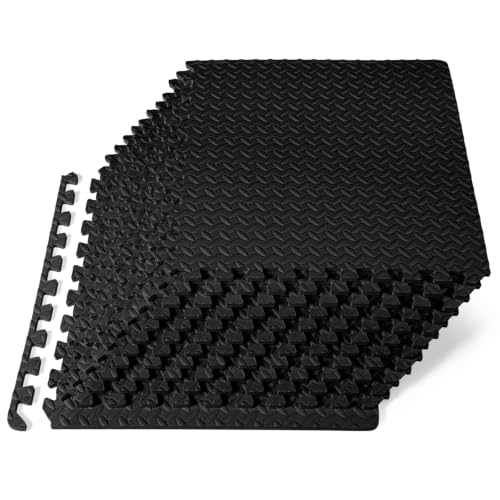
Six interlocking foam and rubber-top tile sets, ranked by thickness, coverage, and what each one protects. ProsourceFit leads for most first home gyms, but the deciding number is not the one you think.

By Lauren RossUpdated 15 min read
On this page
- How I screened these six tile sets
- Best interlocking gym flooring for beginners at a glance
- Thickness is the number that decides it
- 1. ProsourceFit Exercise Puzzle Mat 1⁄2-inch — Best overall
- 2. bemaxx Gym Mats Set — Best budget pick
- 3. Haulcove 18 Pcs EVA Foam Floor Tiles — Runner-up
- 4. BalanceFrom Puzzle Exercise Mat 1/2" Thick — Best for heavy use
- 5. AIRHOP 0.56in Thick Exercise Equipment Mats — Best for beginners
- 6. SUPERJARE 30" x 30" Larger Rubber Top Mats — Best premium
- Foam or rubber-top: which do you actually need?
- How much floor do you actually need to cover?
- What the listings do not tell you
- The verdict
- FAQ
The best interlocking gym flooring for beginners is the ProsourceFit Exercise Puzzle Mat, a 0.5-inch EVA tile set covering 48 sq ft across 12 tiles with end borders and a limited lifetime warranty. If you drop loaded weights, the AIRHOP set trades foam for a rubber top at 0.56 in thick. Most first-timers overspend on rubber they don't need. The number that actually splits this field is tile thickness, and half an inch is the line worth crossing.
How I screened these six tile sets
I compared the published specifications for all six sets side by side, then cut on what a first home gym actually needs. Three things decided the shortlist: tile thickness, total coverage, and whether the top layer is plain foam or a rubber wear surface.
Here's the honest part about the word "beginners." Amazon's search returned these on the phrase, but none of the listings state a beginner-specific feature. So I'm treating "beginner" as a shopping profile, not a spec: someone furnishing a first home gym who wants floor protection and joint cushion without overbuying. You'll judge the fit against your own setup.
What I looked for:
- Thickness with a unit, not "thick" as an adjective
- Stated coverage so you can match it to your room
- Foam versus rubber-top construction, since the two protect against different things
- Weight, because it tells you how the tile will behave under a rack
What got no free pass: vague feature claims. Every manufacturer here says its foam is high-density and easy to clean. That tells you nothing that separates one set from another, so I leaned on the numbers instead.
Best interlocking gym flooring for beginners at a glance
| Pick | Thickness | Coverage | Price |
|---|---|---|---|
Best overall ProsourceFit Exercise Puzzle Mat |
0.5 in | 48 sq ft 12 tiles |
Check Price |
Best budget pick bemaxx Gym Mats Set |
0.4 in | 18 sq ft 18 tiles |
Check Price |
Runner-up Haulcove EVA Foam Floor Tiles |
0.4 in | 18 sq ft 18 tiles |
Check Price |
Best for heavy use BalanceFrom Puzzle Exercise Mat |
0.5 in | 48 sq ft 12 tiles |
Check Price |
Best for beginners AIRHOP Rubber Top Mats |
0.56 in | 48 sq ft 12 tiles |
Check Price |
Best premium SUPERJARE 30" Rubber Top Mats |
0.56 in | 75 sq ft 12 tiles |
Check Price |


Thickness is the number that decides it
Most guides to gym flooring push you toward the biggest coverage number. That's the wrong lens. Coverage tells you how many tiles you get. Thickness tells you what those tiles can protect.
Interlocking gym flooring for beginners comes in two practical thicknesses in this set: 0.4 in and roughly 0.5 to 0.56 in. That gap sounds small. It isn't.
- 0.4 in is a comfort layer. Good for yoga, stretching, and standing on hard floors. Thin under anything with weight behind it.
- 0.5 in is the general-purpose line. It cushions knees and elbows during bodyweight work and protects the floor under light dumbbells.
- 0.56 in with a rubber top adds a wear surface, which is about scratch resistance, not extra squish.
For a first home gym, half an inch is the threshold I'd cross before anything else. Below it, you're buying a mat. At or above it, you're buying flooring. The bemaxx and Haulcove sets sit at 0.4 in, which is why they land as the budget and compact picks rather than the outright winner. The best interlocking gym flooring for beginners clears that line without forcing you into a rubber-top price.
1. ProsourceFit Exercise Puzzle Mat 1⁄2-inch — Best overall
A half-inch EVA tile set with a published lifetime warranty and full 48 sq ft coverage, which is the balance most first home gyms want.
Best for: a first home gym on hardwood or carpet Skip it if: you drop loaded barbells directly onto the floor
This set wins on the combination no other pick matches at its price position. You get 12 tiles at 0.5 x 24 x 24 in, covering 48 sq ft, plus end borders for a finished edge. That's the general-purpose thickness paired with enough coverage for a 6-by-8-foot workout footprint.
The whole set weighs 9.3 lb, so a single tile is light enough to reposition without help. ProSource says the EVA foam is high-density, water-resistant, and free of toxic phthalates, and that it makes a quieter alternative to rubber mats. Those are the manufacturer's claims, but the thickness and coverage figures are what carry the recommendation.
The standout on paper is the warranty. ProSource states a limited lifetime warranty against manufacturer defects, and it's the only pick here with any warranty listed at all. For a beginner nervous about buying wrong, that's real reassurance.
The trade-off: this is foam, not rubber-top. The listing notes foam may compress slightly under heavy objects. Drop a loaded bar and you'll dent it where a rubber-top tile would shrug it off.
Pros:
- 0.5 in clears the general-purpose thickness line
- Full 48 sq ft across 12 tiles with end borders
- Only pick here with a stated lifetime warranty
- Light 9.3 lb set, easy to reposition
- Sells faster than the rest of this set
Cons:
- Foam may compress under heavy equipment
- No rubber wear layer against scratches
- Black only, no colour choice
- Only two sellers list it
2. bemaxx Gym Mats Set — Best budget pick
The cheapest set here, built from 18 small tiles for a flexible layout in a tight corner.

Best for: a small stretching or yoga corner Skip it if: you need real cushion under a rack
This is the cheapest of the six, and it earns the budget spot by keeping things small and simple. You get 18 tiles at 0.4 x 12.6 x 12.6 in, covering roughly 18 sq ft, which the listing describes as a 6-by-3-foot surface plus edge pieces. The whole set weighs just 2.65 lb.
Smaller tiles are the real feature here. At 12.6 in square, you can shape the coverage around furniture or an odd corner in a way the 24-inch tiles can't. BeMaxx says the compressed EVA foam is non-toxic with an anti-slip surface and reduces pressure on knees and joints. Those are the maker's claims, and at 0.4 in the cushion is genuinely modest.
The listing also mentions 24/7 support rather than a formal warranty, so treat that as a service promise, not coverage.
The trade-off against the winner is thickness and coverage. At 0.4 in you're below the general-purpose line, and 18 sq ft covers a stretching zone, not a full training footprint. This is the pick when the room and the budget are both small.
Pros:
- Cheapest pick in this set
- 18 small tiles for flexible layouts
- Very light at 2.65 lb
- Anti-slip surface claimed by the maker
Cons:
- 0.4 in sits below the general-purpose line
- 18 sq ft covers only a small corner
- No formal warranty stated
- Thin cushion under weighted work
3. Haulcove 18 Pcs EVA Foam Floor Tiles — Runner-up
Near-identical dimensions to the budget pick, sitting one price step up with a dual-texture surface claim.

Best for: a compact apartment setup Skip it if: you want half-inch cushion
The Haulcove set is the second-cheapest here and mirrors the budget pick closely: 18 tiles at 0.4 x 12.6 x 12.6 in, covering 18 sq ft. The set weighs 2.77 lb, near identical to the bemaxx. If those two look like twins on paper, that's because they nearly are.
What Haulcove adds is a dual-texture claim. The listing says both the top and bottom layers are textured, which it pitches as balanced grip for barefoot or shoe use. Haulcove also says the high-density EVA resists compression, cracking, and tearing, and that the surface wipes clean after sweat. Attribute those to the maker; the thickness figure is still 0.4 in.
For a compact apartment gym where you want small tiles you can rearrange, this is a solid alternative to the budget pick, and the texture claim is the reason to pay the small step up.
The trade-off is the same as the bemaxx: at 0.4 in it's a comfort layer, and 18 sq ft won't floor a full training space. No warranty is listed, and only one seller stocks it, so availability is thinner than the winner's.
Pros:
- Second-cheapest pick here
- Dual-texture surface claimed top and bottom
- Small 12.6 in tiles for flexible layouts
- Light 2.77 lb set
Cons:
- 0.4 in below the general-purpose line
- 18 sq ft covers a small area only
- No warranty stated
- Only one seller lists it
4. BalanceFrom Puzzle Exercise Mat 1/2" Thick — Best for heavy use
A half-inch EVA set at full 48 sq ft coverage, with a double-sided non-slip design for stable bodyweight work.

Best for: bodyweight and light dumbbell work Skip it if: you want a rubber wear layer against scratches
BalanceFrom brings the same core recipe as the overall winner: 0.5-inch EVA tiles covering 48 sq ft with end borders. The listed tile dimensions read 0.39 x 23.6 x 23.6 in, and the description states half-inch thick with 12 tiles, so treat the half inch as the working figure. The set weighs 8 lb, making it the lightest of the full-coverage picks.
The distinguishing claim is the surface. BalanceFrom says the tiles are double-sided non-slip, which it pitches for stretching, warm-ups, and martial arts drills where the floor needs to stay put. It also says the foam resists moisture and cleans with soap and water. Those are the maker's claims, but they point at stability, which matters when your workout involves lateral movement.
First listed in 2018, this is an established set with a long track record on the marketplace.
The trade-off against the winner is warranty. ProsourceFit publishes a lifetime warranty; BalanceFrom lists none. And like all the foam picks, it has no rubber top, so heavy or dropped loads will mark it. The "heavy use" label here means sustained bodyweight and light dumbbell sessions, not dropped barbells.
Pros:
- 0.5 in general-purpose thickness
- Full 48 sq ft across 12 tiles
- Double-sided non-slip surface claimed
- Lightest full-coverage set at 8 lb
Cons:
- No warranty stated in the listing
- Foam, no rubber wear layer
- Only one seller lists it
- Listed tile dimension conflicts with half-inch claim
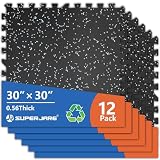
5. AIRHOP 0.56in Thick Exercise Equipment Mats — Best for beginners
The thickest 24-inch tile here, with a rubber top layer aimed squarely at protecting your floor from equipment.

Best for: someone worried about scratched floors under equipment Skip it if: portability matters more than protection
The AIRHOP set answers the exact worry a beginner voices first: will my equipment wreck the floor? It's built as a dual-layer tile, with a rubber top over a high-density EVA base, 12 tiles at 0.56 x 24 x 24 in covering 48 sq ft. AIRHOP says the rubber top is there to stop equipment scratching the floor during workouts, and that the larger interlocking teeth hold the tiles together during use.
At 29 lb for the set, this is by far the heaviest 48 sq ft option here, more than three times the BalanceFrom's weight. That mass is the rubber doing its job. It also means the tiles stay planted, which is the point.
This lands as the beginner pick because it removes the one anxiety foam can't: a rubber wear surface takes the scuffs foam would show. AIRHOP also claims the tiles minimize noise and vibration.
The trade-off is real. This is the second-priciest pick, and the 29 lb weight makes it the least portable full-coverage set. It's also a slower seller than the foam options. You pay in cost and mobility for the scratch protection.
Pros:
- Thickest 24-inch tile at 0.56 in
- Rubber top layer for scratch resistance
- Larger interlocking teeth claimed for secure fit
- Heavy 29 lb set stays planted
Cons:
- Second-most expensive pick here
- 29 lb makes it the least portable
- Slower seller than the foam sets
- No warranty stated
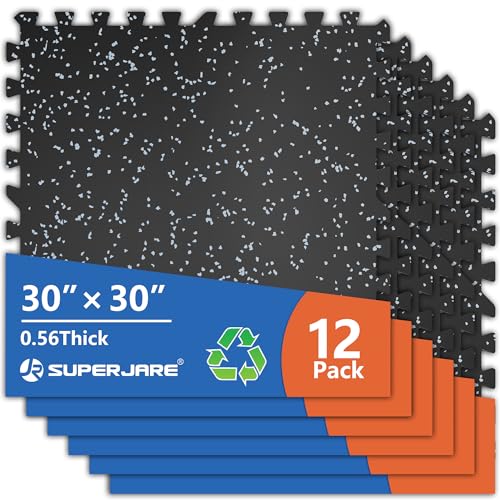
6. SUPERJARE 30" x 30" Larger Rubber Top Mats — Best premium
The biggest coverage in the set, 75 sq ft of rubber-top tiles for a larger dedicated training room.
Best for: a larger dedicated training room Skip it if: your budget is tight or your space is small
SUPERJARE is the most expensive pick here, and it earns the premium label on two numbers. First, coverage: 12 tiles at 0.56 x 29.5 x 29.5 in add up to 75 sq ft, the widest area in this set by a clear margin. Second, tile size: at roughly 30 inches square, each tile covers more ground, so fewer seams cross your floor.
Construction matches the beginner pick's logic. SUPERJARE says it's a dual-layer build with a rubber top over EVA foam, engineered for both high-impact and daily training. It also claims the rubber layer cuts impact and friction noise by 30 to 50 percent versus thinner mats, and that the surface is textured, anti-slip, and waterproof. Those are the maker's figures.
The bigger tiles and 0.56-inch thickness make this the pick when you're flooring a whole room, not a corner.
The trade-off is straightforward. This is the priciest option and the slowest seller of the six, and no warranty is listed. For a first small home gym, 75 sq ft is more floor than you need. This is a step-up buy for a genuinely larger space.
Pros:
- Widest coverage here at 75 sq ft
- Large 30-inch tiles mean fewer seams
- Rubber top for scratch and impact resistance
- Noise reduction claimed by the maker
Cons:
- Most expensive pick in this set
- Slowest seller of the six
- No warranty stated
- 75 sq ft overshoots a small home gym
Foam or rubber-top: which do you actually need?
This is where beginners overspend. The rubber-top tiles cost more and weigh more, and half the time you don't need what they add.
Here's the plain distinction. All six picks use EVA foam. The difference is whether a rubber wear layer sits on top.
- Plain foam (ProsourceFit, bemaxx, Haulcove, BalanceFrom): cushions joints, protects floors from static equipment, quieter and lighter.
- Rubber-top (AIRHOP, SUPERJARE): adds a scratch-resistant, harder-wearing surface for equipment contact and heavier impact.
If your training is bodyweight, yoga, stretching, and light dumbbells, foam does everything you need, and the ProsourceFit set is the right default. If you're setting equipment with hard feet or metal edges directly on the floor, the rubber top earns its cost by taking the scuffs.
One honest note: none of these listings state a weight rating for dropped loads. So if you plan to deadlift and drop, no tile here is verified for that, and you'd want a purpose-built rubber platform instead. For everything short of that, the foam-versus-rubber choice is really a scratch-protection choice.
How much floor do you actually need to cover?
Coverage is the second number to settle, and it's easy to get wrong in both directions.
The sets here split into two coverage tiers:
- 18 sq ft (bemaxx, Haulcove): a 6-by-3-foot strip, enough for a yoga mat's footprint plus a little room to move.
- 48 sq ft (ProsourceFit, BalanceFrom, AIRHOP): roughly 6-by-8-foot, enough for a bench, some free weights, and floor work.
- 75 sq ft (SUPERJARE): a full small room.
A rough way to size it: measure the space your equipment occupies, then add a body-length in every direction you'll move. For most first home gyms that lands around 48 sq ft, which is why three of the six picks target exactly that. The 18 sq ft sets suit a stretching corner or an apartment where floor is scarce. The 75 sq ft set is for a dedicated room. Buy for the space you have, not the gym you imagine in two years.
What the listings do not tell you
A few gaps are worth flagging before you buy, because the specs stay quiet on them.
- No drop-weight rating. None of these state a load rating for dropped weights. Treat all six as protection for static equipment and joint cushion, not as a lifting platform.
- Only one warranty. ProsourceFit is the single pick with a stated lifetime warranty. The rest list none, which matters if a tile fails early.
- Edge finish varies. ProsourceFit and BalanceFrom mention end borders for a clean perimeter. If a finished edge matters to you, that's a real point in their favour.
- Foam compresses. ProsourceFit says its foam may compress slightly under heavy objects, and that's true of every foam tile here, whether the listing admits it or not.
The best interlocking gym flooring for beginners handles the ordinary stuff well. Just don't expect any of it to survive abuse the listing never promised it could take.
The verdict
Sort this by price tier and the choice gets simple.
At the entry tier, the bemaxx set is the right buy for a small stretching or yoga corner. It's the cheapest here, its 18 small tiles shape around furniture, and at 0.4 in the cushion is fine for floor work. The Haulcove set sits one step up with its dual-texture claim if you want it.
In the middle tier, the ProsourceFit Exercise Puzzle Mat is the winner and the default I'd give most beginners. It clears the 0.5-inch general-purpose line, covers a full 48 sq ft with end borders, and it's the only pick carrying a stated lifetime warranty. BalanceFrom matches the thickness and coverage but drops the warranty, so it's the alternative when you want a double-sided non-slip surface for lateral work.
At the premium tier, the choice is about scratch protection and space. The AIRHOP set adds a rubber top at 0.56 in for someone anxious about floor damage. The SUPERJARE set scales that up to 75 sq ft for a dedicated room. Both cost more and weigh more, so buy them only when the rubber layer solves a real problem.
FAQ
Is interlocking gym flooring for beginners worth the cost?
Interlocking gym flooring for beginners is worth it if you train on hardwood, tile, or concrete. Foam tiles cushion knees and elbows and shield the floor from static equipment, and the cheapest set here covers a small corner for very little. The value case weakens only if you already train on carpet you don't mind marking.
Is the ProsourceFit set worth it over the cheaper bemaxx?
Whether the ProsourceFit set is worth the step up depends on your space. ProsourceFit gives you 48 sq ft at 0.5 in with a stated lifetime warranty; bemaxx gives 18 sq ft at 0.4 in for less money. If your gym is a stretching corner, save with bemaxx. For a full workout footprint with warranty backing, ProsourceFit earns the difference.
How thick should beginner gym flooring be?
Beginner gym flooring should be at least 0.5 in for general use. Below that, 0.4-inch tiles work as a comfort layer for yoga and stretching but feel thin under weighted work. The 0.56-inch rubber-top tiles add scratch resistance rather than more cushion, so cross the half-inch line first, then decide whether you need rubber on top.
AIRHOP or SUPERJARE for a rubber-top floor?
For a rubber-top floor, AIRHOP and SUPERJARE differ mainly in scale. AIRHOP covers 48 sq ft with 24-inch tiles and weighs 29 lb, sized for a standard home gym footprint. SUPERJARE covers 75 sq ft with 30-inch tiles for a full room, at the highest price here. Pick AIRHOP for a corner, SUPERJARE for a dedicated space.
What is the biggest mistake buying interlocking gym flooring?
The biggest mistake buying interlocking gym flooring is paying for rubber-top tiles you don't need. Rubber adds scratch resistance and weight, not comfort. If your training is bodyweight and light dumbbells, plain foam at 0.5 in does everything you need for less. Match the surface to your equipment, and don't overbuy coverage for a space you don't have.
Start by measuring your training space and deciding whether anything with hard feet or metal edges will sit on the floor. That single answer sorts foam from rubber-top faster than any spec sheet. For most first home gyms, the ProsourceFit set is the right default: it clears the half-inch line, covers a real workout footprint at 48 sq ft, and it's the only pick here that backs the purchase with a stated lifetime warranty. Buy the thickness first, size the coverage to the room you actually have, and add rubber only when scratched floors are a genuine risk.