Best Portable Interlocking Gym Flooring: Haulcove Wins

A ranked comparison of six interlocking foam and rubber-top gym floors, judged on tile size, thickness, coverage and how easily each one packs away.

By Lauren RossUpdated 16 min read
On this page
- Best portable interlocking gym flooring at a glance
- How I cut the field from forty listings to six
- 1. Haulcove 18 Pcs EVA Foam Floor Tiles — Best overall
- 2. ProsourceFit Exercise Puzzle Mat ½-inch — Best warranty
- 3. bemaxx Gym Mats Set — Best upgrade
- 4. Sorbus Interlocking Wood Grain Foam Floor Tiles — Best premium
- 5. CAP 24-Inch Interlocking EVA Foam Puzzle Mat — Best budget pick
- 6. AIRHOP 0.56in Thick 48 Sq Ft Exercise Equipment Mats — Best minimal setup
- What actually decides interlocking gym flooring
- Small tiles or large tiles: which packs away better?
- How thick does the foam really need to be?
- How portable is best portable interlocking gym flooring, really?
- What the listings do not tell you
- The verdict
- FAQ
The best portable interlocking gym flooring is the Haulcove 18 Pcs EVA Foam Floor Tiles, an 18-tile set of 12.6-inch squares that covers 18 sq ft and weighs 2.77 lb in total. If you want tiles you can carry in one hand and rebuild in a new spot each session, that combination is hard to match here. The ProsourceFit Exercise Puzzle Mat is the pick when the floor stays put and the limited lifetime warranty on manufacturer defects matters more than portability.
Best portable interlocking gym flooring at a glance
| Pick | Tile size | Coverage | Price |
|---|---|---|---|
Best overall Haulcove 18 Pcs EVA Foam Floor Tiles |
12.6 x 12.6 x 0.4 in | 18 sq ft (18 tiles) | Check Price |
Best warranty ProsourceFit Exercise Puzzle Mat ½-inch |
24 x 24 x 0.5 in | 48 sq ft (12 tiles) | Check Price |
Best upgrade bemaxx Gym Mats Set |
12.6 x 12.6 x 0.39 in | 18 sq ft (18 tiles) | Check Price |
Best premium Sorbus Interlocking Wood Grain Foam Floor Tiles |
Wood-grain finish | 36 tiles | Check Price |
Best budget pick CAP 24-Inch Interlocking EVA Foam Puzzle Mat |
24 x 24 x 0.47 in | 24 sq ft (6 tiles) | Check Price |
Best minimal setup AIRHOP 0.56in Thick 48 Sq Ft Exercise Equipment Mats |
24 x 24 x 0.56 in | 48 sq ft (12 tiles) | Check Price |



How I cut the field from forty listings to six
I started with a much longer shortlist and applied three cuts in order.
First cut: no genuine interlocking edge. Any listing that turned out to be a single rolled mat, a solid rectangle without puzzle teeth, or a set that used strips of tape rather than jigsaw connectors came out. The keyword promises tiles that lock together, so that is the floor for entry.
Second cut: no useful published tile dimension. A gym floor that will not tell you how thick or wide each tile is cannot be compared to one that does, and the buyer cannot judge whether it fits their space. Two candidates went here.
Third cut: too heavy or too fixed to call portable in any honest sense. A rubber-only tile at 40 lb per piece is a permanent installation, not something you rearrange. I kept AIRHOP as the heaviest option because a rubber top over foam is a real category, and heavy-lift buyers land in this search too.
What survived is six sets that all interlock, all publish real dimensions, and all sit on the portable side of the line, with one deliberate exception at the top of the weight range.
1. Haulcove 18 Pcs EVA Foam Floor Tiles — Best overall
Small tiles, light total weight and a dual-textured surface make Haulcove the easiest set in this group to move, rebuild and store.
Best for: renters who move a floor in and out for each session Skip it if: you drop heavy dumbbells or park a rack on top
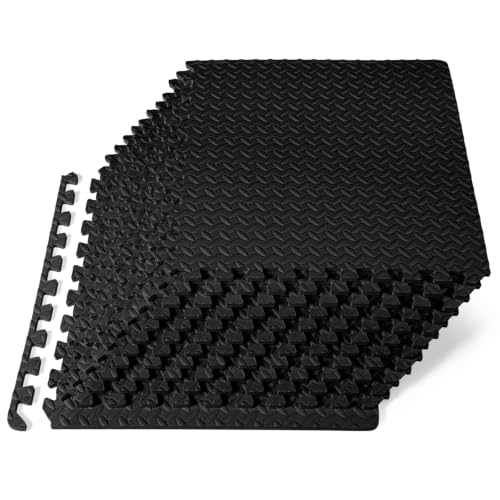
Portability in this category is decided by two numbers: tile footprint and total set weight. Haulcove pairs a 12.6 x 12.6 in tile with a 2.77 lb total for the 18-tile, 18 sq ft set. That is the lightest full set in this roundup, and the small footprint means each tile slides into a wardrobe, under a sofa, or into the back of a hatchback without any tile bending. Haulcove says the surface is dual-textured for barefoot or shoe use and that the foam is water-resistant for wipe-down cleaning after sweat or light spills. The 0.4-inch thickness is on the thin side of the set, which is the trade against Sorbus and AIRHOP: this is a floor for bodyweight training, yoga, Pilates, stretching and light dumbbell work, not for dropped plates. Against bemaxx, which uses tiles the same size and weighs a hair more, Haulcove is plain black rather than tri-colour, which is the deciding factor for anyone who wants the floor to disappear into a bedroom.
Pros:
- Lightest full set here at 2.77 lb total
- Compact 12.6 in tiles pack away easily
- Textured top and bottom for barefoot or shoes
- 18 sq ft covers a single training spot
- Water-resistant surface wipes clean
Cons:
- Thinnest tile in the set at 0.4 in
- No published warranty
- Only one seller lists it
- Not built for dropped weights
2. ProsourceFit Exercise Puzzle Mat ½-inch — Best warranty
A 48 sq ft, 24-inch-tile set backed by a limited lifetime warranty against manufacturer defects, which no other pick here matches.
Best for: a permanent home-gym corner where the manufacturer defect cover matters Skip it if: you want small tiles that pack into a closet
ProsourceFit is the pick when the floor is going down and staying down. The set gives you 12 tiles at 24 x 24 x 0.5 in, covering 48 sq ft, with end borders included for a finished edge. Weight is 9.3 lb for the full set, which is heavier than Haulcove's 2.77 lb but still one person can carry it. What sets this pick apart from every other listing here is the warranty text: ProSource states a limited lifetime warranty on manufacturer defects. CAP publishes 30 days, and the rest publish nothing. If a tile splits along a seam six months in, you have paperwork to lean on. ProSource says the foam is high-density, phthalate-free EVA, water-resistant and noise-reducing. The trade is portability. A 24-inch tile is roughly four times the area of Haulcove's 12.6-inch piece, so it is harder to stash flat, and the half-inch thickness makes each tile bulkier in a stack.
Pros:
- Limited lifetime warranty on manufacturer defects
- 48 sq ft coverage from 12 tiles
- End borders included for a finished edge
- Half-inch EVA thickness
- Phthalate-free foam per the listing
Cons:
- 24-inch tiles are bulkier to store
- Heaviest EVA-only set here at 9.3 lb
- Plain black only
- Not the cheapest way to reach 48 sq ft
3. bemaxx Gym Mats Set — Best upgrade
Same small-tile footprint as Haulcove, with a three-tone blue colourway that separates a workout zone from the rest of the room.

Best for: kids' play zones and shared spaces where colour matters Skip it if: you want a plain black gym look
bemaxx sits on almost identical dimensions to Haulcove: 12.6 x 12.6 in tiles, 0.39 in thick, 18 tiles for 18 sq ft, total weight 3.22 lb. The one meaningful difference is the finish. Where Haulcove is plain black, bemaxx is a cool-blue tri-tone that reads as a floor for a playroom or a corner of a bedroom rather than a garage. That matters more than it sounds, because a foam floor left down in a living space is judged on how it looks as much as how it works, and a black square is a hard sell to a partner. bemaxx describes the foam as compressed, non-toxic EVA with an anti-slip surface. The trade against Haulcove is a fractionally thinner tile (0.39 in against 0.4 in) and a slightly heavier total, both small enough to ignore. Against the 24-inch options, the trade is the same as Haulcove's: portability wins, thickness loses.
Pros:
- Tri-tone colourway suits shared rooms
- 12.6 in tiles pack into small gaps
- Anti-slip textured surface per the listing
- 18 sq ft covers a training corner
- Edge pieces included
Cons:
- Thinnest tile in the set alongside Haulcove
- No published warranty
- Heavier than Haulcove for the same coverage
- Not designed for heavy plates
4. Sorbus Interlocking Wood Grain Foam Floor Tiles — Best premium
A 36-tile wood-grain set that looks like flooring rather than gym kit, for a workout spot that shares a room with everyday life.

Best for: a living-room workout spot that has to look like flooring, not a mat Skip it if: you plan to reassemble the floor every week
Sorbus is the outlier in this set, and that is why it earns a place. Every other pick is a black or blue foam tile. Sorbus prints a pine wood-grain film onto the top layer so the assembled floor reads as timber from a couple of feet away. The set includes 36 tiles, which is the largest tile count here and the highest price position in this group. Sorbus says the tiles use a jigsaw connection with no adhesive, and describes the surface as a printed OPP plastic film over foam. The reason it sits under "portable" with a caveat is the practical use case: nobody rebuilds a 36-tile wood-effect floor twice a week. This is a set you lay down once, live with, and lift only when you move house. The trade is real. You lose the small-tile flexibility of Haulcove and bemaxx, and you accept the highest position in this price set. What you gain is a floor that stays down without an argument about how it looks.
Pros:
- Faux wood-grain finish blends into home rooms
- 36-tile set for larger areas
- Tool-free jigsaw connection
- Distinct look from every other pick here
Cons:
- Highest price position in this set
- No published tile thickness
- No published warranty
- Printed film top is less scuff-tolerant than plain EVA
5. CAP 24-Inch Interlocking EVA Foam Puzzle Mat — Best budget pick
Six 24-inch tiles for 24 sq ft at the lowest price position here, with a diamond-textured surface and a short published warranty.

Best for: a first garage floor covering six square metres cheaply Skip it if: you need a long warranty or a rubber top
CAP is the cheapest of the six and the fastest way onto interlocking flooring. You get six tiles at 24 x 24 x 0.47 in, covering 24 sq ft, with a diamond-textured top and finishing strips for a clean edge. Set weight is 4.5 lb, which sits comfortably between the small-tile foam sets and the heavier 48 sq ft options. CAP publishes a 30-day manufacturer warranty from the date of sale in original packaging, which is short next to ProsourceFit's lifetime cover but longer than the silence from Haulcove, bemaxx, Sorbus and AIRHOP. The listing has been on Amazon since 2017, which is longer than the rest of this set. The trade is coverage. If you need more than 24 sq ft you are buying two boxes, and at that point the 48 sq ft ProsourceFit set closes the gap. As a starter floor for a garage corner, spare bedroom or apartment training spot, this is the shortest route.
Pros:
- Lowest price position in this set
- Diamond-textured surface for grip
- Finishing strips included
- 30-day manufacturer warranty
- Longest-listed product here, since 2017
Cons:
- Only 24 sq ft per box
- Warranty is 30 days, not lifetime
- Only one seller lists it
- Foam-only construction, not rubber-topped
6. AIRHOP 0.56in Thick 48 Sq Ft Exercise Equipment Mats — Best minimal setup
A 0.56-inch rubber-topped tile that handles loaded barbell work no other pick here is built for, at the cost of real portability.

Best for: loaded barbell work over a foam-only floor Skip it if: you carry the floor up and down stairs
AIRHOP is the odd one out on purpose. It is the only pick in this set with a rubber top over EVA foam, and it is the thickest tile at 0.56 in. AIRHOP describes the top layer as recycled rubber laminated to a high-density foam base, with larger interlocking teeth designed to stay put under load. The set is 12 tiles at 24 x 24 in, covering 48 sq ft, and it weighs 29 lb, which is more than three times Haulcove's 2.77 lb. That is why it earns the "minimal setup" award: you lay this floor down once and leave it alone, because carrying 29 lb of tile up two flights of stairs every week is not a plan. If you are dropping dumbbells, using a bench with a loaded bar, or running a rowing machine that walks under load, the rubber top is the feature that separates this set from every foam-only pick. The trade against ProsourceFit is straightforward: heavier, thicker, higher price position, rubber surface, no published warranty.
Pros:
- Rubber-over-foam construction handles heavier equipment
- Thickest tile in the set at 0.56 in
- 48 sq ft coverage from 12 tiles
- Larger interlocking teeth per the listing
- Quieter under equipment per the manufacturer
Cons:
- 29 lb set weight is the heaviest here
- Premium price position
- No published warranty
- Too heavy to move for each session
What actually decides interlocking gym flooring
Most buying guides for interlocking gym flooring compare thickness first. Thickness matters, but it is not what decides this category for a portable use case. Tile footprint is.
A 12.6-inch tile and a 24-inch tile look similar on a listing page. In the room they behave differently. The small tile stacks four-to-a-slot in a wardrobe. The large tile leans against a wall and slides sideways every time the vacuum touches it. If you plan to lift the floor for company, take it to a friend's place, or stash it under a bed on non-training days, the smaller tile wins before thickness enters the conversation.
Thickness decides the second question: what the floor is for. Under 0.5 in and you are protecting the room from you, cushioning knees for yoga and stretching, damping the odd dropped dumbbell. At 0.5 in or a hair over, and especially with a rubber top, the floor starts protecting itself and the concrete under it from loaded equipment.
Everything else, warranty, colour, tile count, finish, is a tiebreaker between products that already passed those two tests.
Small tiles or large tiles: which packs away better?
Three of the six picks use 12.6-inch tiles (Haulcove, bemaxx) or a small-tile approach (Sorbus, sold as a 36-piece set), and three use 24-inch tiles (ProsourceFit, CAP, AIRHOP). The split is the single most useful decision point in this roundup.
Small tiles win on:
- Storage. A 12.6-inch tile fits inside most shelves and under most beds without bending.
- Speed of reconfiguration. You can shrink a floor from 18 sq ft to 9 sq ft in under a minute.
- Total set weight for a given coverage. Haulcove's 18 sq ft weighs 2.77 lb; ProsourceFit's 48 sq ft weighs 9.3 lb, which is heavier per square foot as well as in total.
Large tiles win on:
- Fewer seams to trip on or catch a plate against.
- Faster full-room installation, because six tiles cover what eighteen would.
- Perceived solidity underfoot, especially at 0.5 in and above.
If the floor comes up between sessions, buy small. If it stays down, buy large.
How thick does the foam really need to be?
Thickness in this set runs from bemaxx's 0.39 in to AIRHOP's 0.56 in. That is a narrower range than it looks, and it maps neatly to use case.
At 0.39 to 0.4 in (bemaxx, Haulcove) you have a floor for bodyweight training, mat work, kids playing, and light dumbbell work with the weights placed rather than dropped. The tiles feel firm underfoot with a little give, and they pack down small.
At 0.47 to 0.5 in (CAP, ProsourceFit) you have the standard home-gym thickness. It handles heavier dumbbells, a bench, a rower or a spin bike without the tile compressing badly under the corner load. This is the default choice if you do not know which side of the line you sit on.
At 0.56 in with a rubber top (AIRHOP) you have a floor for loaded barbell work, kettlebell swings and equipment that walks under load. Sorbus does not publish a thickness, which is the trade you accept for the wood-grain finish.
The mistake people make is buying 0.5-in foam and expecting it to survive dropped plates. It will not. If you drop weight, buy rubber-topped, and buy once.
How portable is best portable interlocking gym flooring, really?
Portable is a spectrum in this category, not a yes-or-no answer. Here is what "portable" actually means for each pick, measured on the two numbers that count.
- Haulcove: 2.77 lb, 12.6 in tiles. Genuinely portable. Move it every session if you want.
- bemaxx: 3.22 lb, 12.6 in tiles. Genuinely portable, same class as Haulcove.
- CAP: 4.5 lb, 24 in tiles. Portable, but the tiles are stiff and bulky in a stack of six.
- ProsourceFit: 9.3 lb, 24 in tiles. Portable in the sense that one person can carry the box. Not something you lift daily.
- Sorbus: no published weight, 36 tiles. Portable at purchase, semi-permanent in practice, because nobody wants to rebuild a wood-grain floor weekly.
- AIRHOP: 29 lb, 24 in tiles. Portable only in the sense that it is not glued down. This is a set-and-leave floor.
If the keyword "portable" is doing the work in your buying decision, the top two are Haulcove and bemaxx and the choice between them is colour.
What the listings do not tell you
A few things the product pages do not spell out, that matter in the room.
Interlocking foam tiles compress under point loads. Park a squat rack leg on one tile for six months and you will lift a permanent dent when you move it. This is not a defect. It is what EVA foam does. The fix is a hardwood puck under each rack foot, or a rubber-topped tile in that spot.
Seams open under lateral force. If you do burpees, lunges or side shuffles across the seams, the tiles will inch apart over a session. The fix is a border strip on all four sides, which ProsourceFit and CAP include and the small-tile sets typically do not.
Sunlight fades the top layer. Sorbus's printed wood-grain film is more vulnerable to this than plain black EVA. If the floor sits in a sunroom or a conservatory, factor that in.
Foam smell is normal for the first few days out of the box. The listings mostly note phthalate-free construction, which is a manufacturing choice, not a promise of no odour. Air the tiles out in a garage or a spare room for 48 hours before you use them indoors.
The verdict
The winner is the Haulcove 18 Pcs EVA Foam Floor Tiles. Small 12.6-inch tiles, 2.77 lb total for 18 sq ft, and a dual-textured surface make it the easiest set here to move, rebuild and put away. If your floor comes up between sessions and goes down again, this is the default answer.
Two conditions flip that. If the floor stays down and you want warranty cover in writing, the ProsourceFit Exercise Puzzle Mat is the better buy: 48 sq ft, half-inch tiles and a limited lifetime warranty on manufacturer defects, which no other pick here matches. If you drop weight or park heavy equipment on the tiles, the AIRHOP 0.56in Thick 48 Sq Ft Exercise Equipment Mats is the right choice, because the rubber top is the one feature that separates a lifting floor from a yoga floor in this set.
Everyone else has a lane. bemaxx swaps Haulcove's black for a tri-tone blue at a small weight penalty. CAP is the cheapest route to 24 sq ft. Sorbus is the pick when the floor has to look like flooring. But if you type the keyword and stop reading, Haulcove is the answer.
FAQ
Is portable interlocking gym flooring worth it over a single rolled mat?
Portable interlocking gym flooring is worth it when the shape of your training space changes. A rolled mat is one size forever. Tiles let you cover 9 sq ft on a Monday, 18 sq ft on a Saturday, and pack the extras away when the room is a bedroom again. The Haulcove and bemaxx sets both use 12.6-inch tiles that reconfigure in under a minute.
How thick should the tiles be for a home gym?
The tiles should be thick enough for the heaviest thing you do on them. For yoga, mat work and light dumbbells, 0.4 in is enough, as on Haulcove and bemaxx. For a bench, a rower or moderate dumbbells, 0.5 in is the standard, as on ProsourceFit and CAP at 0.47 in. For loaded barbell work, 0.56 in with a rubber top, as on AIRHOP, is the honest minimum.
Haulcove versus bemaxx: which one wins?
Haulcove versus bemaxx comes down to colour and a fractional weight difference. Both use 12.6-inch tiles and both cover 18 sq ft. Haulcove is 2.77 lb, plain black, 0.4 in thick. bemaxx is 3.22 lb, cool-blue tri-tone, 0.39 in thick. If the floor lives in a garage or a training room, Haulcove disappears. If it lives in a shared room with kids or a partner, bemaxx earns its keep.
Will interlocking foam tiles protect a hardwood floor from a squat rack?
Interlocking foam tiles will protect a hardwood floor from scuffs, dust and everyday scratches, but a loaded rack will still compress the foam under each foot over time. Under a rack, put a hardwood puck or a rubber-topped tile like AIRHOP's 0.56-in construction beneath the foot itself, and use the foam tiles around the rack. That combination protects the wood without leaving permanent dents in the foam.
What is the biggest mistake buyers make in this category?
The biggest mistake buyers make in this category is buying half-inch EVA foam and dropping weights on it. EVA is a cushion, not an impact surface. Dropped dumbbells tear the top layer and compress the core, and no warranty covers that. If you drop weight, buy rubber-topped tiles from the start. If you do not, half-inch foam like the ProsourceFit set is enough and costs less.
The right way to shop this category is to answer two questions in order: does the floor come up between sessions, and does anything heavy land on it. Answer yes to the first and the small-tile sets, Haulcove and bemaxx, are your shortlist. Answer yes to the second and AIRHOP's rubber-topped construction is the only pick built for it. Everyone in the middle, ProsourceFit, CAP and Sorbus, is choosing between coverage, warranty and finish. Start with Haulcove if you are not sure. It is the smallest commitment, the lightest set, and the easiest one to pack away if your training plans change.