Best Pull Up Bar for Men: Home Gym Picks

Doorway, wall or free-standing? Seven pull up bars compared on capacity, footprint and grip options, with a named winner and the conditions that flip the pick.

By Lauren RossUpdated 17 min read
On this page
- Best pull up bar for men at a glance
- How I narrowed seven listings down to a ranked set
- 1. ALLY PEAKS Thickened Steel Pipe — Best overall
- 2. Ally Peaks Adjustable Doorway Bar — Most versatile
- 3. Sportneer Pull Up Bar for Doorway — Best for beginners
- 4. Kipika Heavy Duty Wall Mounted — Best for heavy use
- 5. XMark Commercial Wall Mounted — Best premium
- 6. YYJO Foldable Free-Standing Power Tower — Best for families
- 7. Sportsroyals Power Tower — Best upgrade
- Doorway, wall-mount or free-standing: which suits your space?
- What weight capacity actually means on a pull up bar
- How many grip positions do you really need?
- What the listings do not tell you
- The verdict
- FAQ
The best pull up bar for men, taken across a mixed set of doorway, wall-mount and free-standing designs, is the ALLY PEAKS Thickened Steel Pipe doorway bar: a 4.03 lb frame rated to 440 lb that fits any standard 24 to 32 in doorway with no drilling. If you want a permanent install that clears the door frame and takes a rougher beating, the XMark Commercial Wall Mounted bar mounts across 48 in stud spacing and quotes an 850 lb capacity. Everything else in this guide sits between those two poles.
Best pull up bar for men at a glance
| Pick | Mount type | Rated capacity | Price |
|---|---|---|---|
Best overall ALLY PEAKS Thickened Steel Pipe |
Doorway, no-drill | 440 lb claim | Check Price |
Most versatile Ally Peaks Adjustable Doorway Bar |
Doorway, width-adjustable | 500 lb claim | Check Price |
Best for beginners Sportneer Pull Up Bar for Doorway |
Doorway, no-drill | 297 lb manual limit | Check Price |
Best for heavy use Kipika Wall Mounted Pull Up Bar |
Wall mount | Not listed | Check Price |
Best premium XMark Commercial Wall Mounted |
Wall mount, 48 in stud | 850 lb claim | Check Price |
Best for families YYJO Foldable Free-Standing Tower |
Free-standing, foldable | Not listed | Check Price |
Best upgrade Sportsroyals Power Tower |
Free-standing power tower | 360 lb claim | Check Price |


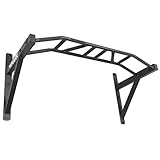


How I narrowed seven listings down to a ranked set
I built this list around one question: which pull up bar suits which space. That framed the ranking more than any single specification did.
The seven picks split cleanly into three mount types. Three are doorway bars that wedge or brace against a frame with no drilling. Two are wall-mounted bars that need studs and hardware. Two are free-standing power towers that need floor space and a ceiling above 82.68 in.
The criteria I weighted, in order:
- Rated capacity claim. For a pull up bar for men, the load number decides whether weighted work is safe.
- Mount type versus install effort. A renter cannot drill; a garage owner probably should.
- Grip options. Four or more grip positions expand the exercises meaningfully.
- Footprint. A 68.9 x 33.5 x 51.2 in tower is a piece of furniture; a 4.03 lb doorway bar is not.
- Manufacturer detail. More specifications usually signals a listing worth trusting; the XMark is unusual in publishing an 850 lb figure while giving a nonsense 0.28 g total weight.
One caveat on the keyword. Nothing in the specifications flags these as "for men" specifically. Pull up bars are unisex tools, and the sensible reading of the qualifier is "rated for heavier users doing weighted or high-volume work." That is what I optimised for.
1. ALLY PEAKS Thickened Steel Pipe — Best overall
The strongest all-round doorway pick: 1.7 mm steel, a 440 lb capacity claim and silicone door-frame contact, all inside a 4.03 lb frame.
Best for: renters who want a no-drill doorway bar rated to 440 lb. Skip it if: your door frame sits outside the 24 to 32 in range.
The reason this bar leads: it hits the balance the others miss. The frame measures 20.2 x 37 x 37 in and weighs 4.03 lb, which makes it the lightest bar in this set, yet Ally Peaks quotes a 440 lb load. That is the same headline capacity as the Sportneer, at a lower list position, and it clears the 360 lb the Sportsroyals tower quotes.
Ally Peaks says the tubing is 1.7 mm "thickened refined heavy steel" with a powder coating for corrosion resistance, and the door-frame contact is silicone rather than foam. Silicone lasts longer than foam and, in the listing's words, "better fits and protects door frame without marks." The bar fits 24 to 32 in doorways with a jamb depth of 4.7 to 8.27 in.
Its trade-off against the wall-mounted picks is honest: it is a leverage bar, so the door frame does the work. The 4.03 lb steel frame is a supporting player, not the anchor.
Pros:
- 440 lb capacity claim in a 4.03 lb frame
- Silicone contact instead of foam, per the listing
- Fits standard 24 to 32 in doorways
- No drilling, no permanent install
- Multi-grip layout for pull-ups, push-ups and dips
Cons:
- Door-frame integrity, not the bar, sets the real limit
- Depth range excludes very thin trims
- Only one seller lists it
2. Ally Peaks Adjustable Doorway Bar — Most versatile
The doorway bar to buy when the frame is oddly sized: five width levels and a 500 lb capacity claim in a 6.22 lb chrome steel body.

Best for: awkward or corner doorways that need width adjustment. Skip it if: you want a permanent mount you can leave up.
This is the same brand as the winner, but a different bar with different priorities. Ally Peaks says the width has five levels of adjustment and the depth has two, which is unusual in this set: every other doorway pick fixes to a single range. The result is a bar that fits corner doorways and non-standard frames the others reject outright.
The construction claim steps up too. The listing quotes 1.7 mm chrome steel with double-pipe superposition and a 500 lb capacity, which is the highest published figure among the three doorway picks. Frame dimensions are 11 x 42 x 42 in and the bar weighs 6.22 lb, so it is heavier and wider than the winner. Released in 2024 per the listing, which is the only pick here with a stated release year.
Its trade-off is price position and setup fiddle. It sits above the winner, and the adjustable levels are a small setup step every time you move it.
Pros:
- Five width levels for non-standard frames
- 500 lb capacity claim, highest of the doorway picks
- Double-pipe chrome steel construction, per Ally Peaks
- Silicone door-frame contact
- The only pick here with a listed release year
Cons:
- Heavier than the winner at 6.22 lb
- Adjustable joints add small setup steps
- Only one seller lists it
3. Sportneer Pull Up Bar for Doorway — Best for beginners
A no-drill doorway bar that publishes an unusually conservative rated limit: 297 lb per the manual, with a 2.5x safety factor to the destructive load.

Best for: lighter users who want a no-drill install with a conservative rated load. Skip it if: you weigh over 297 lb or plan weighted pull-ups.
Sportneer takes a different route on load ratings, and it is the reason this bar earns the beginner slot. The manual limit is 297 lb, though the listing says destructive testing reached 744 lb, a 2.5x safety factor. The two Ally Peaks bars publish 440 lb and 500 lb "hold up to" figures without that context. If you are new to the movement and want the tighter number, this is the pick.
The bar fits doorways from 29.5 to 37 in, which is a wider adjustment range than the winner's 24 to 32 in. The frame is 2 mm outer and 1.5 mm inner steel pipe, per Sportneer, with a 360-degree dual gear lock on each end and two 6.5 x 1.8 in PVC friction mats to stop slippage. Total weight is 5.18 lb.
Its trade-off is the load ceiling itself. A 200 lb male doing weighted pull-ups will run into the 297 lb figure fast.
Pros:
- Conservative 297 lb rated limit with published safety factor
- Wider 29.5 to 37 in fit range
- Dual gear lock system on each end
- PVC friction mats for stability
- Two sellers stock it
Cons:
- Rated cap sits below the doorway alternatives
- Not suited to weighted pull-ups
- Not compatible with frames under 29.5 in
4. Kipika Heavy Duty Wall Mounted — Best for heavy use
The wall-mount pick for a permanent install: a 38 in bar, 6 in of wall clearance and four grip positions on a triangular base plate.
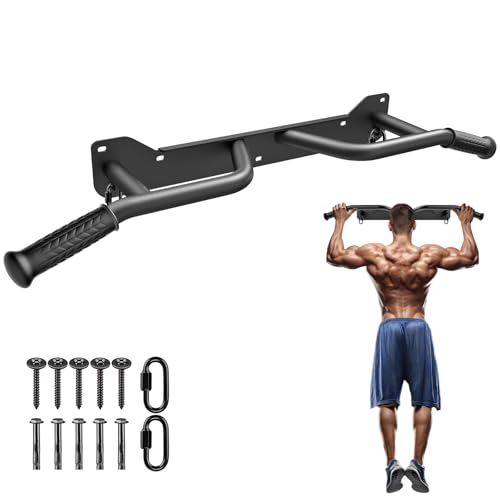
Best for: a permanent wall install with four grip positions. Skip it if: you cannot drill into studs.
Once you commit to drilling, the calculation changes. A wall-mounted bar puts the load on a stud, not a door jamb, and Kipika designs around that. The 9.8 lb frame is over twice the weight of the winner, dimensions run 4 x 39 x 39 in, and the listing describes a triangular base plate with a six-hole bolt pattern to distribute pressure evenly.
The grip layout is the standout. Four positions — wide, narrow, neutral and mixed — cover more of the pull-up variations than any doorway pick here. The bar sits 6 in off the wall, which is enough clearance for a full range of motion without your knees clipping the drywall on a knee raise.
Kipika does not publish a rated capacity, which is the real weakness. The other wall-mount option quotes 850 lb; this one says only "thickened heavy duty steel tube with strong welding." The trade-off against the XMark is fewer numbers on the spec sheet in exchange for a mid-range price position.
Pros:
- Four grip positions including neutral and mixed
- 6 in wall clearance for full-range work
- Triangular base plate with six-bolt pattern
- Heavier frame at 9.8 lb than any doorway pick
- All mounting hardware included, per Kipika
Cons:
- No published load capacity
- Requires drilling and stud access
- Only one seller lists it
5. XMark Commercial Wall Mounted — Best premium
A commercial-grade wall bar built for 48 in stud spacing: multi-grip, welded steel frame and an 850 lb capacity claim.

Best for: a garage gym mounted across studs at 48 in spacing. Skip it if: you need something portable.
XMark sits at the top of this set by a distance on published capacity. The listing quotes 850 lb when properly installed, which is 350 lb more than the strongest doorway pick and comfortably the highest number here. That figure sets it apart before you look at anything else.
Dimensions run 23.8 x 50.3 x 50.3 in, with the 48 in width intentionally chosen to align with standard 16 in stud spacing across three studs. The frame is one-piece welded steel with parallel and angled handles, plus knurled textured grips that the listing says give confident control during heavy sets. This is the only pick built around a specific stud pattern rather than a generic wall.
A caveat on the specifications. The listing shows a total weight of 0.28 g, which is not a real figure for a welded steel bar of this size, so treat that field as a listing error rather than product data. The trade-off is price position and install commitment: it is the most expensive pick here, and once it is on the wall, it is staying there.
Pros:
- 850 lb capacity claim, highest in this set
- 48 in width matches three-stud spacing
- Knurled grips per the listing
- Parallel and angled handles for grip variety
- One-piece welded steel frame
Cons:
- Most expensive pick here
- Requires accurate stud location
- Listing weight field is unreliable
6. YYJO Foldable Free-Standing Power Tower — Best for families
A free-standing tower with 11 height levels and a foldable base for storage between sessions.

Best for: shared households needing height adjustment and foldable storage. Skip it if: your ceiling is under seven feet.
For households where more than one person will use the bar, a fixed-height mount is a compromise. YYJO solves that with 11 height levels, adjustable from 68.9 to 82.68 in via a spinning knob. That range covers most adult heights while giving the tallest user a full hang without ceiling clearance issues, provided the room supports the top setting.
The frame footprint is 68.9 x 33.5 x 51.2 in when set up, and the triangular base folds for storage. YYJO says the interior width is 24 in, which is enough room to swing knees or legs on hanging raises without clipping the uprights. That interior figure matters more than headline dimensions for anyone tall.
The trade-off is what the listing does not publish. YYJO gives no total weight and no rated capacity, so you are trusting the design description rather than a number. Against the Sportsroyals tower, that gap is real: Sportsroyals quotes 360 lb and 47.2 lb frame weight; YYJO gives you neither.
Pros:
- 11 height levels from 68.9 to 82.68 in
- Foldable triangular base for storage
- 24 in interior width for leg work
- Free-standing, no drilling or door frame needed
- Covers multiple users of different heights
Cons:
- No published capacity or total weight
- Needs a ceiling above 82.68 in for the top setting
- Only one seller lists it
7. Sportsroyals Power Tower — Best upgrade
A 10-in-1 free-standing station with a 47.2 lb frame, eight height levels and a 2-year warranty.

Best for: a full 10-in-1 station with pull-ups, dips and vertical knee raises. Skip it if: you weigh close to the 360 lb rated cap.
If a doorway bar and a plain wall mount both feel like a step backwards, this is the upgrade. Sportsroyals describes the tower as a 10-in-1 station covering pull-ups, dips, inverted rowing, leg raises and push-ups, and it is the only pick in this set that publishes a written warranty. The listing states a 2-Year Warranty, which no other product here matches.
The build numbers back it. Frame weight is 47.2 lb, five times the Kipika wall bar and eleven times the winner. Dimensions run 83 x 44 x 38 in, height adjusts across eight levels from 57.09 to 83.07 in, and the rated capacity is 360 lb. There is a wider padded backrest for the vertical knee raise station, which the listing says distributes pressure more evenly than a thinner pad.
Trade-off against the other free-standing pick: it is heavier and less obviously foldable, so it stays where you put it. Against the wall mounts, it costs more floor space in exchange for zero drilling.
Pros:
- Only pick with a stated 2-year warranty
- 10 exercise stations in one frame
- 360 lb rated capacity
- Eight height levels from 57.09 to 83.07 in
- Padded backrest for knee-raise work
Cons:
- Large 83 x 44 x 38 in footprint
- 47.2 lb frame is not easily moved
- Rated capacity is lower than the doorway winners
Doorway, wall-mount or free-standing: which suits your space?
Mount type is the first fork in the road, and it decides more than any other spec. Get this wrong and no amount of grip variety saves the purchase.
Doorway bars are the right pick if you rent, if you move often or if you want the bar down between sessions. All three doorway picks here — the two Ally Peaks bars and the Sportneer — install and remove in under a minute. The frame does not carry the load on its own: it wedges against the jamb, so the door frame's integrity is the real ceiling. Old plaster frames or thin trims fail before the bar does.
Wall-mounted bars are the pick for a garage, a basement or a spare room where you own the walls. The Kipika bolts to a single wall section; the XMark spans 48 in across studs. Wall mounts remove the leverage limits of a doorway bar, hold heavier loads and clear the wall enough for kipping or knee raises. The cost is permanence: once it is up, it is up.
Free-standing towers are the pick when the walls are off-limits and the doorway is wrong. The YYJO folds; the Sportsroyals does not, really. Both need a floor footprint the size of a coffee table and a ceiling above seven feet for full extension.
- Renter, small apartment: doorway
- Garage owner, weighted pull-ups: wall mount
- Shared household, no wall access: free-standing
What weight capacity actually means on a pull up bar
Capacity claims on the best pull up bar for men are the most misread number on the spec sheet, so it is worth being clear on what the figures actually cover.
Ally Peaks quotes 440 lb and 500 lb "hold up to" figures. Sportneer takes a different route and publishes both a 297 lb manual limit and a 744 lb destructive-test result, framing the gap as a 2.5x safety factor. XMark quotes 850 lb when properly installed. Sportsroyals quotes 360 lb. Kipika and YYJO publish no rated capacity at all.
Two things to read from this. First, "hold up to" is a static load claim, not a dynamic one. Kipping, a hard drop off the bar, or a weighted vest with fast reps loads the frame at multiples of your bodyweight. A 440 lb static rating on a 200 lb user has less headroom than it looks. Second, on doorway bars the frame is only half the system: the jamb carries the leverage load, and no listing rates your door.
The pull up bar for men who plan weighted work is the wall-mounted or free-standing pick with the highest published number and the clearest install instructions. That is the XMark, followed by the Sportsroyals if you want zero drilling.
How many grip positions do you really need?
Grip variety is the feature buyers overpay for, and it deserves a plainer look. Every bar in this set offers at least a wide overhand and a neutral grip; the difference is what else you get.
The Kipika publishes the most grip positions of the wall picks: four, covering wide, narrow, neutral and mixed. The XMark adds parallel and angled handles with knurled texture. The doorway bars all offer a wide grip and inside neutral positions; the Ally Peaks winner adds the outside knurled sections for push-ups and dips when the bar sits on the floor.
For most users, three positions cover everything that matters:
- Wide overhand for lat width.
- Narrow underhand for biceps and chin-up work.
- Neutral parallel for shoulders and elbows that dislike the pronated position.
Anything beyond that is a nice-to-have, not a decider. If your elbows are healthy and your goal is straight strength, a two-grip doorway bar covers 90% of the training. If you have shoulder history and need the neutral grip, the Kipika or the XMark earn their extra cost.
What the listings do not tell you
Three things go unmentioned across every one of these listings, and they matter.
Ceiling and clearance: none of the doorway bars specifies how much room you need above the bar for a full hang. A 6-foot user needs at least 8 inches of dead-hang clearance above the bar height, which most 7-foot ceilings supply and most low basements do not.
Door frame construction: the ratings on doorway bars assume a solid wood or steel frame properly attached to the wall studs. Hollow-core interior frames in newer homes can fail under load, and the listings do not warn you. Test the frame by pressing hard on the trim before you commit.
Grip diameter: none of the seven listings publishes bar thickness. A thicker bar builds grip strength faster but is harder to hang on for long sets. If forearm training is a priority, expect to add a thick-grip sleeve rather than rely on any of these bars' bare tubing.
The verdict
Two picks handle 80% of the audience for the best pull up bar for men, and the pick depends on one question: can you drill?
If you cannot drill, the winner is the ALLY PEAKS Thickened Steel Pipe doorway bar. It fits 24 to 32 in frames, weighs 4.03 lb, uses silicone rather than foam against the door frame and claims 440 lb capacity. That combination beats every other doorway pick here: it is lighter than the adjustable Ally Peaks, has a higher rated cap than the Sportneer and sits at the lowest price position in this set. For a renter, someone who moves often or anyone with a shared household space, this is the default.
If you can drill and you want a permanent bar for weighted work, the XMark Commercial Wall Mounted bar is the pick instead. Its 850 lb capacity claim is the highest in this set by a comfortable margin, the 48 in width lines up with standard three-stud spacing, and the welded steel frame with knurled handles is built for volume. The cutoff between the two is simple: if your training will ever include a weight vest, added plates or kipping, buy the XMark. If it will not, buy the Ally Peaks winner and save the drilling.
FAQ
Is a doorway pull up bar strong enough for a heavy man?
A doorway pull up bar is strong enough for most men, but the door frame becomes the real limit before the bar does. The two Ally Peaks doorway bars here quote 440 lb and 500 lb capacities respectively. The frame those bars press against is rarely rated for anything, so a solid wood or steel jamb properly fixed to studs matters more than the headline number on the bar itself.
Should I get a doorway bar or wall-mounted pull up bar?
The choice between a doorway bar or wall-mounted pull up bar comes down to whether you can drill and whether you want the bar up permanently. Doorway bars remove in seconds and suit renters. Wall mounts hold more weight, clear the wall for kipping and knee raises, and stay put. If you plan weighted pull-ups or expect to train for years in one spot, the wall mount is the right investment.
How much clearance do I need above a pull up bar?
Clearance above a pull up bar needs to cover a full dead hang plus the top of your reach. Most six-foot users want at least eight inches of ceiling space above the bar height. The free-standing YYJO tower extends to 82.68 in, so a room needs a ceiling above seven feet to use its top height setting. Doorway bars hang lower and rarely have this problem.
Is the XMark better than the Kipika wall-mounted bar?
The XMark is better than the Kipika on published specifications, at a higher price position. XMark quotes 850 lb capacity and a 48 in width matched to three-stud spacing; Kipika publishes no rated capacity but offers four grip positions in a shorter 38 in bar with 6 in of wall clearance. If your walls have standard stud spacing and you want the strongest published rating, the XMark wins.
What is the biggest mistake buying a pull up bar?
The biggest mistake buying a pull up bar is picking on grip variety before mount type. Four grip positions do nothing if the bar does not fit your doorway or if your walls have no accessible studs. Decide mount type first based on your space, then pick the highest published capacity within that mount type, then look at grip options. Every doorway and wall type here handles the three grips most training needs.
The right pull up bar is the one that matches the room you actually train in, not the one with the longest spec list. For most readers here, that room has a doorway between 24 and 32 in wide, a solid frame and no drill in sight, and the ALLY PEAKS Thickened Steel Pipe covers it at the lowest price position in this set. Measure the frame, test the trim by pressing hard on it, and confirm the ceiling gives you eight inches of hang clearance. Then order the bar, mount it once, and start with three sets of whatever you can hold. The equipment stops being the interesting part after week two.