Best Quiet Large Yoga Mat for Home Practice
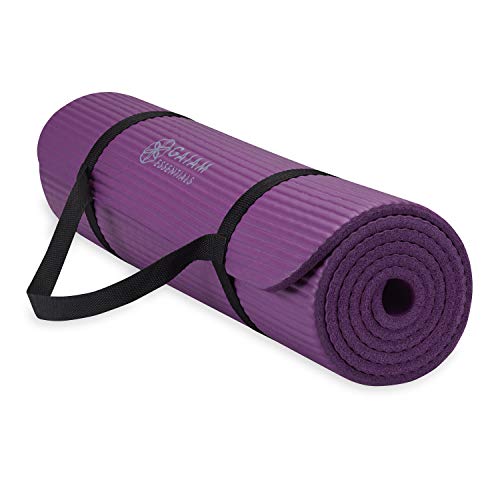
Six large mats compared on thickness, footprint and floor feel. One clear winner for hard floors, one for tall practitioners, and honest trade-offs for the rest.

By Lauren RossUpdated 17 min read
On this page
- Who this guide is not for
- Best quiet large yoga mat at a glance
- How I screened the six mats
- 1. Gaiam Essentials Thick Yoga Mat — Best overall
- 2. MRZZATA Extra Long & Wide Thick Yoga Mat — Best premium
- 3. Amazon Basics 1/2 Inch Extra Thick Exercise Yoga Mat — Best upgrade
- 4. Retrospec Solana 1" Extra Thick Yoga Mat — Best minimal setup
- 5. VTORY Large Yoga Mat — Most versatile
- 6. Gaiam Yoga Mat Classic Print — Best budget pick
- Is a thicker mat really quieter?
- Footprint: how much floor do you actually need?
- What the listings do not tell you about grip
- How to keep a thick foam mat lasting
- The verdict
- FAQ
The best quiet large yoga mat for most home practice is the Gaiam Essentials Thick Yoga Mat, a 72 by 24 inch NBR foam slab at 10mm that soaks up impact on hard floors better than any other standard-length pick here. If you need real length instead of thickness, the MRZZATA 84 by 32 inch TPE mat is the runner-up, adding 12 inches of length and 8 inches of width for tall practitioners.
Who this guide is not for
Two things worth saying before the picks. "Quiet" in a yoga mat is not a rated specification, and no product data supplied here carries a decibel figure. What thick foam actually does is absorb the tap and thud of a hand or knee hitting the floor, so a 10mm foam mat feels quieter to a downstairs neighbour than a 4mm one. Treat this as a physics inference, not a marketing promise.
The other point: "large" here means large enough for a full flow without hanging off the edges. If you want gym-flooring size for two people side by side, only one mat in this set clears 30 inches wide.
Skip this guide if you are chasing a studio-grade rubber mat with a stated grip rating, since none of these six publishes one. Skip it too if portability outranks cushion, because the thick mats in this comparison roll into fat cylinders that fight a backpack.
Best quiet large yoga mat at a glance
| Pick | Thickness | Footprint | Price |
|---|---|---|---|
Best overall Gaiam Essentials Thick Yoga Mat |
10mm (2/5 in) | 72 x 24 in | Check Price |
Best premium MRZZATA Extra Long & Wide Yoga Mat |
7mm (0.28 in) | 84 x 32 in | Check Price |
Best upgrade Amazon Basics 1/2 Inch Thick Yoga Mat |
12.7mm (1/2 in) | 73.2 x 24.3 in | Check Price |
Best minimal setup Retrospec Solana 1" Thick Yoga Mat |
1 in (25.4mm) | 72 x 24 in | Check Price |
Most versatile VTORY Large Yoga Mat |
6mm (0.25 in) | 72 x 58 in | Check Price |
Best budget pick Gaiam Yoga Mat Classic Print |
4mm | 68 x 24 in | Check Price |


How I screened the six mats
I compared the published specifications side by side, and cut the fluff to three things that decide a large yoga mat on a hard floor: thickness in millimetres, footprint in inches, and material. Colour, print, and included carry straps are trim, not deciders.
Two disqualifiers dropped candidates fast. A mat under 6mm was out for the quiet-on-hard-floors question, because there is no way for 4mm of foam to absorb what 10mm can. And a mat under 68 inches long was out for the "large" question, because a standard adult flow needs the full 72 inches or thereabouts to keep hands and feet on the mat.
The exceptions are deliberate. The 4mm Gaiam Classic Print stayed as the budget pick because its 68-inch length still covers the majority of adults for gentle stretching, and its low weight of 2.09 lb makes it the easiest to move room to room. The 6mm VTORY stayed because its 58-inch width is unmatched in this set, and width is the reason someone buys a mat like this in the first place.
1. Gaiam Essentials Thick Yoga Mat — Best overall
A 10mm NBR foam mat that hits the right point on the thickness curve for hard-floor practice at home.
Best for: home practice on hard floors where noise carries Skip it if: you need a mat wider than 24 inches
Inside this set of six, the Gaiam Essentials Thick Yoga Mat sits at the sweet spot: 10mm of high-density NBR foam on a standard 72 by 24 inch footprint, at just 2.05 lb. Only two picks are thicker, and both make compromises. The Amazon Basics is thicker at 1/2 inch (roughly 12.7mm) but adds noticeable heft. The Retrospec Solana is a full 1 inch thick and rolls into a fat cylinder that fights normal storage.
The best quiet large yoga mat argument leans on thickness, and 10mm is the point where a mat feels plush under knees without turning your standing balance work into a wobble. Gaiam says the surface is textured to reduce slipping on hard floors during dry workouts, which is fair to attribute rather than assert; on damp skin or in hot yoga, NBR foam is not the material to trust.
Against the others in this set, it gives up width to the VTORY and length to the MRZZATA. That is the trade-off you accept for the lightest thick mat here and the second-lowest price position among the six.
Pros:
- 10mm NBR foam, plush under knees and elbows
- Lightest thick mat here at 2.05 lb
- Standard 72 by 24 in footprint fits most homes
- Included cinch carrier strap for easy rolling
- Second-cheapest of the six
Cons:
- No stated grip rating, and NBR foam struggles when damp
- 24 inches wide is narrow next to the VTORY and MRZZATA
- Only one seller lists it, so availability can wobble
2. MRZZATA Extra Long & Wide Thick Yoga Mat — Best premium
The only mat here that clears 80 inches long and 30 inches wide, aimed squarely at tall practitioners.

Best for: tall practitioners who need the full 84-inch length Skip it if: you want the deepest cushion in this set
Where the Gaiam Essentials wins on cushion, this MRZZATA mat wins on footprint. 84 by 32 inches is 12 inches longer and 8 inches wider than the standard 72 by 24 template. For anyone over about six feet, that difference is the whole point of buying a large yoga mat: your hands and feet stay on the mat during a full downward dog to plank transition, and your knees are not floating over cold floor in child's pose.
The material is TPE at 7mm, and MRZZATA describes it as an upgrade over PVC with no latex or heavy metals. Attribute that as the listing's claim rather than a test result. TPE is grippier than NBR foam when damp, which matters if you sweat or drip water near the mat. At 2.5 lb, it is the heaviest of the six, though the difference is measured in ounces.
The trade-off against the winner is thickness. At 7mm, this mat sits a bit firmer than the 10mm Gaiam under your knees, and firmer still than the 1/2 inch Amazon Basics. On carpet that is fine; on hardwood, taller and heavier practitioners will feel it in a long kneeling sequence.
Pros:
- 84 by 32 in footprint, the largest here
- TPE material claim, no latex or PVC per the listing
- Double-sided non-slip surface per MRZZATA
- Included carry strap for a bulky roll
Cons:
- 7mm is firmer than the 10mm and 1/2 inch picks
- The most expensive pick here
- Heaviest of the six at 2.5 lb
- The slowest seller in this set aside from the VTORY
3. Amazon Basics 1/2 Inch Extra Thick Exercise Yoga Mat — Best upgrade
A 1/2 inch mat with a slightly longer 73.2 inch footprint that hits harder than the winner on pure cushion.

Best for: a slightly longer standard mat with real cushion Skip it if: you already own a 10mm mat and want more width
If the Gaiam Essentials at 10mm feels close but not quite enough under your knees, this is the natural next step. At 1/2 inch (roughly 12.7mm), it is the second-thickest pick in this set behind the 1-inch Retrospec Solana, and its 73.2 by 24.3 inch footprint adds a hair over the standard mat template without going full oversized.
Amazon Basics says the mat uses durable foam that springs back into shape and includes an elastic strap for over-the-shoulder carrying. As claims go, both are fair to attribute. What is verifiable from the specifications: 2.2 lb of mat, which is only 0.15 lb over the winner, for a genuine step up in thickness.
Against the six, it plays a specific role. It is not the widest, so the VTORY wins for shared workouts. It is not the longest, so the MRZZATA wins for tall users. It is not the thickest, so the Retrospec wins pure cushion. What it is: the mat you buy when the winner would be right in every way except you want a touch more padding, at a mid price position rather than a premium one. It is also the fastest seller here of the six, which suggests a lot of buyers reach the same conclusion.
Pros:
- 1/2 in thick, second-thickest in this set
- 73.2 by 24.3 in footprint, slightly longer than standard
- Elastic strap for over-the-shoulder carry
- Manufacturer says foam springs back into shape
Cons:
- No published warranty
- 24.3 in wide is still narrow next to the wide-format mats
- Slightly heavier than the winner at 2.2 lb
- Black only, if colour matters to you
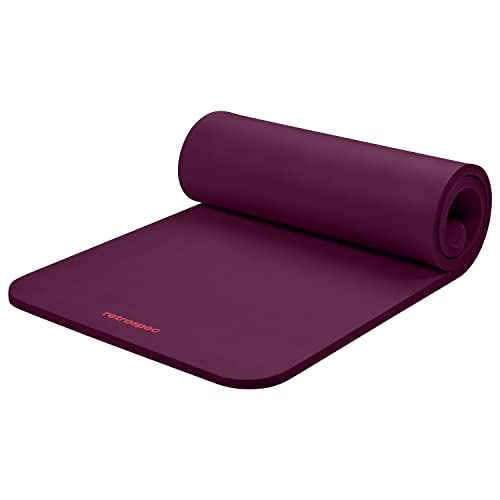
4. Retrospec Solana 1" Extra Thick Yoga Mat — Best minimal setup
A full 1-inch thick mat that turns almost any floor into a viable practice surface.
Best for: kneeling work and floor drills where cushion matters most Skip it if: you plan to travel with it or roll it tight
The Retrospec Solana is the outlier on thickness. At 1 inch, it is more than twice as thick as the winner and roughly double the Amazon Basics. That extra cushion is why the pick exists. If your practice leans heavily on kneeling, seated work, physical therapy or core drills on a hard floor, this is the mat that stops your bones complaining before your muscles do.
The trade-off is what a 1-inch foam slab does when you try to roll it. Even with the included strap, it becomes a fat cylinder that does not slide under a bed or into a slim closet. Retrospec says the material is BPA-free and free of phthalates, heavy metals and latex, and the listing notes it may release a mild odour that airs out over a day or two. Both are worth taking as listing claims rather than measured facts.
The footprint is a standard 72 by 24 inches, which is where this pick loses ground to the MRZZATA and the VTORY. If you are tall or wide in your reach, thickness alone will not save you from hanging off the edges. This mat is a specialist for the low-impact, ground-based session where you want the floor to feel a long way away.
Pros:
- 1 in thick, the deepest cushion in this set
- Standard 72 by 24 in footprint
- Included strap and easy-clean surface per Retrospec
- BPA-free, phthalate and latex-free claim
Cons:
- Rolls into a bulky cylinder that fights storage
- No stated warranty
- The second-most expensive pick here
- Firm standing balance work is harder on 1 inch of foam
5. VTORY Large Yoga Mat — Most versatile
A 72 by 58 inch mat that is really a small home-gym floor in a yoga mat shape.

Best for: shared workouts that need a wide footprint Skip it if: you want the plush foam feel of a 10mm mat
The VTORY plays a different game. At 72 by 58 inches, it is 34 inches wider than the winner, which puts two adults side by side or one adult with room for a kettlebell, a foam roller, and a full lateral reach. In this set of six, nothing else comes near for pure floor coverage.
Material is HPE at 6mm. VTORY says the mat has upgraded double-sided non-slip texture and delivers balanced shock absorption for knees, elbows and wrists during practice. Both are listing claims. The 6mm figure is the piece to weigh: it is thinner than the winner, thinner than the Amazon Basics, and much thinner than the Retrospec. That is the trade you make for the width.
The published data on this mat is thinner than most in this set, with no weight figure and no warranty listed. That is worth naming because it makes head-to-head cushion comparisons less exact. For someone doing bodyweight circuits, partner drills, or kids' floor play alongside a solo yoga session, the wide footprint outweighs the cushion gap. For someone who only ever does yoga on a hard floor, it does not.
Pros:
- 58 in wide, unmatched in this set
- Double-sided non-slip claim per VTORY
- HPE material, wear and tear resistant per listing
- 72 in long matches a standard mat
Cons:
- 6mm is thinner than four of the six picks
- No published weight in the listing
- No stated warranty
- The slowest seller of the six
6. Gaiam Yoga Mat Classic Print — Best budget pick
A light 4mm PVC mat for stretching, gentle flow and anyone who prioritises easy handling over cushion.
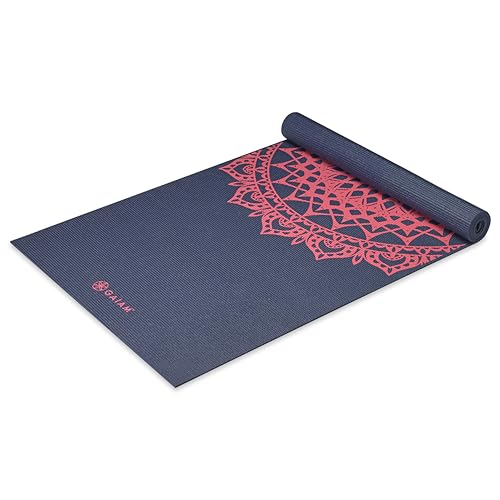
Best for: a light, standard-length mat for occasional stretching Skip it if: your floor is hard and you kneel a lot
The Gaiam Classic Print sits at the entry end of this set. It is the cheapest here, and its 4mm thickness on a 68 by 24 inch footprint is the closest thing in this comparison to a traditional studio-style mat. At 2.09 lb, it is barely heavier than the winner despite being less than half as thick, and it rolls into a slim cylinder that actually fits in a bag.
For gentle stretching, morning mobility, or a session on carpet, 4mm is enough. On a hard floor, with weight on your knees, it is not. That is why this is the budget pick and not a serious contender for the quiet-on-hard-floors question. Gaiam says the surface has a textured sticky finish and the PVC is free of DEHP, DBP, BBP, DINP, DIDP and DNOP. Both are worth attributing to the listing.
The 68-inch length is worth flagging. It is four inches shorter than the standard mats in this set, and 16 inches shorter than the MRZZATA. Taller users will find their heels sliding off in supine work. Everyone else gets a mat that is easy to store, easy to carry, and priced accordingly.
Pros:
- The cheapest of the six
- Rolls thin and stores easily
- Sticky non-slip PVC surface per Gaiam
- Non-toxic PVC claim, 6P-free per listing
Cons:
- 4mm is the thinnest here, not enough for hard-floor knee work
- 68 in length is shorter than every other pick
- No warranty in the listing
- Only one seller stocks it
Is a thicker mat really quieter?
Foam thickness is the closest thing to a quiet setting on a yoga mat. When your hand or knee lands on a hard floor, the sound comes from the impact energy going somewhere. A thick foam slab absorbs more of that energy inside itself, so less of it reaches the floor as vibration, and less of it reaches your downstairs neighbour as noise. None of the six listings here publishes a decibel figure, so nobody can put a number on it, but the physics is not controversial.
That said, the curve flattens. Going from 4mm to 10mm buys you a lot of hush. Going from 10mm to 1 inch buys you more cushion for your knees, but the extra quieting is smaller than the first jump. This is why the Gaiam Essentials wins overall rather than the Retrospec Solana: 10mm is the point where you have paid for most of the benefit without buying a mat you cannot roll into a closet.
Two other things matter that thickness will not fix. A mat that shifts on the floor makes squeaks and scrapes even when it is thick, so double-check that the underside texture is one you can trust. And any hollow floor, laminate over subfloor especially, will drum a little no matter what you put on it.
Footprint: how much floor do you actually need?
The word "large" hides three different questions. Length, width, and combined area. Here is how the six sort out on each.
- Length. Standard is 72 inches. Anything shorter, and taller practitioners will feel it. The MRZZATA leads at 84 inches. The Amazon Basics is a hair over at 73.2 inches. The Gaiam Essentials, VTORY and Retrospec Solana all sit at 72 inches. The Gaiam Classic Print is the odd one out at 68 inches.
- Width. Standard is 24 inches. The MRZZATA at 32 inches gives you shoulder room in a wide-legged pose. The VTORY at 58 inches gives you two adults side by side. Everyone else is at 24 inches or within a whisker.
- Combined footprint. VTORY covers the most floor by area, MRZZATA the most by usable length. The four standard-format mats cover roughly the same space and compete on thickness instead.
Match the shape to the practice. A tall solo practitioner needs length before width. A family, a couple, or a bodyweight circuit needs width before length. And a small apartment where the mat lives permanently unrolled needs both to be honest about the space.
What the listings do not tell you about grip
Grip is where marketing copy runs ahead of the data. Every one of these six listings claims some flavour of non-slip surface. None of them publishes a friction coefficient, a wet-grip test, or a rating you could compare across brands. That is normal for the category, and it is why generalisations matter more than promises.
- NBR foam (Gaiam Essentials) is soft and quiet, but its grip drops fast when damp. It is a hard-floor mat for dry practice.
- PVC (Gaiam Classic Print) has the traditional sticky feel most people associate with a studio mat, and it holds up in mildly damp conditions.
- TPE (MRZZATA) grips better when wet than NBR, and it is the material of choice if you sweat or if the room runs warm.
- HPE (VTORY) sits closer to a firm exercise-mat feel than a yoga-specific grip.
If you sweat heavily, or if you practise anything that raises your heart rate on the mat, the material matters more than the thickness figure. Fresh out of the packaging, most foam mats have a slight release film and can feel slippery for a session or two. Unroll the mat and let it air for a day before you judge the surface.
How to keep a thick foam mat lasting
A thick mat is a bigger investment in space than a thin one, and the wrong care habits show up as compression, tears, and a permanent curl. Three habits keep a foam mat useful.
- Wipe, do not soak. Every one of these listings, where care is mentioned, says wipe with a damp cloth or mild soap. Submerging a foam mat lets water in between the layers, and it does not come back out cleanly.
- Roll, do not fold. A fold in a thick mat creates a memory crease that never fully flattens. Roll from one short end and store standing up if you can.
- Rest it flat before use. A tightly rolled mat that has been in a closet for a week will curl at the corners for the first ten minutes of practice. Unroll it the night before, or roll it the opposite way for a minute to break the memory.
One extra note on the Retrospec Solana and the MRZZATA. Both are thick enough that a standard elastic mat strap struggles to hold them tight. Use the included strap and do not force the roll smaller than it wants to be.
The verdict
If you want a straight answer, buy the Gaiam Essentials Thick Yoga Mat. At 10mm on a standard 72 by 24 inch footprint and 2.05 lb, it hits the point on the thickness curve where hard-floor practice stops feeling punishing without turning your mat into an unmanageable slab. It is the second-cheapest of the six, and the argument for spending more on the Retrospec Solana's 1 inch or the Amazon Basics' 1/2 inch is a real one only if you kneel constantly and your floor is unforgiving.
Two flips are worth flagging. If you are over six feet tall, the MRZZATA at 84 by 32 inches is the better buy: at that height, no amount of foam thickness fixes hands and feet sliding off the edges of a 72-inch mat. And if two people practise in the same room at the same time, or if the mat doubles as a bodyweight training surface, the VTORY at 58 inches wide is the honest answer, thinner foam and all.
The cutoff is 72 inches of length and 10mm of thickness. Below either, you are compromising on something a large yoga mat is supposed to fix.
FAQ
Is a large yoga mat worth it over a standard one?
A large yoga mat is worth it when your practice already suffers from a standard one. If your hands slide off the top edge in downward dog, or your feet hang off the bottom in savasana, the extra length pays for itself in a week. If you fit comfortably on a 68 by 24 inch mat, the upgrade is a comfort, not a fix. Height and reach decide this, not budget.
Is the Gaiam Essentials really quiet on hard floors?
The Gaiam Essentials Thick Yoga Mat is not tested for noise, and no decibel figure is published. What is verifiable is 10mm of NBR foam on a 72 by 24 inch footprint at 2.05 lb, which absorbs impact better than any 4mm or 6mm mat here. On a hardwood or laminate floor, that translates to less thud from hands and knees, though a hollow subfloor will still transmit some vibration.
How does the MRZZATA compare with the Gaiam Essentials?
The MRZZATA compares favourably on footprint and less favourably on cushion. It gives you 84 by 32 inches of TPE at 7mm, versus 72 by 24 inches of NBR foam at 10mm on the Gaiam. For a tall practitioner, the 12 extra inches of length is the deciding figure. For a shorter one on a hard floor, the Gaiam's extra 3mm of foam is the better trade.
What thickness of yoga mat is best for knees?
What thickness of yoga mat is best for knees depends on your floor. On carpet, 4mm to 6mm is usually enough because the carpet does part of the cushioning. On hardwood, tile or concrete, 10mm is a sensible minimum, and 1/2 inch to 1 inch is where the Amazon Basics and Retrospec Solana come in. Any thicker and standing balance work becomes harder because the surface gives too much.
What is the biggest mistake people make buying a large yoga mat?
The biggest mistake is buying on thickness alone and ignoring footprint. A 1-inch thick mat that is still only 68 inches long does not solve the problem a tall practitioner is trying to solve. Match the mat to the actual issue: length for reach, width for shared use or bodyweight work, thickness for hard floors and knee comfort. Buying for all three at once means paying for space and cushion you may not use.
The right mat is the one that stops you thinking about the mat. Start with the Gaiam Essentials Thick Yoga Mat if a standard footprint suits you, because 10mm of NBR foam covers the quiet-on-hard-floors question at the lightest weight in this thick-mat set. If you have already decided that 24 inches wide is not enough, or that 72 inches long is not enough, jump straight to the MRZZATA or the VTORY without stopping at the middle picks. The middle of this set is where mats sit when a buyer has not yet decided what problem they are solving, and that indecision is what leaves a mat rolled up in a closet.