Best Commercial Grade Gym Mirror for Safe Home Setups

Five wall and floor gym mirrors compared on glass construction, panel size, weight and mounting hardware, with a named winner and the conditions that flip the pick to something else.

By Lauren RossUpdated 16 min read
On this page
- Best commercial grade gym mirror for seniors at a glance
- How I ranked these five, and what I weighted
- Does a gym mirror suit older exercisers?
- Laminated or tempered: which glass is safer?
- 1. AMOISE Home Gym Mirror for Wall — Best overall
- 2. Dulles Glass Shatter-Resistant Home Gym Mirror — Best for heavy use
- 3. brisafe 67"x55" Folding Mirror with Wheels — Best for beginners
- 4. Fab Glass and Mirror Large Gym Mirror 48x84 — Best premium
- 5. Delma Home Gym Mirror — Best budget pick
- How much wall do you actually need?
- What does mounting one of these involve?
- The verdict
- FAQ
The best commercial grade gym mirror for seniors is the AMOISE Home Gym Mirror for Wall, because it splits a 50" x 25" panel into three pieces so nobody has to lift a single 80 lb sheet of glass. If you want laminated glass instead of tempered, the Dulles Glass 48" x 72" panel is the better buy. Get this wrong and the failure mode is ugly: a heavy mirror mounted with adhesive alone, over a floor where somebody exercises barefoot.
Best commercial grade gym mirror for seniors at a glance
| Pick | Panel size | Glass construction | Price |
|---|---|---|---|
Best overall AMOISE Home Gym Mirror for Wall |
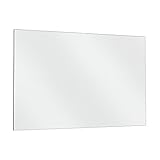
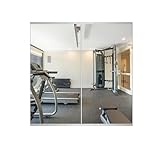
50" x 25", 3 panels | Float tempered, anti-spike film claim | Check Price |
Best for heavy use Dulles Glass Shatter-Resistant Home Gym Mirror |
72" x 48", 1 panel | Laminated, 1/8" + interlayer + 1/8" claim | Check Price |
Best for beginners brisafe 67"x55" Folding Mirror with Wheels |
67" x 55", 3-panel stand | Nano film, 0.04mm claim | Check Price |
Best premium Fab Glass and Mirror Large Gym Mirror 48x84 |
84" x 48", 1 panel | Tempered, low-iron claim | Check Price |
Best budget pick Delma Home Gym Mirror |
48" x 24", 2 panels | HD float glass, frosted edges | Check Price |


How I ranked these five, and what I weighted
I built the ranking on three criteria, weighted in this order.
- Glass construction and safety backing, weighted heaviest. A mirror on a gym wall sits above a floor where people drop weights and lose their balance. Laminated glass and safety-backed tempered glass behave very differently from a plain float panel when something hits them.
- Per-panel weight and panel count, weighted second. This is where the set separates sharply. One pick ships 84.3 lb in a single sheet. Another splits its surface across three pieces. That difference decides whether the job needs two people or one.
- Mounting hardware supplied, weighted third. Four of the five list a mount kit in the feature copy. Only one has no wall mount at all, because it rolls.
Why those three and not clarity or size? Because clarity claims are near-identical across the set. Four listings claim low-iron or HD distortion-free glass, so it stops being a differentiator. Size matters, but you can solve size by buying two panels. You cannot solve a 6mm laminated build by buying more of it.
What I cut from consideration: any mirror where the listing publishes no glass thickness or construction detail at all, and anything sold as a decorative wall mirror rather than for a gym, garage or studio wall.
Does a gym mirror suit older exercisers?
Here's the honest position. None of these five listings publishes a specification aimed at older exercisers, so no pick here can be claimed to satisfy that. The best commercial grade gym mirror for seniors is a judgment you make on the installation, not something a spec sheet answers.
What you can judge from the data:
- Per-panel weight. The AMOISE splits its surface into 3 pieces. The Delma splits into 2 at 42.3 lb total. Both mean lighter individual lifts than the 84.3 lb Fab Glass sheet.
- Glass build. The Dulles panel is laminated, meaning an interlayer holds fragments together. The brisafe uses a nano film surface rather than glass, at a claimed 9.38 lb for the whole stand.
- No drilling. The brisafe rolls on wheels. Nothing goes into a wall.
- Mount height. A wall panel can be hung low enough to give a seated reflection. A floor-standing mirror gives you one fixed height.
Sensible extra step: whatever you buy, have the mounting done by someone comfortable working overhead with glass. That is a labour question, not a product question, and no listing here can answer it for you.
Laminated or tempered: which glass is safer?
Most guides to the best commercial grade gym mirror for seniors compare surface area. That is not what decides it. Glass construction is, and the two dominant builds in this set behave in opposite ways.
Tempered glass is heat-treated. Fab Glass claims it runs up to four times stronger than regular glass. When it does fail, it crumbles into blunt fragments rather than shards. Three picks here are tempered or float glass with an added safety layer.
Laminated glass is two thinner sheets bonded around a plastic interlayer. Dulles describes its MiraSafe build as a 1/8" low-iron mirror plus a 0.030" DuPont Butacite interlayer plus 1/8" clear glass, and the listing states plainly that it is not tempered. The pitch is that fragments stay stuck to the interlayer instead of falling.
Film-backed float glass is the third route. AMOISE claims a shock-proof film and an anti-spike design. Delma frosts its panel edges, which is about handling during installation more than impact.
Which do you want? Over a floor where someone might fall against the wall, laminated has the stronger argument on paper. Over a garage wall behind a rack, a safety-filmed tempered panel is the usual choice, and it comes lighter.
1. AMOISE Home Gym Mirror for Wall — Best overall
Three separate 50" x 25" panels turn one unmanageable lift into three that most people can handle alone.
Best for: a home gym wall where each panel has to be light enough to lift alone Skip it if: you want one unbroken sheet with no seams
What separates the AMOISE within this set is the count: 3 panels at 50" x 25" each. Run them side by side and you get roughly 75 inches of width at 50 inches tall, which covers a squat or a full yoga flow. Run them vertically and you get a taller strip. The important part is that no single piece of glass in the box weighs anything like the 84.3 lb of the Fab Glass panel or the 72 lb of the Dulles.
AMOISE lists float tempered glass with a professional shock-proof film and describes the design as anti-spike. It also claims a solid aluminium frame along the top and bottom edges, which is unusual here since three of the five picks are fully frameless. The company says all mounting hardware is included and that no professional help is needed. Treat that as the manufacturer's position rather than a promise about your wall.
The trade-off is seams. Three panels means two visible joins across your reflection, and you will see them when checking hip alignment across the middle of the mirror. It also means three separate alignment jobs. The Dulles and Fab Glass panels give you one continuous surface, and if that matters more than lift weight, they win.
Pros:
- Splits into 3 panels, so no single heavy lift
- 50" x 25" per panel covers standing and floor work
- Aluminium frame top and bottom, unlike the frameless picks
- Second-cheapest of the five
- Mounting hardware listed as included
Cons:
- Two visible seams across the reflection
- Three separate alignment jobs during install
- No published weight figure for the set
- Only one seller lists it
2. Dulles Glass Shatter-Resistant Home Gym Mirror — Best for heavy use
The only laminated panel in this set, and the only one whose listing spells out the exact glass sandwich.
Best for: a busy studio wall that needs laminated rather than tempered glass Skip it if: you can't handle a 72 lb single panel
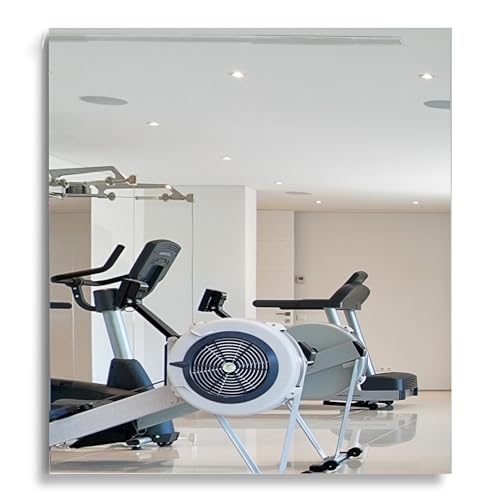
Dulles is the outlier on construction. Every other pick here leans on tempered or filmed glass. This one states it is not tempered, and argues that laminated is the higher safety standard. The published build is a 1/8" low-iron mirror, a 0.030" DuPont Butacite interlayer, and a 1/8" clear backing sheet, giving a 0.5" listed depth on a 72" x 48" panel.
That depth is why it weighs 72 lb. The kit listed includes chrome round mirror clips, mirror adhesive, and a j-bar with mounting screws, which is the most specific mounting description in the set. A j-bar carries the load along the bottom edge rather than trusting adhesive alone, and that is the detail I'd want on a heavy panel over a workout floor.
Clarity is claimed as low-iron with no green tint. The 72" height gives a genuine head-to-toe reflection for most adults standing a couple of feet back.
The cost is handling. This is a single 72 lb sheet of glass that needs two people and a clear path from the door to the wall. It's also the slowest seller of the five by a wide margin, so it's a considered purchase rather than a common one. And at a premium price position it asks for more than the AMOISE without giving you the option of lighter pieces.
Pros:
- Only laminated build in this set, with the layers published
- Most detailed mount kit: j-bar, clips and adhesive
- 72" x 48" gives full-length reflection in one sheet
- Low-iron glass claim, no green tint
Cons:
- 72 lb single panel, two-person install
- Premium price position with no lighter panel option
- Slowest seller of the five
- Only one seller lists it
3. brisafe 67"x55" Folding Mirror with Wheels — Best for beginners
Nothing gets drilled, nothing gets glued, and the whole thing claims to weigh 9.38 lb.
Best for: renters and anyone who can't drill into the wall Skip it if: you need a permanently fixed, dead-flat surface
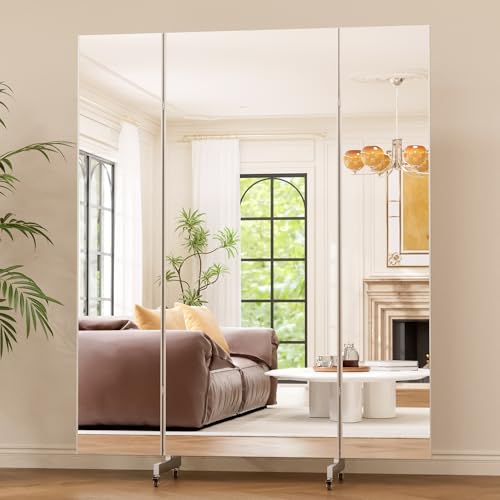
This is the only pick in the set that never touches your wall. It's a 3-panel folding stand at 67" x 55", rolling on castors that brisafe describes as silent and 360-degree. The claimed body weight is 9.38 lb, which the listing says allows single-hand movement between rooms. Compare that to 72 lb and 84.3 lb elsewhere and you can see why it belongs in a guide about handling.
The reflective surface is not glass. brisafe claims a patented 0.04mm flexible nano-layer and describes it as 100% shatterproof. That's a materials claim from the manufacturer, not a measured figure, and it's the reason the whole unit is light enough to roll.
For a first home gym, the appeal is obvious. You get a large reflection without committing a wall, you can angle the panels to see side-on form, and you can wheel it out of a shared living room when you're done. It's also mid-range for this set rather than premium.
Where it loses: a folding stand on wheels is never as flat or as steady as a bonded wall panel. Three hinged panels mean the reflection breaks at every joint, and the listing publishes no depth, footprint or panel-thickness figure at all, so you can't check whether it clears a doorway. brisafe also claims commercial-grade durability and a 60% insurance reduction, which is marketing copy with no specification behind it.
Pros:
- No drilling, no adhesive, no wall commitment
- 9.38 lb claimed, movable by one person
- Panels angle for side-on form checks
- Mid-range price position, not premium
Cons:
- Film surface, not glass, so scratch risk differs
- Reflection breaks at two hinges
- No published footprint or folded depth
- Wheels mean it can shift during use
4. Fab Glass and Mirror Large Gym Mirror 48x84 — Best premium
The tallest panel here at 84 inches, which is a genuine studio wall in one sheet.
Best for: a full 7-foot head-to-toe reflection on a load-bearing wall Skip it if: your ceiling is under 84 inches of clear wall
At 84" x 48" this is the largest single surface in the set, and it's the pick that most resembles what you see on a commercial studio wall. Seven feet of height means a tall adult sees head to toe with room to spare, and overhead press or jump work stays inside the frame. Fab Glass lists the weight at 84.3 lb with a 0 x 84 x 48 in dimension listing.
The glass is described as tempered, up to four times stronger than regular glass, with a protective safety backing that the company says minimises injury risk if broken. Composition is claimed as low-iron, copper-free and lead-free, which is the pitch against yellow tinting. The mount kit is listed as heavy-duty brackets, commercial-grade adhesive and full hardware. Fab Glass also notes it's a Certified B Corporation.
Two things hold it back. First, geometry: 84 inches of clear wall is more than a lot of basements and garages have once you allow for skirting and a ceiling line, so measure before you commit. Second, it's the most expensive pick here and it's a single 84.3 lb sheet, which is the hardest handling job in the set. The Dulles gives you laminated glass for less. This one gives you height.
Pros:
- 84" tall, the largest single surface here
- Tempered with safety backing, claimed 4x regular glass
- Low-iron, copper-free and lead-free glass claim
- Brackets, adhesive and hardware listed as included
Cons:
- 84.3 lb in one sheet, two-person install minimum
- Needs 84 inches of clear wall, which rules out many rooms
- Most expensive pick here, and still tempered rather than laminated
- Only one seller lists it
5. Delma Home Gym Mirror — Best budget pick
Two 48" x 24" tiles at 42.3 lb total, and the lowest price position in this set.

Best for: a narrow strip of wall in a garage or spare bedroom Skip it if: you want a frame or a warranty on paper
The Delma is the cheapest of the five and the fastest seller of the group by a wide margin, which tells you something about how many people are solving this problem on a modest budget. You get 2 panels, each listed at 47.6" x 23.8", for 42.3 lb across the pair. That's roughly half the weight of the Fab Glass sheet split across two pieces, so it's the second-lightest install job here after the rolling brisafe.
Construction is HD float glass with frosted edges, which Delma says makes handling more secure. The listing mentions suitability for tile, brick, wood and painted walls and points to a step-by-step install video. Panel thickness is listed as approximately 0, which is a data gap rather than a figure, so treat depth as unpublished.
Two narrow 24-inch panels side by side give you 48 inches of width, enough for standing work but tight for anything where your arms travel wide. That's the honest limitation.
Against the rest of the set, this is the pick with the least published detail. No frame, no stated warranty, no interlayer, no safety film claim. It's plain float glass with frosted edges at the lowest price position. That's a real trade against the AMOISE, which adds an aluminium frame and a shock-proof film claim for very little more.
Pros:
- Cheapest pick in this set
- 42.3 lb total split across 2 panels
- Frosted edges for safer handling
- Two sellers list it, unlike the rest
- Fastest seller of the five
Cons:
- Plain float glass, no laminate or safety film claim
- No frame and no published warranty
- Panel thickness listed as approximately 0, so unpublished
- 48 inches of combined width is narrow for wide-arm work
How much wall do you actually need?
Measure before you buy. That's the single most common mistake in this category, and it's the reason the biggest panel isn't automatically the right one.
Here's the practical arithmetic. For standing work, you want the top of the mirror above your eye line and the bottom low enough to show your feet from a few feet back. For floor work like yoga or stretching, the bottom edge matters far more than the top, so mounting low beats mounting tall.
- Under 50 inches of usable height: the AMOISE at 50" x 25" per panel, hung horizontally, or the Delma pair.
- 50 to 72 inches: the Dulles at 72" x 48" is the natural fit.
- Over 84 inches of clear wall: the Fab Glass panel earns its size.
- Can't drill at all: the brisafe rolling stand at 67" x 55".
Width is easier to solve than height. Two Delma tiles give 48 inches. Three AMOISE panels give roughly 75 inches. You can add width by adding panels. You cannot add height to a 50-inch panel.
What does mounting one of these involve?
Four of the five picks go on a wall, and the listings vary a lot in how much they tell you about that.
What the kits include. Dulles is the most specific: chrome mirror clips, adhesive, and a j-bar with screws. Fab Glass lists heavy-duty brackets, commercial-grade adhesive and hardware. AMOISE says all hardware is included. Delma points you to an install video and mentions tile, brick, wood and painted walls.
Why the j-bar detail matters. Adhesive alone on a heavy panel is trusting chemistry over gravity. A bottom rail or clip system carries actual load. If you're mounting anything in the 70 to 85 lb range, the mechanical fixing is not optional, whatever the adhesive claims.
What no listing here tells you. None publishes the wall types it's rated for, none states a stud spacing requirement, and none gives a load figure for the supplied fixings. That's a genuine gap in the data across all five. Drywall alone will not carry 84.3 lb of glass on adhesive.
If any of that reads as more project than you want, the brisafe skips it entirely by rolling on wheels.
The verdict
If you're weighing the best commercial grade gym mirror for seniors on handling and installation, the AMOISE Home Gym Mirror for Wall is the pick. Three 50" x 25" panels mean no single lift approaches the 72 lb and 84.3 lb sheets elsewhere in this set, it adds an aluminium frame top and bottom that the frameless picks don't have, and it sits at the second-cheapest price position here. You accept two seams across the reflection in exchange for a job one person can plausibly stage alone.
If you're weighing it on glass safety instead, the Dulles Glass panel is the answer. It's the only laminated build here, and the listing publishes the exact sandwich: 1/8" low-iron mirror, 0.030" DuPont Butacite interlayer, 1/8" clear backing. It also ships the most specific mount kit, including a j-bar that carries load mechanically rather than relying on adhesive. The price you pay is 72 lb in one piece.
The cutoff is per-panel weight against wall height. Below roughly 50 lb per piece, one competent person can manage the lift and the AMOISE or the Delma make sense. Above that, you need two people and a clear route to the wall, and at that point you may as well take the laminated glass or the 84-inch height. Can't drill? The brisafe rolls.
FAQ
Is a commercial grade gym mirror worth the money over a cheap wall mirror?
A commercial grade gym mirror is worth it mainly for the safety layer. The Dulles publishes a laminated build with a DuPont interlayer. Fab Glass claims tempered glass with safety backing. A decorative wall mirror has neither, and it hangs above a floor where people drop weights and lose balance. That backing is what you're paying for, not the reflection.
Which is better for a garage, the AMOISE or the Delma?
Comparing the AMOISE and the Delma for a garage, the AMOISE wins on coverage and build. Three 50" x 25" panels give roughly 75 inches of width against the Delma's 48, and AMOISE claims an aluminium frame plus a shock-proof film. The Delma is cheaper and lighter at 42.3 lb total. Choose it if wall space is narrow.
Do these mirrors work on drywall?
These mirrors work on drywall only with proper mechanical fixing. Delma lists tile, brick, wood and painted walls. Dulles ships a j-bar with screws. None of the five publishes a load rating for its supplied hardware, and none states a stud requirement. Adhesive alone will not hold 72 lb or 84.3 lb of glass on plasterboard. Find studs, or hire it out.
What size gym mirror do I need for yoga?
For yoga, the bottom edge matters more than the total size. You spend most of the session near the floor, so mount low rather than tall. The AMOISE at 50" x 25" hung horizontally works well. The 84-inch Fab Glass panel gives height you won't use on a mat, and it costs the most in this set.
Can you get a gym mirror without drilling into the wall?
You can get a gym mirror without drilling: the brisafe 67" x 55" folding stand rolls on 360-degree castors and never touches a wall. Claimed body weight is 9.38 lb, and the surface is a 0.04mm nano film rather than glass. It's the only pick here suited to a rental, though the reflection breaks at two hinges.
Start with a tape measure, not a shortlist. Note the clear wall height you actually have once skirting and ceiling line are accounted for, then decide whether one person or two will be lifting. Those two numbers eliminate most of this set before you compare anything else. For most home gyms the AMOISE is the sensible default, because three 50" x 25" panels solve the problem the other wall picks create: a single sheet of glass too heavy to position accurately. Getting a mirror flat and level matters as much as the glass inside it.