Best Gym Flooring by Tile Thickness and Density

Six interlocking tile sets compared on published thickness, weight and material, plus what to check before you commit 48 square feet of your garage to foam.

By Lauren RossUpdated 17 min read
On this page
- Best gym flooring for heavy people at a glance
- How I screened these six tile sets
- Why thickness matters more than tile size for heavy gym flooring
- Foam, rubber-top or TPE: which surface holds up?
- 1. AIRHOP 0.56in Thick 48 Sq Ft Exercise Equipment Mats — Best overall
- 2. SUPERJARE 1" Extra-Thick Rubber Top Exercise Mat — Best for pros
- 3. AIRHOP 0.79" Thick Gym Flooring for Home Gym — Best premium
- 4. Baselayer Performance Series Interlocking Floor Tiles — Best upgrade
- 5. Dalmbox 0.56" Thick Rubber Gym Floor Mats 12 Tiles 48 Sq — Best minimal setup
- 6. ProsourceFit Exercise Puzzle Mat ½-inch — Best budget pick
- How much floor do you actually need to cover?
- What the listings don't tell you about weight limits
- When a different pick wins
- The verdict
- FAQ
The best gym flooring for heavy people is the AIRHOP 0.56in Thick 48 Sq Ft Exercise Equipment Mats set, because it pairs a recycled-rubber top with a high-density EVA base across 12 tiles at 0.56 x 24 x 24 in. If you drop loaded barbells or train above a finished room, the SUPERJARE 1" Extra-Thick Rubber Top Exercise Mat doubles that thickness. Most buyers compare square footage first. Thickness and top-layer material are what actually decide whether a tile survives a rack leg.
Best gym flooring for heavy people at a glance
| Pick | Thickness | Top layer | Price |
|---|---|---|---|
| 0.56 in | Rubber over EVA foam | Check Price | |
Best for pros SUPERJARE 1" Extra-Thick Rubber Top Exercise Mat |
1 in | EPDM rubber over EVA claim | Check Price |
Best premium AIRHOP 0.79" Thick Gym Flooring for Home Gym |
0.79 in | Rubber over EVA foam | Check Price |
| 0.5 in | Injection-moulded TPE | Check Price | |
Best minimal setup Dalmbox 0.56" Thick Rubber Gym Floor Mats |
0.56 in | Rubber claim | Check Price |
Best budget pick ProsourceFit Exercise Puzzle Mat ½-inch |
0.5 in | EVA foam only | Check Price |


How I screened these six tile sets
I lined up the published specifications for every interlocking tile set in this group and compared them on four things only: thickness in inches, total coverage in square feet, shipping weight where the listing gives it, and the material named for the top surface. Everything else is marketing language.
Three figures did most of the sorting:
- Thickness. The range here runs from 0.5 in to 1 in. That is a doubling across six products, and it is the single biggest published difference between them.
- Weight per square foot. The AIRHOP 48 sq ft set weighs 29 lb. The ProsourceFit set covers the same 48 sq ft at 9.3 lb. Same footprint, roughly three times the mass. That gap tells you which one has rubber in it.
- Top-layer material. Rubber-topped, TPE and pure EVA foam are three different products wearing the same puzzle-tile shape.
What I did not screen on: any claim about supporting a specific body weight or load rating. None of these six listings publishes one. That matters, and I come back to it below.
Why thickness matters more than tile size for heavy gym flooring
Every set here uses 24 x 24 in tiles except the Baselayer, which uses 19 x 19 in. Tile size changes how many seams you get and how the layout fits your room. It does not change what happens when a 45 lb plate lands.
Thickness does. Here's the trick with tile flooring: the tile compresses under a point load, and once it has compressed to nothing, the load reaches your slab or your subfloor. A 0.5 in tile has half the material to give as a 1 in tile. Under a rack leg, under a treadmill foot, under your own heel during a heavy set, that difference is the whole product.
The gym flooring for heavy people question is really a point-load question. Body weight spreads across a wide contact area and is gentle on tiles. A 2 in rack foot carrying several hundred pounds is not. Neither is a dumbbell landing on edge.
So sort by thickness first:
- 0.5 in: bodyweight work, cardio, light dumbbells, floor protection from scuffs.
- 0.56 in: the same plus moderate free weights, especially with a rubber top.
- 0.79 in to 1 in: barbell work, kettlebells, racked equipment, shared walls and ceilings.
Foam, rubber-top or TPE: which surface holds up?
Three materials appear across these six picks, and they behave differently.
Pure EVA foam. The ProsourceFit set is EVA throughout. ProSource states the foam is high-density and phthalate-free, and the listing also concedes that foam "may compress slightly under heavy objects." That is an unusually honest line and it tells you exactly where the ceiling is.
Rubber over EVA. Both AIRHOP sets and the Dalmbox tiles use a rubber wear layer bonded to a foam base. AIRHOP calls it a dual-layer design and says the rubber is recycled. SUPERJARE names its top layer EPDM rubber over an EVA base. The logic is sound: rubber resists tearing and abrasion, foam absorbs shock.
TPE. Baselayer moulds its Performance Series from thermoplastic elastomer in one piece. The company says TPE gives the resilient feel of high-grade rubber with a no-slip texture and no odour, and it labels the tiles firmer in density. One-piece construction means no bond line to delaminate.
If your equipment scrapes and drags, prioritise the wear layer. If your neighbours matter more, prioritise thickness.
1. AIRHOP 0.56in Thick 48 Sq Ft Exercise Equipment Mats — Best overall
A rubber wear layer over dense foam at 0.56 in, and by far the fastest seller of the six, which makes it the safe default for the best gym flooring for heavy people.
Best for: a squat rack and dumbbells in a single-car garage bay
Skip it if: you need to cover more than 48 sq ft in one order
The 29 lb shipping weight is the number I keep coming back to. Twelve tiles covering 48 sq ft at 29 lb works out to roughly three times the mass of the ProsourceFit set over the identical footprint, and that mass is the rubber top layer AIRHOP describes. Dense material under a load point is what stops a rack foot punching through to concrete.
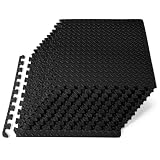
Each tile measures 0.56 x 24 x 24 in and the 12-piece set lays out as 8 x 6 ft. AIRHOP says the interlocking teeth were enlarged to stop tiles separating during use, which is the failure mode that ruins cheap puzzle flooring: you finish a set, look down, and the seams have crept apart. The finish is black and white rather than plain black, so seams and layout errors show more than they would on a uniform floor.
Against the others in this set, it gives up outright thickness to the SUPERJARE and the 0.79 in AIRHOP, and it covers less ground than the 144 sq ft option. It sits at a middle price position, which is exactly the trade-off: neither the cheapest nor the thickest.
Pros:
- 29 lb across 48 sq ft, the density you want under equipment
- Rubber wear layer bonded over high-density EVA base
- Enlarged interlocking teeth per AIRHOP's own description
- Fastest-selling pick of the six here
- Lays out as a clean 8 x 6 ft rectangle
Cons:
- Thinner than three other picks in this set
- No warranty published on the listing
- Two-tone black and white shows seams and dirt
- 48 sq ft caps out fast in a two-car garage
2. SUPERJARE 1" Extra-Thick Rubber Top Exercise Mat — Best for pros
At 1 x 24 x 24 in this is the thickest tile in the group, double the 0.5 in options, and the one to buy if barbells hit the floor.

Best for: barbell work in a room above living space
Skip it if: your rack has a low pull-up bar and 1 in of tile matters
One inch is the headline and it earns the award. SUPERJARE builds this on a high-density EVA foam base with an EPDM rubber top, and EPDM is the same family of rubber used in commercial gym flooring. The company frames the pitch around noise: lift heavy, drop confidently, no complaints from downstairs. That is a claim rather than a measurement, but the physics of a thicker compliant layer under an impact is not controversial.
Twelve tiles cover 48 sq ft, the same footprint as the AIRHOP winner and the ProsourceFit budget set, in a black and grey finish. SUPERJARE describes the surface as matte and non-slip, aimed at squats and deadlifts where a foot sliding mid-rep is the actual hazard.
The cost of that inch is height. Raising your platform by 1 in changes your pull-up bar clearance, your bench height relative to a rack's J-hooks, and the door swing in a tight garage. It also lands mid-range on price with no published shipping weight and no stated warranty, so you get less specification detail than the ProsourceFit set costs less to buy.
Pros:
- 1 in thick, the deepest cushion of all six picks
- EPDM rubber top over high-density EVA base
- Matte non-slip surface aimed at heavy squats and pulls
- Covers 48 sq ft from 12 interlocking tiles
Cons:
- 1 in of added height affects rack and door clearance
- No shipping weight published, so density is hard to judge
- No stated warranty
- Only one seller lists it
3. AIRHOP 0.79" Thick Gym Flooring for Home Gym — Best premium
Thirty-six tiles at 0.79 in covering 144 sq ft, which is a whole room rather than a corner.

Best for: a full 12 x 12 ft dedicated gym room
Skip it if: you're covering a small corner and don't want 101.9 lb of tile
This is the same dual-layer construction as the winner, scaled up in both directions. Each tile is 0.79 x 24 x 24 in, so you gain almost a quarter inch of depth, and the pack contains 36 tiles for 144 sq ft laid out as 12 x 12 ft. Three times the coverage of every other pick here except the Baselayer, which covers 30 sq ft.
The 101.9 lb total weight is worth sitting with. Divided across 144 sq ft it comes to a similar density to the 29 lb over 48 sq ft winner, which is a good sign: AIRHOP scaled the product, not just the box. It also means a delivery you will want help moving, and 36 tiles to lay rather than 12.
Buying coverage in one order is the real argument here. Mixing two smaller packs bought months apart risks slight colour or texture variation between production runs, and interlocking teeth from different sets rarely mate cleanly.
It carries the highest price position of the six. Against the SUPERJARE it gives up 0.21 in of thickness, so if your room is small and your barbell is heavy, the thicker tile is the better spend. This one wins on area.
Pros:
- 144 sq ft from a single pack, a 12 x 12 ft room
- 0.79 in thick, third-deepest here
- 101.9 lb total, dense for the area covered
- Same rubber-over-EVA build as the top pick
Cons:
- Most expensive pick in this set
- 101.9 lb shipment is awkward to handle alone
- Thinner than the 1 in SUPERJARE option
- 36 tiles means a longer install and more seams
4. Baselayer Performance Series Interlocking Floor Tiles — Best upgrade
The only one-piece TPE tile here, with cord channels moulded into the underside and a firmer feel than the foam-cored options.

Best for: a firmer, odour-free surface with cord channels underneath
Skip it if: you want a finished edge included in the box
Baselayer takes a different route. Instead of bonding rubber to foam, it injection-moulds the whole tile from TPE, and the listing is emphatic that this is rubber-like and not foam, with no odour. Anyone who has opened a box of cheap gym tiles and had to air out a garage for a week will understand why that sentence is on the listing.
The dimensions are the outlier: 19 x 19 x 0.5 in tiles, 12 of them, covering 30 sq ft. That is the smallest coverage in this group and the smallest tile. Baselayer calls the density firmer and positions it for heavy weights and high-impact training, and a firmer surface is genuinely better under a rack, since a squishy tile lets equipment rock.
The cord channels under the tiles are a detail nobody else here offers. If you're running a treadmill, a fan and a sound system in a garage, routing cables under the floor removes a real trip hazard.
Two catches. Edges and corners are sold separately, so a finished perimeter costs extra. And at 0.5 in it ties the ProsourceFit for thinnest here while sitting at a premium price position.
Pros:
- One-piece injection-moulded TPE, no layers to delaminate
- Firmer density stated for heavy weights and impact
- Cord channels underneath keep cables off the floor
- No-odour and no-slip texture per Baselayer
- Made in USA per the listing
Cons:
- Only 30 sq ft, the least coverage of the six
- Edges and corners not included
- 0.5 in ties for thinnest here despite premium pricing
- No published weight or warranty figures
5. Dalmbox 0.56" Thick Rubber Gym Floor Mats 12 Tiles 48 Sq — Best minimal setup
Same 0.56 in thickness and 48 sq ft coverage as the winner, at the second-cheapest price position in this set.

Best for: a temporary or rented space you'll disassemble later
Skip it if: you want published weight and warranty figures before buying
On paper this shadows the AIRHOP winner closely. Twelve tiles, 24 x 24 in each, 0.56 in thick, 48 sq ft total, plain black. Dalmbox describes dense shock-absorbing rubber with a textured non-slip surface, and says the tiles resist tearing and cracking under heavy weights and repetitive use.
The plain black finish is a quiet advantage over the two-tone AIRHOP sets. Uniform colour hides dust, chalk and rubber scuffs, and it means you can add a tile later without a visible patch.
Where it falls short is the specification sheet, not the product. There is no published weight, which is the one figure that separates a genuinely rubber-topped tile from a foam tile with a rubber print. The winner's 29 lb tells you what's inside. Here you're taking the material description on trust.
It's also the only pick with a single seller listing it, and it moves slowly compared with the AIRHOP winner and the ProsourceFit budget set. If you're kitting out a rental and expect to pull the floor up in a year, the low price position and the easy-detach interlock make sense. For a permanent install where you want documented density, the winner earns its extra outlay.
Pros:
- 0.56 in thickness matches the overall winner
- 48 sq ft from 12 tiles, second-cheapest here
- Plain black hides chalk, dust and scuffs
- Non-porous surface stated to resist sweat and odour
Cons:
- No published weight, so density is unverifiable
- No stated warranty
- Only one seller lists it
- Slow seller compared with the AIRHOP and ProsourceFit sets
6. ProsourceFit Exercise Puzzle Mat ½-inch — Best budget pick
The cheapest of the six and the only one with a published warranty, but at 9.3 lb per 48 sq ft it is foam and it behaves like foam.
Best for: bodyweight training, cardio and light dumbbells
Skip it if: you drop loaded barbells or park a heavy rack on it
Two facts define this pick. First, it's the cheapest here and it sells faster than every option except nothing, moving quickly in its category. Second, at 9.3 lb across 48 sq ft it weighs less than a third of the AIRHOP winner over the same area. That's high-density EVA foam with no rubber wear layer, and the difference shows up the first time something heavy sits still on it.
ProSource is upfront about the limit: the listing states foam may compress slightly under heavy objects. Believe that. Rack feet and bench legs will leave dents, and dents under a rack become instability.
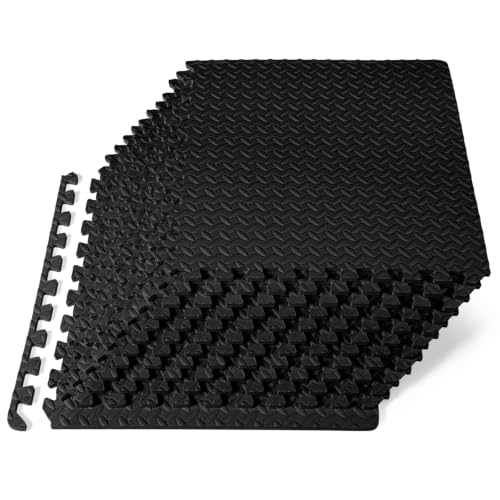
What you do get is the only warranty in this group, a limited lifetime warranty against manufacturer defects. End borders come in the box, which the Baselayer charges extra for. Tiles are 0.5 x 24 x 24 in, phthalate-free, water-resistant and easy to lift for storage.
Read the modifier honestly. Nothing here publishes a load rating, and a 0.5 in foam tile is the least suited in this set to concentrated heavy loads. For a treadmill room, a stretching area or a kids' play zone that doubles as a workout space, it's the sensible buy. For deadlifts, it isn't.
Pros:
- Cheapest pick of the six
- Only listing here with a published warranty
- End borders included for a finished perimeter
- 9.3 lb total makes it easy to lift and store
- Phthalate-free, water-resistant EVA
Cons:
- Foam only, with no rubber wear layer
- Listing itself warns foam may compress under heavy objects
- 0.5 in ties for thinnest in this group
- Poorest choice here for dropped barbells or racked weight
How much floor do you actually need to cover?
Buyers routinely underbuy, then order a second pack and discover the tiles don't match. Measure before you shop.
The coverage figures across this set:
- 30 sq ft — Baselayer, 12 tiles at 19 x 19 in
- 48 sq ft — AIRHOP 0.56 in, Dalmbox, SUPERJARE and ProsourceFit, all 12 tiles at 24 x 24 in
- 144 sq ft — AIRHOP 0.79 in, 36 tiles at 24 x 24 in
A 48 sq ft set lays out as 8 x 6 ft. That's enough for a rack plus a lifting zone, roughly the footprint of a single garage bay's worth of usable space. It is not enough for a rack, a bench, a treadmill and a walking path.
Two practical points. Rack and bench footprints need tile under every foot, not just under the middle. And a 24 in tile only cuts cleanly on its own grid, so an odd room dimension leaves a gap you'll want to trim with a utility knife and a straight edge.
What the listings don't tell you about weight limits
Here's the honest part. Not one of these six listings publishes a load rating, a compressive strength figure, a durometer reading or a stated maximum user weight. That's normal for consumer puzzle tiles and it's also the gap that makes shopping for gym flooring for heavy people frustrating.
What that means in practice: nobody can promise you a specific tile supports a specific body weight or a specific barbell drop, and any article that does is inventing the number. What you can do is use the figures the listings do give as proxies.
- Weight per square foot. Published for three of the six. Higher means more material, which usually means rubber.
- Stated thickness. Published for all six. Ranges from 0.5 in to 1 in here.
- Named top material. EPDM rubber, recycled rubber, TPE and EVA are four different answers.
- Construction type. One-piece moulding versus a bonded two-layer tile.
Most shoppers miss that body weight is rarely the problem. Standing on a foam tile at any weight is fine. The tile fails at the rack foot, the dumbbell edge and the bench leg. Solve for point loads and the body weight question answers itself.
When a different pick wins
Three concrete conditions flip my recommendation away from the AIRHOP winner.
You lift above someone else's ceiling. Take the SUPERJARE at 1 x 24 x 24 in. Nearly double the depth of the 0.5 in options, with an EPDM rubber top that SUPERJARE pitches specifically at impact noise. In an apartment or a bonus room over a bedroom, that half inch is worth more than anything else on this page.
Your room is bigger than 8 x 6 ft. The AIRHOP 0.79 in set covers 144 sq ft in one order, 36 tiles at 101.9 lb. Buying coverage in a single production run avoids mismatched tiles later.
Nothing heavier than a dumbbell touches the floor. The ProsourceFit set is the cheapest pick here, includes end borders, and is the only one with a stated warranty. For cardio, yoga and light weights, spending more on rubber buys you nothing you'll notice.
One more: if odour is a deal-breaker, the Baselayer TPE tiles are the only ones whose listing specifically claims no odour, and the cord channels are a genuine bonus in a cable-heavy garage.
The verdict
Sort this by price tier and the answer is clean.
At the entry tier, the ProsourceFit Exercise Puzzle Mat is the cheapest of the six, covers 48 sq ft, includes end borders and carries the only published warranty here. It's 0.5 in of EVA foam with no rubber layer, and the listing itself warns about compression under heavy objects, so it belongs under cardio and bodyweight work rather than under a loaded rack. The Dalmbox tiles sit just above it and add 0.56 in of stated rubber for a small step up, though without a published weight you're trusting the description.
The middle tier is where I'd spend. The AIRHOP 0.56in set is the best gym flooring for heavy people because 29 lb across 48 sq ft is real density you can verify from the listing, and the rubber-over-EVA build handles equipment feet that foam won't. The SUPERJARE sits alongside it and wins outright on depth at 1 in, which is the pick if barbells hit the floor or neighbours share a wall.
At the premium tier, the AIRHOP 0.79 in set buys area rather than thickness: 144 sq ft in one order at 101.9 lb. Baselayer buys a firmer one-piece TPE tile with cord channels, but only 30 sq ft of it, and edges cost extra.
FAQ
Is thicker gym flooring for heavy people worth the extra cost?
Thicker gym flooring is worth it when concentrated loads are involved. The SUPERJARE at 1 in gives double the compliant material of the 0.5 in options, which is what stands between a rack foot and your slab. For yoga, stretching and treadmill use, the extra depth changes nothing you'd feel, and the cheaper 0.5 in ProsourceFit tiles do the job.
What's the cheapest way to floor a home gym properly?
The cheapest way to floor a home gym properly is to buy foam tiles for the general area and reserve thicker rubber-topped tiles for the lifting zone only. The ProsourceFit set is the cheapest of these six across 48 sq ft. Put the AIRHOP 0.56 in tiles under your rack and platform, where 29 lb of density actually matters.
AIRHOP 0.56 in or SUPERJARE 1 in: which should I choose?
Choosing between AIRHOP and SUPERJARE comes down to what hits the floor. The AIRHOP 0.56 in set is denser per published figure at 29 lb over 48 sq ft and sells far faster. The SUPERJARE doubles thickness to 1 in with an EPDM rubber top. Drop barbells or live above someone, take the SUPERJARE. Otherwise the AIRHOP.
Will 48 square feet cover my garage gym?
Forty-eight square feet covers an 8 x 6 ft rectangle, which fits a rack plus a small lifting zone. It won't cover a rack, bench, treadmill and walkway together. Four of these picks land at 48 sq ft. The AIRHOP 0.79 in set covers 144 sq ft in one order, laid out as 12 x 12 ft across 36 tiles.
Do these tiles state a maximum user weight?
No tile here states a maximum user weight, a load rating or a compressive strength figure. That's standard for consumer interlocking tiles. Judge them instead on published thickness, weight per square foot and the named top material. The AIRHOP 0.56 in set publishes 29 lb over 48 sq ft; the ProsourceFit publishes 9.3 lb over the same area.
Start with a tape measure, not a shopping cart. Write down your usable floor dimensions and mark where every equipment foot will land, because those points decide the tile, not your body weight. Then order enough coverage in a single pack so the tiles all come from one production run. The AIRHOP 0.56in set is the default because it's the only mid-priced option here that publishes the weight backing up its rubber-top claim, and 29 lb across 48 sq ft is a number you can check against the listing before you commit a garage bay to it.