Best Foldable Folding Squat Rack: JELENS FS01 Wins
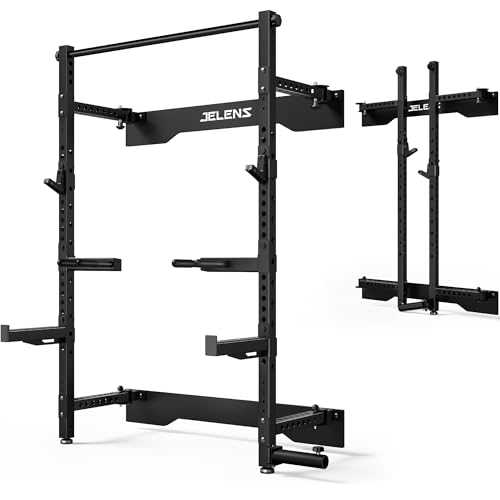
Six wall-mounted folding racks, ranked by what actually matters at home: stud spacing, steel gauge, footprint when folded, and whether the pulley add-ons are worth the extra depth.

By Lauren RossUpdated 16 min read
On this page
- Best foldable folding squat rack at a glance
- Who this is not for
- How I screened the shortlist
- 1. JELENS FS01 Folding Squat Rack — Best overall
- 2. GOIMU WM3-V4 Folding Squat Rack — Best for heavy use
- 3. Mdeam Folding Squat Rack — Best budget pick
- 4. Mikolo Folding Squat Rack — Best premium
- 5. Mikolo 2" x 2" Folding Wall Mounted Squat Rack — Best compact
- 6. Mdeam Folding Squat Rack with Dual Pulley System — Best for families
- Wall studs decide this, not steel gauge
- What more money actually buys
- Cable stack or bare rack: which do you actually need?
- What the listings do not tell you
- The verdict
- FAQ
The best foldable folding squat rack for most home lifters is the JELENS FS01, a 2 in by 2 in wall-mounted power cage rated to 1,100 lb with an 86.2 x 50.7 x 23.6 in open footprint. If you want a built-in cable stack for supersets, the GOIMU WM3-V4 with its dual 1:1 pulley system is the better buy. Both fold flat against the wall in seconds, and both mount straight into wooden or concrete studs.
Best foldable folding squat rack at a glance
| Pick | Open depth | Steel & capacity | Price |
|---|---|---|---|
Best overall JELENS FS01 Folding Squat Rack |
23.6 in | 2x2 in, 1,100 lb claim | Check Price |
Best for heavy use GOIMU WM3-V4 Folding Squat Rack |
33.5 in | Dual 1:1 pulleys | Check Price |
Best budget pick Mdeam Folding Squat Rack |
25 in | 60x60 mm, 1,000 lb claim | Check Price |
Best premium Mikolo Folding Squat Rack |
30 in | 2x2 in, 14-gauge | Check Price |
Best compact Mikolo 2" x 2" Folding Wall Mounted Squat Rack |
22 in | 2x2 in, 1,000 lb claim | Check Price |
Best for families Mdeam Folding Squat Rack with pulleys |
Not listed | 2x2 in, 1,000 lb claim | Check Price |



Who this is not for
If you're renting and your lease forbids putting fasteners into structural walls, close this tab. Every one of these six racks is a wall-mounted design: they need pilot holes into wood studs or masonry anchors into concrete, and the pull force on those anchors at the top of a heavy squat is not trivial. A floor-standing power cage or a squat stand is the right search instead.
The same applies if your only viable wall is drywall over metal studs, with no wood stringer to bite into. Two of the picks here, the JELENS FS01 and the smaller Mikolo, ship with a mounting stringer and metal studs to spread the load across the framing, but you still need something solid behind the drywall for the lag bolts to reach.
Two more groups should look elsewhere. Anyone chasing published capacity above 1,100 lb, and anyone who trains in an unheated shed where a cable trainer's pulleys will collect condensation. Foldable racks are a compromise built for space, not for elite loads.
How I screened the shortlist
I started with wall-mounted folding racks in the Racks and Cages and Free-Weight Racks categories, then filtered on four criteria drawn from the product data.
- Published steel dimensions. A rack that will not name its upright size in inches or millimetres is not one I trust. Five of the six picks list 2 in by 2 in uprights; the sixth, the budget Mdeam, publishes 60 x 60 mm, which is the same footprint in metric.
- A capacity claim in the listing. Four of the six state a specific pound rating: 1,100 lb for the JELENS FS01 and 1,000 lb for both Mdeam models and the compact Mikolo. The two premium picks describe their stability differently, so I judged them on their pulley systems instead.
- A folded configuration. Every pick collapses toward the wall. The Mdeam entry cites a 15-second switch, the GOIMU cites a 4.3 sq ft folded footprint, the Mikolo premium cites a 3 sq ft folded footprint.
- A stated warranty. Five of six list one year; the compact Mikolo lists two.
What got cut: floor-standing cages, half racks with no fold, and any listing whose upright dimension was described only as "heavy duty" with no number. That criteria set left the six racks below.
1. JELENS FS01 Folding Squat Rack — Best overall
The FS01 is the shallow, high-capacity pick that gets a lifter squatting and pressing without turning the room into a permanent gym.
Best for: a garage lifter who needs a 1,100 lb capacity claim and a shallow folded footprint. Skip it if: you want a built-in cable stack for supersets.
The JELENS wins on the numbers a foldable rack should be judged on. Its 86.2 x 50.7 x 23.6 in open footprint sticks out just 23.6 in from the wall, the second-shallowest here after the compact Mikolo. JELENS says the 2 in by 2 in heavy-duty steel is rated to a 1,100 lb safe load, which is the highest published capacity in this set. The kit lists J-hooks, a pin-on pull-up bar and a 360° landmine, so the day-one workout is a squat, bench, overhead press, row and pull-up circuit without buying add-ons.
The trade-offs are honest. It is a bare power cage, not a cable trainer, so lat pulldowns and cable flyes are off the menu. Warranty is the standard one year. And the FS01 sits at the second-cheapest position of the six here, which means the value-per-inch is strong but the amenity list is short.
Pros:
- 1,100 lb capacity, the highest published figure here
- 23.6 in open depth folds shallow against the wall
- 2 in by 2 in steel uprights
- Pull-up bar, J-hooks and landmine included
- Fits wooden or concrete walls with supplied stringer
Cons:
- No cable pulley system
- Warranty is one year, not two
- Only one seller lists it
2. GOIMU WM3-V4 Folding Squat Rack — Best for heavy use
A folding cage built around dual independent cables, for a lifter who wants supersets and partner work in one wall footprint.

Best for: a lifter running supersets or partner sessions who wants dual independent cables. Skip it if: your wall clearance is under 34 in.
The GOIMU is the busier of the two premium cable-stack picks, and it has the harder-working sales position of the pair: it moves faster than the other cable-equipped rack here. Its 85 x 33.5 x 50 in open footprint is deeper than the bare cages, which is the physical cost of the pulleys. GOIMU claims a folded footprint of 4.3 sq ft, dual 1:1 ratio cable machines for simultaneous or superset use, 15 adjustable pulley heights and quick-swap J-hooks and safety arms. Warranty is one year.
The case for the GOIMU is the case for cable training at home: lat pulldowns, cable rows, face pulls and crossovers without a second machine or a plate-loaded pulley conversion. The case against is the extra 10 in of open depth you'll live with, and the premium price position. It is the second most expensive pick in this set, and there is no bar, plate or bench in the box. Plan for those separately.
Pros:
- Dual 1:1 independent pulley cables
- 15 adjustable pulley heights claimed
- Sells fastest of the six in this set
- Folded footprint claim of 4.3 sq ft
- Detachable pull-up bar and safety arms
Cons:
- 33.5 in open depth is the deepest bare rack here
- No bar or bench included at this price position
- One-year warranty
3. Mdeam Folding Squat Rack — Best budget pick
The cheapest pick in the set, and the one that actually publishes both its steel size and its capacity claim.
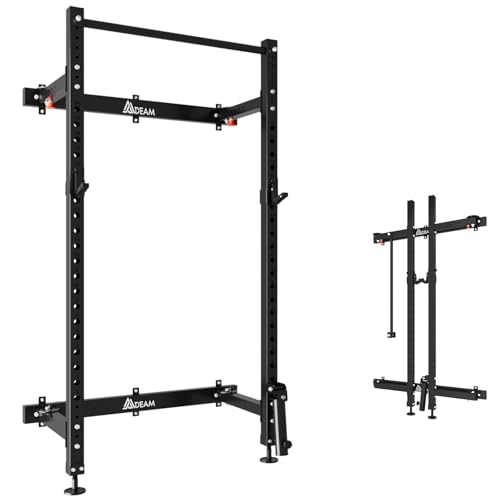
Best for: a first foldable rack for a small basement or a spare bedroom. Skip it if: you want cables, a stack, or a warranty longer than a year.
The entry Mdeam is the cheapest of the six and the one I'd suggest for a lifter buying their first rack. Uprights are 60 x 60 mm, which is the same 2 in by 2 in profile the pricier picks use in imperial. Mdeam says the rack handles up to 1,000 lb, folds and unfolds in 15 seconds, and opens to 25 x 44 x 87 in. Textured powder coat is claimed for grip on the uprights. Attachments listed: landmine, pull-up bar, J-hooks.
Where does the money show? It doesn't, really, on the core specification: this is a 2 in by 2 in wall cage with a four-figure capacity claim, the same as the mid-tier Mikolo. The trade-off is at the margins. It is the slowest seller of the six by rank, warranty is one year, and there's no cable option or upgrade path to a stack. If you never planned to run pulleys anyway, that trade-off is easy to accept.
Pros:
- Cheapest of the six
- 1,000 lb capacity claim
- 60 x 60 mm uprights, same profile as the premium picks
- 15-second fold claim
- Landmine, pull-up bar and J-hooks in the box
Cons:
- No cable pulley option
- One-year warranty
- Slowest seller of the six in this set
4. Mikolo Folding Squat Rack — Best premium
A package pick: cable-equipped folding cage bundled with a bar, 230 lb of plates and a bench.

Best for: someone buying the rack, the bar, the plates and the bench in a single order. Skip it if: you already own a bar and bench you like.
This is the most expensive pick in the set, and the reason is on the size line: it ships as the CHEETAH Package with 230 lb of plates, a bar and a bench, weighing 150 lb in total. The rack itself opens to 86 x 30 x 45 in on 2 in by 2 in 14-gauge steel, with reinforced screw-in wall mounts and four adjustable ground support feet. Mikolo says it folds to 3 sq ft and opens to 9.5 sq ft. The cable side is a dual independent pulley crossover with 15 height options and a detachable pull-up bar.
Read the size field carefully before buying. The premium here is the bundle, not the rack alone. If you already have a bar and plates, the GOIMU delivers the dual pulley system at a lower price position. If you don't, the Cheetah package is a one-transaction home gym on a foldable footprint. Warranty is one year manufacturer.
Pros:
- Ships with bar, 230 lb of plates and a bench
- Dual independent cable crossover
- 2 in by 2 in 14-gauge steel uprights
- Four adjustable ground support feet
- 3 sq ft folded footprint claim
Cons:
- The most expensive pick here
- Overspend if you already own a bar and bench
- One-year warranty
5. Mikolo 2" x 2" Folding Wall Mounted Squat Rack — Best compact
The shallowest open depth in the set, and the only rack here with a published two-year warranty.

Best for: a rack behind a garage door or in a hallway that needs to disappear when folded. Skip it if: you plan to load past a 1,000 lb capacity claim.
At 47 x 86 x 22 in open, the compact Mikolo has the shallowest open depth in this roundup: 22 in from the wall, 1.6 in less than the JELENS and 3 in less than the entry Mdeam. Weight is 80 lb, the lightest bare rack listed here. Mikolo says the rack holds 1,000 lb and includes safety catches, a quick-attach pull-up bar reaching 89 in off the ground, J-cups with UHMW plastic liners, and a landmine attachment. It's the only pick with a two-year warranty on the listing.
What you give up for the shallow footprint is nothing on the training side: this is still a full power cage with J-hooks, safety arms, a pull-up bar and a landmine. What you don't get is cables. If pulleys are on your list, the GOIMU or one of the two Mikolo cable systems is the right pick. If they aren't, this is the cleanest small-space bare rack of the six.
Pros:
- 22 in open depth, the shallowest here
- Two-year warranty, the only one in this set
- Pull-up bar at 89 in height
- UHMW plastic on the J-cups
- 1,000 lb capacity claim
Cons:
- No cable or pulley system
- Free-Weight Racks listing category, not Power Cages
- Lower published capacity than the JELENS
6. Mdeam Folding Squat Rack with Dual Pulley System — Best for families
A dual-cable folding cage aimed at two people sharing one home gym.

Best for: two people who want to share a cable trainer at home. Skip it if: you need published open-depth and total-weight figures before you buy.
The second Mdeam is the third dual-cable pick here, and the most affordable route into that feature. Mdeam says the pulley system uses a 1:1 cable ratio for smooth independent crossover movements, with seven adjustable angles. Construction is described as 2 in by 2 in 14-gauge steel with reinforced screw-in wall mounts and four adjustable ground support feet, rated to 1,000 lb. Attachments listed: multi-grip pull-up bar, 360° landmine and the pulley system itself. Warranty is one year.
The reason this pick ranks last of the six is transparency. Its listing publishes the length as 42.4 in but not the full open depth or total weight, so the pre-purchase comparison is harder than for the others. The GOIMU and the premium Mikolo publish both. If the price position is compelling and you don't need the full footprint number, it's a valid family pick with two independent cables. If you want the numbers up front, one of the other two cable-equipped racks is a cleaner buy.
Pros:
- Dual 1:1 pulley cables at a mid price position
- Seven adjustable pulley angles
- 1,000 lb capacity claim
- Four ground support feet
- Multi-grip pull-up bar and landmine included
Cons:
- Full open dimensions not published
- Total weight not listed
- One-year warranty
Wall studs decide this, not steel gauge
Most guides on the best foldable folding squat rack compare uprights: 2 in by 2 in, 3 in by 3 in, 11-gauge, 14-gauge. That is not what decides the purchase for a home lifter. Five of the six picks here use the same 2 in by 2 in profile, and the sixth uses the metric equivalent at 60 x 60 mm. The steel is not the bottleneck.
The bottleneck is your wall. A foldable rack transfers the load of a heavy squat into a small number of lag bolts driven into whatever framing sits behind your drywall. That means:
- Wood-framed walls need stud spacing that matches the rack's mounting stringer. JELENS and Mikolo ship with a stringer that spans studs; check yours before you order.
- Metal-stud walls are marginal. You need a wood backer, or masonry behind, to trust the anchors under a 1,000 lb-rated rack.
- Concrete or block walls are the strongest anchor, provided you use the right sleeve or wedge anchors.
Steel gauge only decides the rack's rated capacity claim. Your anchor points decide whether that claim is meaningful in your room. Measure the studs, know the wall type, then pick the rack.
What more money actually buys
Prices span from the entry Mdeam at the cheapest position to the Mikolo Cheetah package at the most expensive. Here is what the extra money buys, in order:
- Entry price positions (Mdeam entry, JELENS FS01): a wall-mounted 2 in by 2 in cage with pull-up bar, J-hooks and landmine. Capacity claim in the 1,000 to 1,100 lb range. One-year warranty. No cables.
- Mid price positions (compact Mikolo, Mdeam with pulleys): the same core cage, but with either a two-year warranty or a dual pulley system added. You choose one of the two upgrades at this tier.
- Premium price positions (GOIMU, Mikolo Cheetah): dual independent 1:1 cable crossover with 15 pulley heights. The Cheetah adds a bar, 230 lb of plates and a bench inside the box, which is why it sits at the top of the range.
If you already own a bar and plates, you get the most usable upgrade per dollar by staying in the mid tier and choosing the warranty or the cables, whichever you value more.
Cable stack or bare rack: which do you actually need?
Three of the six picks include a pulley system, three do not. The decision is not about which is better; it is about which movements you plan to train.
If your programme is squat, bench, overhead press, deadlift and rows, a bare rack does all of it. The JELENS FS01 or the compact Mikolo are enough. Adding pulleys costs extra depth off the wall, extra money, and extra maintenance on the cables themselves.
If your programme includes lat pulldowns, cable rows, face pulls, triceps pushdowns or cable crossovers, and you don't want to buy a second machine, the pulley picks earn their footprint. The GOIMU is the cheapest of the three cable-equipped racks; the Cheetah package is the most expensive because it also brings the bar, plates and bench.
A useful test: list every exercise you did in the last four weeks. If more than three of them are cable movements, buy the stack. If not, the bare rack is more space per dollar.
What the listings do not tell you
The product data is generous on steel size, capacity claims and folded footprints. It is silent on three things worth thinking about before you buy.
- Anchor hardware for your wall type. Every listing here describes the rack as wall-mounted with a stringer and metal studs supplied, but concrete anchors, wedge bolts and lag screws for wood are usually the buyer's problem. Budget a trip to the hardware store.
- Ceiling height for the pull-up bar. The compact Mikolo publishes an 89 in bar height; the others do not. If your ceiling is under 8 ft, measure the bar height on any rack before ordering.
- Bar and plates for the bare-rack picks. Only the Mikolo Cheetah package includes a bar and weights. The other five picks are the rack alone, plus the attachments named in the listing. Add a barbell, plates and collars to your basket separately, and a bench if you plan to press.
None of that is a fault of the picks. It is the shape of the category. The rack is the platform; you supply the rest.
The verdict
If you're buying one wall-mounted foldable squat rack today, buy the JELENS FS01. Its 1,100 lb capacity claim is the highest in this set, its 23.6 in open depth is among the shallowest, and it ships with the pull-up bar, J-hooks and landmine you need to train from day one. The two-year warranty on the compact Mikolo is tempting, but the JELENS carries more load and comes at a lower price position.
The runner-up is the GOIMU WM3-V4, and its advantage is exact: dual independent 1:1 cable pulleys with 15 heights, in a folding cage. If lat pulldowns, cable rows and crossovers are in your programme, the GOIMU replaces a second machine and is the pick regardless of what JELENS offers. The extra 10 in of open depth is the real cost, not the price position.
The cutoff between them is your training list. If your programme is barbell-only, the JELENS wins. If you use cables more than three times a week, the GOIMU does. The rest of the field earns a place at edges: the entry Mdeam for the tightest budget, the compact Mikolo for the shallowest wall, the Cheetah package for a one-order home gym, the second Mdeam for a family sharing pulleys.
FAQ
Is a foldable folding squat rack worth it in a small home gym?
A foldable folding squat rack is worth it when floor space is at a premium and you can mount into wood studs or masonry. The picks here open to 22 to 33.5 in from the wall and fold flat when unused, so a garage or basement can double as living space. If your only wall is drywall over metal studs with no wood backer, a floor-standing cage is safer.
How much weight can these racks actually hold?
How much weight varies by pick. The JELENS FS01 lists a 1,100 lb capacity claim on 2 in by 2 in steel. The two Mdeam racks and the compact Mikolo list 1,000 lb. The two premium cable-equipped picks describe stability through 14-gauge steel and reinforced mounts rather than a specific pound figure. Real-world load is limited by your wall anchors more than the rack's steel.
JELENS FS01 vs GOIMU WM3-V4: which is the better buy?
JELENS FS01 vs GOIMU WM3-V4 comes down to cables. The JELENS is the shallower, higher-capacity bare rack at a lower price position, ideal for barbell training. The GOIMU adds a dual independent 1:1 pulley system with 15 heights, at the cost of 10 in more open depth and a premium price position. Buy the JELENS for pure barbell work, the GOIMU if cable movements matter.
Do foldable squat racks work on drywall?
Foldable squat racks do work on drywall only when there is structural framing behind it. Wood studs at standard spacing are fine with the supplied stringer and lag bolts. Metal studs alone are marginal for a 1,000 lb rated rack. Masonry behind drywall works with sleeve or wedge anchors. Never rely on drywall anchors alone: the pull-out force at the top of a squat will fail the fastener before the rack fails.
What accessories do these racks come with?
The accessories vary. The JELENS FS01 lists J-hooks, a pin-on pull-up bar and a 360° landmine. Both Mdeam racks include J-hooks, a pull-up bar and a landmine. The compact Mikolo adds safety catches with UHMW-lined J-cups. The GOIMU and the Mikolo Cheetah package add cable pulleys, handles and safety arms. Only the Cheetah package includes a barbell, plates and bench in the box.
The right foldable rack for your room is the one that matches your wall, your ceiling and your training list. Measure the studs first, count the cable movements in your programme second, then pick from this shortlist. The JELENS FS01 is the default because it does the barbell job at the highest published capacity here and folds back to 23.6 in when the workout ends, but the GOIMU, the compact Mikolo and the Cheetah package each own a slice of the market the FS01 leaves on the table. Order the anchors and the bar in the same week as the rack, and the room becomes a gym the day the box arrives.