Best Wall Mounted Squat Rack for a One-Car Garage
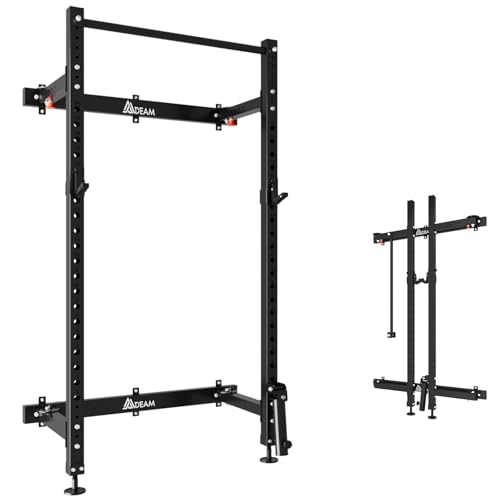
Depth when folded is what decides a wall mounted rack, not steel gauge. Six picks compared on published footprint, attachments and warranty, with the profile each one actually suits.

By Lauren RossUpdated 18 min read
On this page
- Best wall mounted squat rack for small spaces at a glance
- How I cut the field down to six
- Why folded depth decides it, not steel size
- 1. Mdeam Folding Squat Rack — Best overall
- 2. Mikolo 2" x 2" Folding Wall Mounted Squat Rack — Most versatile
- 3. JELENS FS01 Folding Squat Rack — Best upgrade
- 4. Garvee Folding Squat Rack — Best minimal setup
- 5. GOIMU WM3-V4 Folding Squat Rack — Best premium
- 6. Mdeam Folding Squat Rack with Dual Pulley — Best for pros
- What does more money buy in this category?
- Will it actually fit your wall and ceiling?
- Mdeam vs Mikolo: which one for a tight garage?
- What the listings do not tell you
- The verdict
- FAQ
The best wall mounted squat rack for small spaces is the Mdeam Folding Squat Rack, because it opens to just 25 in of depth and folds flat to 44 x 87 in against the wall. If you want cable crossovers and a lat pulldown in the same frame, the GOIMU WM3-V4 is the better buy, though it needs 50 in of clearance. Six racks here, all folding, all wall-anchored. The cheapest and the priciest are separated by a pulley stack, not by steel.
Entry money buys a bare cage: uprights, J-hooks, a pull-up bar, a landmine. Mid money buys longer warranties and finer adjustment. Premium money buys cables. That map decides most of this.
Best wall mounted squat rack for small spaces at a glance
| Pick | Open depth | Attachments | Price |
|---|---|---|---|
Best overall Mdeam Folding Squat Rack |
25 in | Pull-up bar, J-hooks, landmine | Check Price |
Most versatile Mikolo 2" x 2" Folding Wall Mounted Squat Rack |
22 in | Pull-up bar, J-hooks, safety catches, landmine | Check Price |
Best upgrade JELENS FS01 Folding Squat Rack |
23.6 in | Pull-up bar, J-hooks, 360° landmine | Check Price |
Best minimal setup Garvee Folding Squat Rack |
22 in | Pull-up bar, J-hooks, 360° landmine | Check Price |
Best premium GOIMU WM3-V4 Folding Squat Rack |
50 in | Dual pulleys, lat pulldown, pull-up bar, safety arms | Check Price |
Best for pros Mdeam Folding Squat Rack with Dual Pulley |
Not published | Dual pulleys, lat pulldown, multi-grip bar, landmine | Check Price |


How I cut the field down to six
Three things got racks cut before I compared a single specification.
The first was a missing depth figure. A rack sold on "space saving" that never publishes how far it sticks out is asking you to guess at the one number that matters. Two picks here still fall short of a full set of published dimensions, and I have flagged that in their sections rather than pretending the gap does not exist.
The second was a non-folding frame. Fixed cages belong in a dedicated room. Every pick below folds, and the makers describe that fold as flush or near-flush to the wall.
The third was a bare upright with no attachments. A rack that arrives without J-hooks and a pull-up bar means a second purchase before your first session. All six here list J-hooks and a bar, and five list a landmine.
What survived splits neatly into two groups:
- Four bare cages: Mdeam, Mikolo, JELENS and Garvee, all built on 2 in or 2.36 in uprights with claimed capacities between 1,000 and 1,100 lb.
- Two pulley cages: the GOIMU WM3-V4 and the Mdeam dual-pulley model, both adding cable crossovers and a lat pulldown to the same folding frame.
Both groups are legitimate answers. Which one you want depends entirely on whether the wall you have chosen can give up 50 in of depth, or only 25.
Why folded depth decides it, not steel size
Every listing here leads on steel. 2 x 2 in tubing, 2.36 x 2.36 in tubing, 14-gauge, 1,000 lb, 1,100 lb. Those numbers are close enough together that they will not decide anything for you. Nobody buying a home rack is loading 1,000 lb.
Depth is what decides it. A wall mounted squat rack lives in a room that already has a purpose, and the question is how much of that room you lose. The bare cages here open between 22 and 25 in. The pulley cages go to 50 in on the GOIMU. That is more than double, and it is the difference between parking a car in front of the rack and not.
Three thresholds are worth measuring before you buy:
- Under 24 in of usable depth. Mikolo at 22 in and Garvee at 22 in are your shortlist. The Mdeam at 25 in will overhang.
- 24 to 30 in. All four bare cages fit. Choose on warranty and wall width instead.
- Over 40 in you can permanently give up. The pulley cages become viable, and the cable stack changes what you can train.
Wall width matters just as much and gets discussed far less. The JELENS needs 50.7 in of clear run, the Garvee 47 in, the Mikolo 47 in, the Mdeam 44 in. Light switches, breaker panels and window trim all count against you. Measure the wall before you compare capacities.
1. Mdeam Folding Squat Rack — Best overall
The smallest published open footprint of any bare cage here, at 25 in of depth and 44 in of wall width, and the cheapest of the six.
Best for: a one-car garage where the rack shares floor space with a car Skip it if: you want cables and a lat pulldown in the same unit
This is the narrowest pick in the set on wall width. At 44 in, it slots between a garage door track and a workbench where the JELENS at 50.7 in would not. Open depth runs 25 in, which is three inches more than the Mikolo, and Mdeam says the fold takes 15 seconds either way.
The uprights are the thickest here at 60 x 60 mm, which is 2.36 in. Mdeam claims a 1,000 lb capacity and a textured powder coat for grip. The listing also specifies stabiliser levelling feet alongside the wall anchors, which matters on the uneven concrete most garages have. Installation is described as 15 to 30 minutes with no special tools.
Attachments are the standard bare-cage set: pull-up bar, J-hooks and a landmine. Warranty is one year.
The trade-off is real. This is the cheapest of the six and it shows in what you do not get: no safety catches in the listed attachments, unlike the Mikolo, and no cable system at all. It also sells more slowly than the Mikolo and the GOIMU, so fewer people are choosing it. On published footprint and price position together, though, nothing else here matches it.
Pros:
- Narrowest wall width in the set at 44 in
- Thickest uprights here at 2.36 in
- Cheapest of the six picks
- Levelling feet listed alongside wall anchors
- 15-second fold claim, 15 to 30 minute install
Cons:
- No safety catches in the listed attachments
- One-year warranty against Mikolo's two
- 25 in depth is three inches deeper than Mikolo or Garvee
- No published unit weight
2. Mikolo 2" x 2" Folding Wall Mounted Squat Rack — Most versatile
Ties for the shallowest open depth at 22 in and carries the only two-year warranty in the set.

Best for: shallow rooms where every inch off the wall counts Skip it if: you are working around a low ceiling
Two things separate the Mikolo from the rest of the bare cages. It opens to 22 in, tying the Garvee for shallowest, and it publishes a two-year warranty, double the cover of the Mdeam and the JELENS and roughly twenty-four times the Garvee's 30 days.
It is also the only pick in the set whose listed attachments include safety catches. On a folding rack you use alone, that is the difference between failing a squat and pinning yourself under one. Mikolo says the J-cups use UHMW plastic liners, which is the material that stops a bar chewing the finish off the uprights.
Dimensions are 47 x 86 x 22 in, and the quick-attach pull-up bar is quoted at 89 in off the ground. Note the mismatch: the bar sits higher than the frame is tall, so a low basement ceiling will stop you using it properly. Unit weight is 80 lb, the lightest published figure here.
It is the one buyers choose most often among the bare cages, and it costs more than the Mdeam and the Garvee for it. You are paying for the warranty and the catches, not for more steel. Wall width is 47 in, three inches wider than the Mdeam.
Pros:
- Only two-year warranty in this set
- Ties for shallowest open depth at 22 in
- Safety catches included in listed attachments
- UHMW J-cup liners claimed
- Lightest published unit weight at 80 lb
Cons:
- Pull-up bar at 89 in needs real ceiling height
- Costs more than the Mdeam or Garvee for the same 1,000 lb claim
- Needs 47 in of clear wall, three more than the Mdeam
- No cable option in the frame
3. JELENS FS01 Folding Squat Rack — Best upgrade
The highest claimed capacity of the six at 1,100 lb, on 2 x 2 in steel and a 23.6 in open depth.
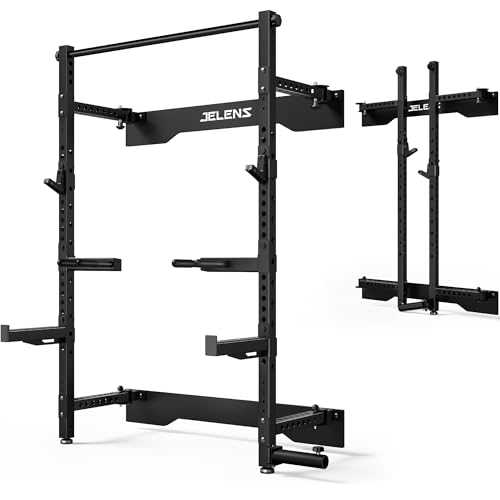
Best for: a heavier lifter who wants headroom above 1,000 lb Skip it if: your usable wall is narrower than about 51 in
JELENS quotes 1,100 lb where the other five bare and pulley cages quote 1,000. That is a 100 lb margin on the manufacturer's own number, and it is the only spec sheet in the group that breaks the pattern. Steel is 2 x 2 in heavy-duty tube.
Open depth is 23.6 in, which sits between the Mikolo's 22 and the Mdeam's 25. Frame height is 86.2 in. The attachment list covers J-hooks, a pin-on pull-up bar and a 360° landmine, and JELENS says the mounting hardware includes pre-drilled stringers and metal studs for both wooden and concrete walls. That second point matters more than it sounds: a rack that only anchors to timber studs is useless on a poured basement wall.
Warranty is one year. Price position is third of six, so it sits below the Mikolo despite the higher capacity claim.
The cost is width. At 50.7 in this is the widest bare cage here, nearly seven inches more than the Mdeam. In a garage bay with a door track on one side, those seven inches are frequently the whole problem. It also lists no unit weight, which makes planning a solo install harder than it should be.
Pros:
- Highest claimed capacity here at 1,100 lb
- Cheaper than the Mikolo despite the higher claim
- Wood and concrete mounting hardware both listed
- 23.6 in open depth beats the Mdeam
Cons:
- Widest bare cage at 50.7 in of wall
- No published unit weight
- One-year warranty, half the Mikolo's
- No safety catches in the listed attachments
4. Garvee Folding Squat Rack — Best minimal setup
The second-cheapest pick, with 22 in of open depth and the most adjustment points published in the set.

Best for: a first rack on a modest budget with plenty of height Skip it if: you want more than a month of manufacturer cover
Garvee publishes more adjustment detail than anyone here: 5 wall-mount height options, 4 pull-up bar heights and 23 J-hook levels. If you share the rack with someone a foot shorter than you, that granularity earns its keep session to session.
Uprights are 2.36 x 2.36 in, matching the Mdeam for thickness, with a claimed 1,000 lb capacity and a non-slip powder finish. Open depth is 22 in, tying the Mikolo for shallowest. It is the second-cheapest of the six.
Two figures push against it. The frame is 89 in tall, the tallest here, so it demands more ceiling than the 85 in GOIMU or the 86 in Mikolo. And the warranty is 30 days manufacturer cover, by far the shortest in this set. Every other pick publishes at least a year. On a bolted-to-the-wall steel structure you intend to load, that gap is the single biggest reason to spend more elsewhere.
Unit weight is 89.8 lb, the heaviest published figure here, which makes it the least pleasant of the six to hold against a wall while you find the studs. Wall width is 47 in.
Pros:
- 23 J-hook positions, most published here
- Second-cheapest of the six
- Ties for shallowest depth at 22 in
- 2.36 in uprights match the Mdeam
Cons:
- 30-day warranty, shortest in the set by a wide margin
- Tallest frame at 89 in needs the most ceiling
- Heaviest published unit weight at 89.8 lb
- Slowest seller of the six
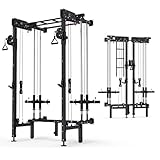
5. GOIMU WM3-V4 Folding Squat Rack — Best premium
A dual independent pulley system with 15 pulley heights, folding to a claimed 4.3 square feet.

Best for: replacing a rack plus a cable machine with one unit Skip it if: your room is shallow or your budget is tight
This is the most expensive pick here and the most capable on paper. GOIMU describes a power rack, dual cable crossover, lat pulldown station, pull-up bar and safety arms in one folding frame, with 5 adjustable function modes and 15 pulley heights. Two independent 1:1 cables mean two people can train at once, or one person can superset without re-rigging.
Dimensions are 85 x 33.5 x 50 in. Read that carefully. The 50 in figure is depth, and it is double what the bare cages need. GOIMU's counter is the 4.3 square feet folded claim, which is a floor-area number, not a depth number, and the two are easy to confuse.
It is also the one buyers choose most often across the whole set, and the lowest frame height at 85 in, which helps in a basement with ducting.
The trade-offs stack up. Fifty inches of depth is a permanent commitment; you are not parking in front of this. It costs the most of the six. Warranty is one year, the same as the entry-priced Mdeam. And cables add pulleys, cams and wire to a machine bolted to your drywall, so there is simply more that can wear than on a bare cage.
Pros:
- Dual independent 1:1 pulleys for simultaneous training
- 15 pulley heights and 5 function modes
- Lowest frame height here at 85 in
- Fastest seller of the six
- Safety arms included in the attachment list
Cons:
- 50 in open depth, double the bare cages
- Most expensive pick in this set
- One-year warranty despite the price position
- No published unit weight
- Cable hardware adds wear points a bare cage does not have
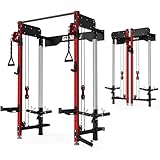
6. Mdeam Folding Squat Rack with Dual Pulley — Best for pros
Cable crossovers with 7 adjustable angles on 2 x 2 in 14-gauge steel, at a lower price than the GOIMU.

Best for: cable work with fine angle control on a narrower wall Skip it if: you need published depth and weight before you commit
Mdeam's pulley model undercuts the GOIMU while offering the same core idea: power cage, dual 1:1 cable crossover, lat pulldown, multi-grip pull-up bar and a 360° landmine in one folding unit. Steel is called out as 2 x 2 in 14-gauge, the only gauge figure published in this set, with reinforced screw-in wall mounts, four adjustable ground feet and a 1,000 lb claim.
Where the GOIMU offers 15 pulley heights, this one offers 7 adjustable angles. Fewer positions, but angle adjustment and height adjustment are not the same control, and for cable flyes the angle is what changes the movement. The listed size is 42.4 in length, which is narrower than the GOIMU's 50 in depth figure, though the two numbers describe different axes.
That is the problem. This listing publishes only a size, a colour and a one-year warranty. No full three-axis dimensions, no unit weight. For a product you are bolting to a load-bearing wall in a room you have already measured, that gap in the paperwork is a genuine strike, and it is why the GOIMU takes the premium slot ahead of it. It also sells more slowly than the GOIMU despite costing less.
Pros:
- Dual 1:1 cable pulleys below the GOIMU's price position
- Only pick publishing a steel gauge, at 14-gauge
- 7 adjustable angles for crossover work
- Four ground support feet plus screw-in wall mounts
Cons:
- No published open depth, width or height
- No published unit weight
- One-year warranty at a premium price position
- Fewer pulley positions than the GOIMU's 15
What does more money buy in this category?
Not steel. Every pick here claims 1,000 lb except the JELENS at 1,100, and the cheapest rack in the set uses the thickest uprights. If you are spending more expecting a stronger frame, you are spending for nothing.
Here is what the money actually maps to:
- Entry: a bare cage with J-hooks, a pull-up bar and a landmine. That is the Mdeam and the Garvee. Both fold flat, both claim 1,000 lb, and the Mdeam has the narrowest wall footprint of all six.
- Mid: the same cage with better paperwork or a higher number. Mikolo adds safety catches, UHMW liners and a two-year warranty. JELENS adds the 1,100 lb claim and dual-surface mounting hardware.
- Premium: cables. Both premium picks add dual 1:1 pulleys and a lat pulldown. That is the entire justification for the jump, and it comes with a depth penalty on the GOIMU.
Warranty runs almost independently of price. The two-year cover sits mid-range on the Mikolo, and the most expensive pick here publishes the same one year as the cheapest. If cover is what you care about, the Mikolo is the pick, and price will not tell you that.
Will it actually fit your wall and ceiling?
Four measurements decide this, and most buyers only take one.
Wall width. Clear run needed, per the published dimensions: Mdeam 44 in, Mikolo 47 in, Garvee 47 in, JELENS 50.7 in. Trim, switches and shelving all eat into that.
Ceiling height. Frame heights range from 85 in on the GOIMU to 89 in on the Garvee. But the Mikolo quotes its pull-up bar at 89 in off the ground, above its own 86 in frame height, so a 90 in basement ceiling leaves you nothing to hang from. Add your own height in the hang position, not the rack's.
Open depth. 22 in for Mikolo and Garvee, 23.6 in for JELENS, 25 in for the Mdeam, 50 in for the GOIMU. The dual-pulley Mdeam does not publish one, which is a planning problem.
Wall construction. JELENS specifically lists hardware for wooden and concrete walls. Mdeam's pulley model lists reinforced screw-in mounts and four ground feet. If you are anchoring to poured concrete or masonry, check that language before you buy, because timber-only hardware is a dead end.
The bare Mdeam and the pulley Mdeam both list levelling or ground support feet. On a sloping garage slab that detail keeps the uprights plumb, which is worth more than an extra 100 lb of claimed capacity.
Mdeam vs Mikolo: which one for a tight garage?
These two are the real decision for most people shopping a wall mounted squat rack for small spaces, so it is worth putting them side by side.
The Mdeam wins on width and price. It needs 44 in of wall against the Mikolo's 47, it uses 2.36 in uprights against 2 in, and it is the cheapest of the six. If your bay is bounded by a garage door track on one side, those three inches decide it outright.
The Mikolo wins on depth and cover. It opens to 22 in against 25, publishes a two-year warranty against one, and is the only pick here listing safety catches. Its 80 lb unit weight is the lightest published figure in the set, which makes a solo install less of a wrestling match.
The clean cutoff: if wall width is your constraint, take the Mdeam. If depth or training alone is your constraint, take the Mikolo and pay the difference for the catches and the extra year.
What the listings do not tell you
Three gaps are worth naming before you commit.
Folded depth is missing everywhere. All six describe the fold as flush or space-saving, and the GOIMU quotes 4.3 square feet of floor area folded, but none publishes how many inches the folded frame projects. Assume the depth of the uprights plus the hardware and leave yourself a margin.
Hardware for your wall type is often vague. Only the JELENS and the pulley Mdeam get specific about mounting surfaces. Everyone else says stringers and studs without saying what those studs bite into.
Unit weight is published for two of six. The Mikolo at 80 lb and the Garvee at 89.8 lb. Nobody else lists one, so plan on a second pair of hands regardless.
Bar capacity is not on that list, because a claimed 1,000 lb is far past what a home lifter will load, and a claim is not a tested rating anyway. Treat every capacity figure here as the manufacturer's number and choose on footprint, attachments and warranty instead.
The verdict
The Mdeam Folding Squat Rack is the best wall mounted squat rack for small spaces, because it needs the least wall of any pick here at 44 in, opens to 25 in, uses the thickest uprights in the set at 2.36 in, and costs the least. In a one-car garage or a shared basement corner, wall width is usually the binding constraint, and this is the rack that fits where the others do not.
Two conditions flip that.
If your room is shallow rather than narrow, take the Mikolo. Its 22 in open depth is three inches better, and it brings the only two-year warranty here plus the only listed safety catches, which matters if you train alone. That is a real advantage, not a spec-sheet one.
If you can permanently give up 50 in of depth and you want a cable machine as well as a cage, take the GOIMU WM3-V4. Dual independent 1:1 pulleys, 15 pulley heights and a lat pulldown replace a second piece of equipment you would otherwise buy.
Skip the Garvee unless the price is decisive for you; a 30-day warranty on a bolted steel frame is thin next to everyone else's year. And hold off on the dual-pulley Mdeam until it publishes full dimensions, because you cannot plan a wall install around a single length figure.
FAQ
Is a wall mounted squat rack worth it over a free-standing cage?
A wall mounted squat rack is worth it when floor space is the thing you are short of, not money. All six picks here fold, opening to between 22 and 50 in and then flattening against the wall. A free-standing cage keeps that footprint permanently. The catch is that you need a wall able to take anchors, and you accept a fixed location for the life of the rack.
What is the best wall mounted squat rack for small spaces on a budget?
The best wall mounted squat rack for small spaces on a budget is the Mdeam, the cheapest of the six, with 2.36 in uprights, a 44 in wall footprint and a one-year warranty. The Garvee is second-cheapest and shallower at 22 in, with 23 J-hook positions, but its warranty runs only 30 days. That gap is the reason I would spend the small difference on the Mdeam.
How much ceiling height do I need for a folding power rack?
Ceiling height requirements start at the frame and go up. Frame heights here run 85 in on the GOIMU, 86 in on the Mikolo, 86.2 in on the JELENS, 87 in on the Mdeam and 89 in on the Garvee. Mikolo separately quotes its pull-up bar at 89 in off the ground. Add clearance above that for your head and hands in a dead hang.
Mdeam or Mikolo for a narrow garage wall?
Mdeam or Mikolo comes down to which dimension is tight. The Mdeam needs 44 in of wall against the Mikolo's 47, so it wins in a narrow bay. The Mikolo opens to 22 in against 25 and publishes a two-year warranty plus safety catches in its attachment list. Narrow wall, take the Mdeam. Shallow room or solo training, take the Mikolo.
Do these racks come with a pull-up bar and J-hooks included?
Pull-up bar and J-hooks are listed on all six picks, so no separate purchase is needed to start. Five also list a landmine attachment. Beyond that the lists diverge: the Mikolo adds safety catches, the GOIMU adds dual pulleys, a lat pulldown and safety arms, and the Mdeam pulley model adds a multi-grip bar. Check each listing's attachment list against the exercises you plan to run.
Measure twice before you order anything here. Clear wall width, ceiling height above your dead-hang reach, and how many inches of depth you can permanently give up. Those three numbers narrow six racks to one or two faster than any spec comparison will. For most people with a car in the garage and a strip of drywall to work with, the Mdeam is the right default: it asks the least of your wall at 44 in, uses the thickest steel in the group, and costs the least of the six. Spend up only if cables are the point.