Best Folding Squat Rack for Home Gyms: Wall-Mount Picks

Seven wall-mounted folding racks compared on capacity, footprint and cable options. The MU 2x2 wins on rated load and folded depth; the Mikolo Cheetah wins if you want a real cable crossover at home.

By Lauren RossUpdated 17 min read
On this page
- Best folding squat rack for home gyms at a glance
- Who this guide is not for
- How I narrowed seven racks from a much longer list
- What decides a folding rack, and what does not
- 1. MU 2" x 2" Folding Squat Rack — Best overall
- 2. Mikolo Folding Squat Rack (Cheetah) — Best premium
- 3. Danrelax Wall Mounted Power Rack with Cable Crossover — Best upgrade
- 4. Mikolo 2" x 2" Folding Wall Mounted Squat Rack — Best for pros
- 5. GOIMU WM3-V4 Folding Squat Rack — Best minimal setup
- 6. JELENS FS01 Folding Squat Rack — Runner-up
- 7. Mdeam Folding Squat Rack — Best budget pick
- Wall, floor and ceiling: will your room actually take one?
- Which folding rack should you pick?
- The verdict
- FAQ
The best folding squat rack for home gyms is the MU 2" x 2" Folding Squat Rack, because it pairs a rated 1100 lb capacity with a folded depth of just 2 inches against the wall. If you want a real cable crossover in the same footprint, the Mikolo Folding Squat Rack with the Cheetah frame is the better buy. Both mount to studs, both open to roughly a four-foot working width, and both close flat when the session ends.
Most guides to the best folding squat rack for home gyms compare grand promises: 15-in-1 stations, commercial-grade steel, all-in-one systems. That is not what decides it. What decides it is your wall, your ceiling and your floor, and whether the rack you like will fit all three once it is unfolded. A rack that folds to 2 inches is useless if it needs 87 inches of ceiling and you have 84. Everything below is written with that in mind.
Best folding squat rack for home gyms at a glance
| Pick | Open footprint | Capacity | Price |
|---|---|---|---|
Best overall MU 2" x 2" Folding Squat Rack |
47 x 21.8 in | 1100 lb claim | Check Price |
Best premium Mikolo Folding Squat Rack (Cheetah) |
86 x 45 x 30 in | 2x2 14-ga claim | Check Price |
Best upgrade Danrelax Wall Mounted Power Rack |
46.5 x 18.9 in | not listed | Check Price |
Best for pros Mikolo 2" x 2" Folding Wall Mounted Squat Rack |
47 x 22 in | 1000 lb claim | Check Price |
Best minimal setup GOIMU WM3-V4 Folding Squat Rack |
4.3 sq ft folded claim | not listed | Check Price |
Runner-up JELENS FS01 Folding Squat Rack |
50.7 x 23.6 in | 1100 lb claim | Check Price |
Best budget pick Mdeam Folding Squat Rack |
25 x 44 in | 1000 lb claim | Check Price |



Who this guide is not for
If you are renting and cannot drill into studs, close the tab. Every rack in this shortlist is wall-mounted, and every one lives or dies on the fasteners going into framing. There is no free-standing option here. A power cage that stands on its own is a different product with a different footprint, and the value of a folding rack is that it collapses against the wall between sessions. You do not get that with a four-post cage.
If your ceiling is under 85 inches, this category is also awkward. The shortest rack listed here is 85 inches tall, and one is 87. Pull-ups need a few more inches of head room above that bar. A basement with 84-inch joists will force you into a shorter, non-folding half rack instead.
Finally, if you do not own a barbell yet, buy the barbell and plates first. A folding squat rack is empty furniture without them, and the money is better spent on the loaded end of the setup before the frame that holds it.
How I narrowed seven racks from a much longer list
I started with every wall-mounted folding rack in the power cage category, then cut anything that failed a clear disqualification test. Three tests did most of the work.
First, published capacity. A folding rack is a lever pulling on drywall anchors, so a stated load rating is table stakes. Five of the seven publish a figure between 1000 and 1100 lb. Two do not, and both are premium picks that lean on frame gauge and pulley features instead.
Second, upright size. A 2x2 inch steel upright with 1-inch accessory holes is the standard the aftermarket is built around. Spotter arms, dip attachments and monolift J-cups from other brands drop straight in. Racks with proprietary hole spacing were cut.
Third, a real folded state. The MU folds to 2 inches of wall depth. The Danrelax folds to a 6-inch depth. The GOIMU claims a 4.3 sq ft footprint when folded. Racks that only "detach" rather than fold against the wall were cut, because the point of the category is to reclaim the floor between sessions.
What survived is seven racks split across three price positions, from the cheapest Mdeam to the most expensive Mikolo Cheetah.
What decides a folding rack, and what does not
The obvious specification is the weight capacity, and it is the wrong place to start. Five of the racks publish 1000 or 1100 lb. If you are squatting 1000 lb at home, you are not shopping on Amazon. In practice every rack here holds more than any home lifter will load.
Here is the trick with folding racks. The real deciding criterion is the sum of three measurements that live on your side of the transaction, not the product page:
- The distance from your floor to the ceiling joist you plan to mount into. Racks here are 85 to 87 inches tall. Add head room for pull-ups.
- The clear floor depth in front of the wall once the rack unfolds. The narrowest here needs about 22 inches; the widest, 30. That is before you account for the barbell and bumper plates.
- The stud spacing behind your drywall. Wall-mounted racks bolt into 16-inch on-centre framing. If your wall is metal-studded or masonry, that changes the fastener kit entirely.
Get those three figures before you compare capacities. Then pick on cable options: either you want a pulley system built in, or you do not, and that single answer splits the field cleanly in half.
1. MU 2" x 2" Folding Squat Rack — Best overall
The MU is the folding rack that wins on the two figures a garage lifter cares about: a rated 1100 lb capacity and a folded depth of 2 inches.
Best for: a garage lifter who wants a rated 1100 lb capacity and a 2-inch folded depth Skip it if: you want a built-in cable crossover
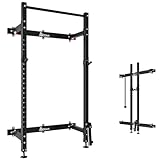
The MU stands 85.8 inches tall, opens to a 47 x 21.8 inch footprint, and folds flat to 47 x 2 x 85.8 inches. That 2-inch folded depth is the shallowest in the shortlist, and it is the specification that separates a folding rack from a rack that only claims to fold. In a single-car garage, giving 20 inches back to the floor is the difference between parking indoors and not.
The kit is honest for the price. MU includes two J-hooks, one LAT pull-up bar, and a 360-degree detachable landmine. Uprights are 2x2 inch heavy-duty steel with 1-inch universal accessory holes, which is the same spacing the major aftermarket brands use, so spotter arms and cable pulleys from elsewhere are compatible. MU says the frame is rated to 1100 lb.
What it gives up against the premium picks is a pulley system. There is no cable crossover, no lat pulldown station and no dip attachment in the box. If you want cables at home, the Mikolo Cheetah below is the direct swap, and it comes at a real cost step.
Pros:
- Rated 1100 lb capacity claim
- Folds to just 2 inches of wall depth
- J-hooks, pull-up bar and landmine included
- Universal 1-inch accessory holes on 2x2 uprights
- Second-cheapest of the seven
Cons:
- No cable pulley system
- No published weight for the frame itself
- Only one seller lists it
2. Mikolo Folding Squat Rack (Cheetah) — Best premium
The Cheetah is the pick when you want a squat rack and a cable machine to share the same wall.
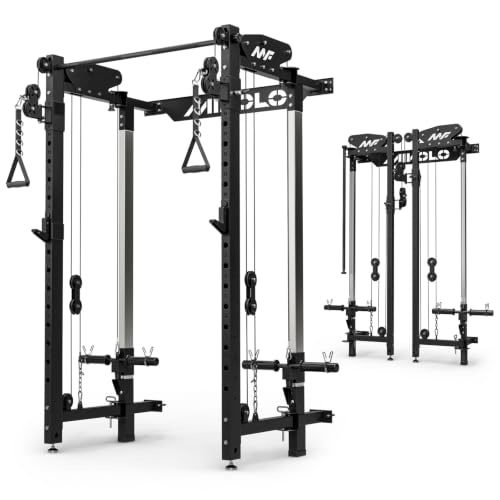
Best for: someone replacing a rack and a cable machine with one wall unit Skip it if: your ceiling is under 87 inches
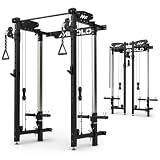
Mikolo's Cheetah is 86 inches tall, 45 inches wide and 30 inches deep when open, and weighs 150 lb, the heaviest frame in the shortlist. It is the most expensive pick here. Mikolo describes an independent dual pulley system with 15 height settings, a detachable pull-up bar, premium J-hooks and a 2x2 inch 14-gauge steel frame with reinforced wall mounts and four adjustable ground support feet.
That combination is the case for it. A separate cable crossover typically needs its own floor slot; folding a cable machine into a wall rack that also squats is the reason this exists. Mikolo says the open unit takes 9.5 sq ft and the folded footprint drops to 3 sq ft, which is the trade you are making for the pulley towers: more depth when open, more compression when closed.
The 30-inch open depth is the ceiling on this. In a room where you cannot spare that reach out from the wall, the plain MU or the Mikolo QJ01 is the correct answer. The warranty is one year on the frame, shorter than the QJ01 sibling below.
Pros:
- Dual independent pulley system, 15 height settings
- 2x2 inch 14-gauge steel frame claim
- Four adjustable ground support feet
- Combines rack, cable crossover and lat pulldown
- Heaviest frame in this shortlist at 150 lb
Cons:
- Highest price position of the seven
- 30-inch open depth needs real floor clearance
- No published maximum load figure
- Only a 1-year manufacturer warranty
- Sells more slowly than the GOIMU cable option here
3. Danrelax Wall Mounted Power Rack with Cable Crossover — Best upgrade
Danrelax folds to a 6-inch depth and includes a 1:1 cable system, which is a rare combination at this price step.
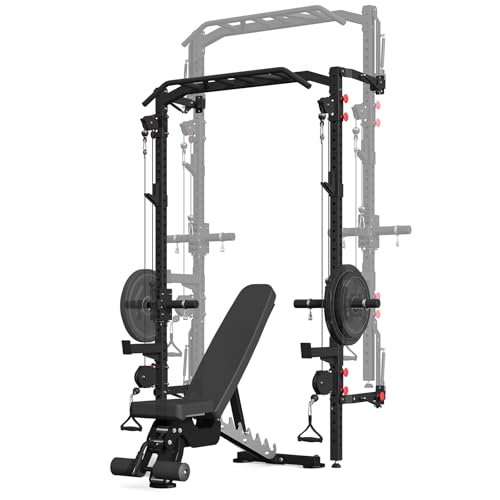
Best for: a mid-size room where the rack folds to a 6-inch depth Skip it if: you need a stated capacity figure before you commit
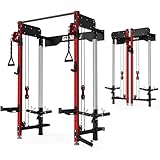
The Danrelax opens to a 46.5 x 18.9 inch footprint and folds flat to 46.5 x 6 inches, per the listing, in a 86.6 x 17.7 x 50.4 inch shipping envelope. The frame weighs 100 lb. Danrelax describes an independent dual pulley system with a true 1:1 cable ratio, a multi-grip pull-up bar, J-hook barbell holders, dip handles, safety spotter arms, cable handles, a low pulley station and plate storage.
For the middle of this shortlist that is a lot of station, and the 18.9-inch open depth is narrower than the Cheetah's 30 inches, which matters in a shallow garage. If your ceiling is 87 inches or more, the Danrelax can sit under it without touching. What is missing is a published load rating: the listing talks about heavy-duty framing but does not commit to a number, so a lifter chasing a specific squat max will want the MU or the JELENS instead.
The one-year warranty is standard for the group and matches everything except the Mikolo QJ01.
Pros:
- 1:1 cable ratio, dual pulley system claim
- Folds to 6 inches of wall depth
- Narrow 18.9-inch open depth
- Full accessory bundle including dip handles
Cons:
- No published capacity figure
- Slowest seller of the seven here
- Premium price position for a rack without a stated load
- Fewer specifications published than the Mikolo picks
4. Mikolo 2" x 2" Folding Wall Mounted Squat Rack — Best for pros
Mikolo's QJ01 is the only rack in the shortlist with a published 2-year warranty and UHMW-lined J-cups.

Best for: a serious lifter who wants a 2-year warranty and UHMW-lined J-cups Skip it if: you want an integrated pulley system
The QJ01 is 86 inches tall, 47 wide and 22 deep when open, and the frame weighs 80 lb. Mikolo rates it to 1000 lb, and the pull-up bar reaches 89 inches off the ground once mounted, which suits taller lifters better than a bar hard-capped at the frame top. UHMW plastic inside the J-cups is the detail I would pay for: it protects the knurl on a barbell where painted or bare steel J-cups will chew it up over a few hundred rack-outs.
The warranty is where this pick separates. Two years, against one year for every other rack here, is a real signal for a buyer keeping the rack for the long run. The kit includes safety catches, a pull-up bar, J-hooks and a landmine attachment, plus the stringer and metal studs for mounting.
The trade against the Cheetah sibling is straightforward. No pulley system. If you want cables, you buy the Cheetah and pay for it. If you want a barbell rack that will last, this is the correct Mikolo.
Pros:
- 2-year warranty, the longest here
- UHMW-lined J-cups protect the bar knurl
- 89-inch pull-up bar height claim
- 1000 lb capacity claim
- Safety catches included
Cons:
- No cable pulley system
- Mid-price position, above the MU
- Frame is lighter than the Cheetah at 80 lb
5. GOIMU WM3-V4 Folding Squat Rack — Best minimal setup
GOIMU claims a 4.3 sq ft folded footprint, the smallest closed shape in the shortlist.

Best for: a tight room where a 4.3 sq ft folded footprint matters most Skip it if: you need a published weight capacity to feel confident
The GOIMU opens to 85 x 33.5 x 50 inches and, per the listing, collapses to 4.3 sq ft against the wall. It is the second-most expensive pick and it is the fastest seller of the seven, which puts it above the other cable-equipped racks on turnover. GOIMU describes dual independent 1:1 cable machines, 15 adjustable pulley heights, a detachable pull-up bar and quick-swap J-hooks and safety arms.
For a room that has to serve two purposes, this is the argument. A dual cable machine you can fold to under 5 sq ft leaves the floor open for a mat, a bike or an office chair between sessions. The colour is the same black and red as the MU, which is a small thing but suggests a similar manufacturing origin.
What is missing is a published capacity, which is a repeat complaint at the premium end of this shortlist. If you are a beginner adding a rack to a spare room, that gap is fine. If you know you will train heavier over three or four years, buy the QJ01 or the MU and add cables separately.
Pros:
- 4.3 sq ft folded footprint claim
- Dual 1:1 cable machines with 15 pulley heights
- Fastest seller of the seven here
- Quick-swap J-hooks and safety arms
- 5 adjustable function modes described
Cons:
- No published maximum load rating
- 50-inch open depth needs floor clearance
- Premium price position
- 1-year warranty only
6. JELENS FS01 Folding Squat Rack — Runner-up
JELENS matches the top pick's 1100 lb capacity claim at a similar entry price, with a slightly wider open footprint.
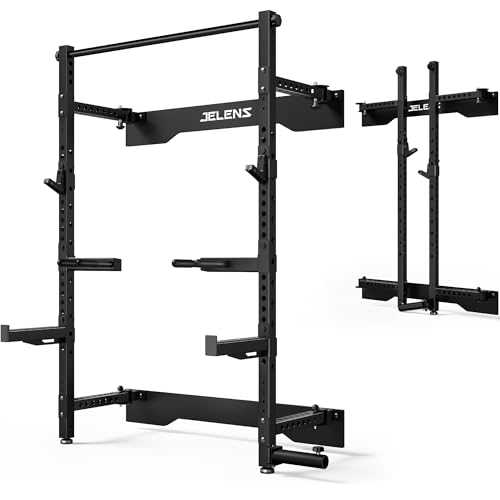
Best for: a first rack when the top pick is unavailable Skip it if: you want the two-inch folded depth of the MU
The JELENS FS01 is 86.2 inches tall, 50.7 wide and 23.6 deep. JELENS describes 2x2 inch heavy-duty steel pipes and a 1100 lb safe working load, with J-hooks, a pin-on pull-up bar and a 360-degree landmine attachment. Mounting hardware includes pre-drilled stringers and metal studs.
Against the MU, the differences are small. The FS01 is about three inches wider and two inches deeper when open, and the listing does not publish a folded depth, so the shortest-closed prize goes to MU. The rest of the spec is close enough that if the MU is out of stock or ships slower than you can wait for, the FS01 is a straightforward substitute.
The category slot here is deliberate. If you are choosing between the two, choose the MU. If the MU is not available, choose this one before you reach for the cheaper Mdeam, because you keep the 1100 lb rating and the pre-drilled stringers.
Pros:
- 1100 lb capacity claim, matching the top pick
- Pre-drilled stringers and metal studs included
- Pin-on pull-up bar and 360 degree landmine
- Entry price position
Cons:
- No published folded depth
- Wider and deeper open footprint than the MU
- Sells more slowly than the GOIMU or Cheetah
- 1-year warranty
7. Mdeam Folding Squat Rack — Best budget pick
Mdeam is the cheapest of the seven and still gets you 60mm uprights and a 1000 lb rating.
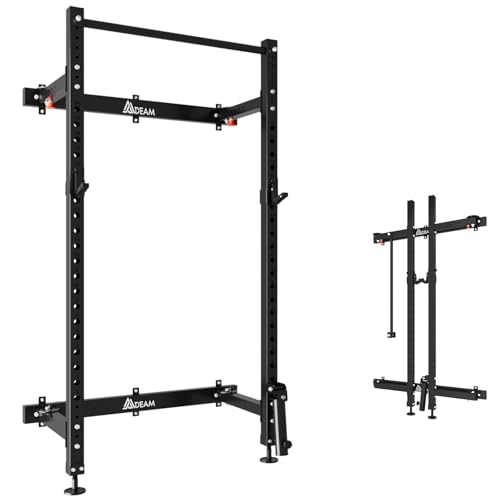
Best for: the cheapest way into a wall-mounted 60mm rack with a 1000 lb rating Skip it if: you want cable attachments or a landmine on a longer warranty
The Mdeam opens to 25 x 44 x 87 inches and, per the listing, folds down to a 44 x 87 inch flat shape. Mdeam says the switch between storage and use takes about 15 seconds, and the frame is built from 60x60mm steel uprights with a textured powder coat, rated to 1000 lb. Wall-mounting brackets and stabilizer leveling feet are described in the listing, and the kit includes a landmine, a pull-up bar and J-hooks.
At the cheapest position in this shortlist, the case is simple. If you want to know the cost of entry to a wall-mounted folding rack with real 60mm uprights and a published capacity, this is it. The upright size is metric-adjacent rather than the 2-inch square standard the other six use, which means aftermarket 1-inch-hole accessories built for 2x2 racks are not a guaranteed fit. That is the trade-off you are making.
If you plan to add cables, dips or a proper safety arm system later, spend the extra on the MU or the JELENS and keep your accessory options open.
Pros:
- Cheapest pick here
- 60x60mm steel uprights
- 1000 lb capacity claim
- Landmine, pull-up bar and J-hooks included
- Stabilizer leveling feet on the base
Cons:
- 60mm uprights are not the 2x2 inch aftermarket standard
- No published folded depth against the wall
- Fewer accessory options than the 2x2 racks
- 1-year warranty
Wall, floor and ceiling: will your room actually take one?
The best folding squat rack for home gyms is the one that fits your room, so measure before you buy. Three checks catch most of the problems.
- Ceiling height. Every rack here is between 85 and 87 inches tall. Add at least 6 inches of clearance above the pull-up bar so your head has somewhere to go. That is a 91 to 93 inch minimum ceiling in the exact spot where the rack will mount, not the middle of the room.
- Wall framing. Wall-mounted racks bolt into wood studs on 16-inch centres. Find your studs with a magnet finder before you order, because the Mikolo QJ01, the JELENS FS01 and the Mdeam all ship with pre-drilled stringers sized for standard framing. Metal studs, brick, concrete or lath-and-plaster all need a different fastener plan.
- Open floor depth. The narrowest open depth here is the Danrelax at 18.9 inches. The deepest is the Mikolo Cheetah at 30 inches. Add the length of a 7-foot Olympic bar loaded with plates, plus room to step back for a walkout, and the working footprint is closer to 7 feet deep than 3.
Two more things buyers overpay for. First, the number of accessories bundled with the rack. Landmines, pull-up bars and J-hooks are cheap; the frame is the expensive part. Second, exotic capacity numbers. The gap between a 1000 lb rating and a 1100 lb rating is not the gap that decides your rack.
Which folding rack should you pick?
Rank your priorities in this order and the answer usually falls out:
- Do you need a cable machine at home? If yes, the Mikolo Cheetah or the GOIMU. If no, the MU.
- Do you want the longest warranty on the frame? Mikolo QJ01, 2 years.
- Is price the constraint? The Mdeam at entry level, or the MU if you can stretch to it.
- Is folded depth the constraint? The MU folds to 2 inches. Nothing else in this shortlist beats that.
The verdict
The best folding squat rack for home gyms is the MU 2" x 2" Folding Squat Rack. It publishes the 1100 lb capacity, it folds to a 2-inch depth against the wall, it ships with a landmine, a pull-up bar and J-hooks, and it uses the 2x2 inch upright with 1-inch accessory holes that the aftermarket is built around. At the second-cheapest price position in the shortlist, that is a strong package for a garage lifter.
Two conditions flip the pick. First, if you want a real cable machine at home in the same footprint, the Mikolo Folding Squat Rack with the Cheetah frame is the better buy: it adds a dual independent pulley system with 15 height settings and a 14-gauge 2x2 inch steel frame, at the highest price position here and the deepest open footprint at 30 inches. Second, if you plan to keep the rack for several years and you want a longer warranty on the frame, the Mikolo QJ01 is the answer, with a published 2-year term against one year for everything else and UHMW-lined J-cups that protect the barbell knurl.
The two runners-up cover the edges. The JELENS FS01 stands in for the MU if it is unavailable. The Mdeam is the cheapest way into the category if you can live with 60mm uprights instead of the 2x2 inch standard.
FAQ
How much ceiling height does a folding squat rack need?
How much ceiling height you need is 91 to 93 inches at a minimum, above the exact patch of floor where the rack will mount. Every rack in this shortlist stands 85 to 87 inches tall, and the pull-up bar sits near the top. You want at least 6 inches of clear space above the bar for your head. A basement with 84-inch joists is too short for this category.
Is a folding squat rack worth it compared with a full power cage?
A folding squat rack is worth it when floor space matters more than the extra features a four-post cage adds. A folding rack gives you back 20 to 30 inches of floor between sessions and mounts to studs, so it disappears against the wall. A full cage does not fold, needs more depth, and adds a back pair of uprights for behind-the-bar safeties. Choose folding when the room does other things too.
Will 2x2 inch accessories from other brands fit these racks?
Yes, on six of the seven. The MU, Mikolo Cheetah, Danrelax, Mikolo QJ01, GOIMU and JELENS FS01 all use 2x2 inch uprights with 1-inch accessory holes, which is the common aftermarket standard. Spotter arms, dip attachments and monolift J-cups built for that hole spacing drop in. The Mdeam uses 60x60mm uprights instead, so third-party fit is not guaranteed.
MU 2x2 or Mikolo Cheetah: which folding rack is right for me?
MU or Mikolo Cheetah depends on cables. The MU is the answer when you want a barbell-only rack that folds to a 2-inch wall depth and publishes an 1100 lb capacity at an entry price. The Cheetah is the answer when you want a dual independent pulley system, a lat pulldown and a squat rack in the same wall footprint, at the highest price position here and a 30-inch open depth.
What is the biggest mistake buyers make with folding squat racks?
The biggest mistake buyers make is choosing the rack before measuring the wall it will mount to. Metal studs, brick or masonry need a different fastener kit than wood framing, and none of these racks ship with the hardware for anything except standard 16-inch on-centre wood studs. Confirm your framing with a stud finder and a magnet before you order, not after the rack arrives.
Buy the rack once, mount it once, and use it for years. The MU 2" x 2" Folding Squat Rack is the default because it does the three jobs a folding rack has to do well: it publishes a load rating, it folds nearly flat against the wall, and it takes the accessory ecosystem the rest of the strength market is built around. Order a stud finder if you do not have one, mark your framing before the rack ships, and pick up a set of longer lag bolts if your drywall runs over half an inch thick. Then you can spend the next weekend lifting instead of returning a rack that never fit.