Best Power Rack for Recovery: XGSW L02 Leads
Coming back from a training break needs a rack that scales down as well as up. Five power cages compared on capacity, footprint and adjustment range.

By Lauren RossUpdated 14 min read
On this page
- How I narrowed the field to five power cages
- Best power rack for recovery at a glance
- 1. XGSW XINGESIWR L02 Power Cage — Best overall
- 2. Goimu DP01 Power Cage — Best for heavy use
- 3. Sportsroyals RK2 Squat Rack — Best for families
- 4. CAP FM-CS7000F Power Rack — Best budget pick
- 5. JELENS S11 Power Cage — Most versatile
- What actually matters for a recovery-friendly rack?
- Footprint and ceiling: will it fit your space?
- Steel gauge, capacity and why the numbers mislead
- How much rack do you really need to come back?
- The verdict
- FAQ
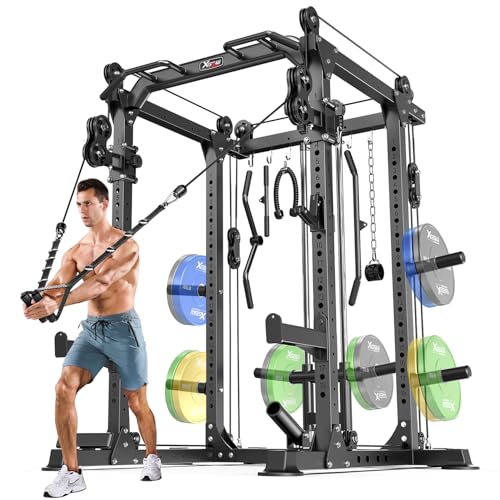
The best power rack for recovery is the XGSW XINGESIWR L02, a full cage measuring 83.4 x 83.4 x 59.8 in with a stated 1,800 lb load rating and a cable crossover built into the frame. It gives a returning lifter room to switch between barbell work and pulley work without swapping stations. If your ceiling is tight, the Goimu DP01 is shorter at 46.5 in deep and still claims 2,000 lb of capacity.
How I narrowed the field to five power cages
Most people compare racks on the steel-tube size printed on the listing. That is not what decides this purchase, especially for anyone coming back from injury or a long layoff. A returning lifter is not going to load 2,000 lb. What matters is whether the rack holds a barbell and a cable stack in the same footprint, whether the safeties adjust in small enough increments to catch a failed rep at half your old working weight, and whether the frame fits under your ceiling.
I started with power cages listed under "Racks & Cages > Power Cages" and cut anything without a stated capacity, a stated footprint, and at least one attachment beyond J-hooks. That left five. Three of the five publish a cable pulley system. Two do not. Four claim capacities at or above 1,200 lb. One is rated at 300 lb and earns its place on price alone.
A note on the recovery angle. Amazon's search did not filter these for rehab or recovery use, and none of the five is marketed as a medical or therapy product. Recovery in this article means training that starts light, progresses in small jumps, and needs the option to bail safely. Whether any specific rack suits your recovery is a call for you and your physio, not a claim I can make from a listing.
Best power rack for recovery at a glance
| Pick | Load rating | Cable system? | Price |
|---|---|---|---|
Best overall XGSW L02 Power Cage |
1,800 lb claim | Cable crossover | Check Price |
Best for heavy use Goimu DP01 Power Cage |
2,000 lb claim | Dual independent pulley | Check Price |
Best for families Sportsroyals RK2 Squat Rack |
1,200 lb claim | Lat pulldown pulley | Check Price |
Best budget pick CAP FM-CS7000F Power Rack |
300 lb capacity | None listed | Check Price |
Most versatile JELENS S11 Power Cage |
2,000 lb claim | Adjustable pulley | Check Price |



1. XGSW XINGESIWR L02 Power Cage — Best overall
The best power rack for recovery in this set is the L02, because it pairs a full 83.4 in cage with a cable crossover in one frame.
Best for: a returning lifter who wants cable work and free-weight work in one frame Skip it if: your ceiling sits under 84 inches
The L02 is the only pick here that combines full-cage geometry (83.4 x 83.4 x 59.8 in) with a cable crossover system and a 2-year manufacturer warranty. That combination matters for a comeback. On light days, a lifter can run cable rows, tricep pushdowns and crossovers without loading the bar at all. On barbell days, the J-hooks and safeties adjust in multi-level increments the listing describes as suitable for whole-family use. XGSW says the frame handles up to 1,800 lb during training, which is comfortably above what any solo recovery block will demand.
The trade-off is size and price. This is the most expensive pick here and the tallest, and the 83.4 in width means it will not tuck under a low basement joist. It is also the slowest seller of the six by a wide margin, so shipping and support may take longer than the more common Goimu or Sportsroyals frames. Only one seller lists it.
Pros:
- 1,800 lb claimed frame capacity
- Cable crossover integrated into the cage
- 2-year manufacturer warranty
- Multi-level J-hook and safety adjustments
- Numbered parts for guided assembly
Cons:
- The most expensive pick here
- Tallest footprint at 83.4 in
- Slowest seller of the five, so support is untested at volume
- Only one seller listed
2. Goimu DP01 Power Cage — Best for heavy use
Pick the DP01 when the rack will see two lifters a day and you want the highest published capacity in this set.

Best for: households running two lifters through the rack daily Skip it if: you rarely load past bodyweight
The DP01 publishes a 2,000 lb capacity built on 2 x 2 in steel tubing, matching the JELENS on paper but with a more detailed pulley story. Goimu describes a 2:1 cable ratio with dual independent pulleys and 31 + 29 height positions, which the listing frames as a precision-adjustment system. For a household where one person is rebuilding and another is training normally, that adjustment range is the real advantage: the recovering lifter can drop the pulley height an inch at a time to work around a sore shoulder.
The dimensions read 84.3 x 57.9 x 46.5 in, so the depth (46.5 in) is the shallowest of the three full cages here. That helps in a narrow garage bay. The 2-year warranty matches the L02. What Goimu does not publish is a total weight for the frame, which makes freight and floor-loading harder to plan than with the Sportsroyals or CAP racks.
Pros:
- 2,000 lb claimed capacity
- Dual independent pulleys with 2:1 ratio
- 31 + 29 height positions per side
- Shallowest depth of the full cages at 46.5 in
- 2-year warranty
Cons:
- Total frame weight not listed
- No published gauge on the steel tubing
- Only one seller stocks it
- Expandable design implies extra parts sold separately
3. Sportsroyals RK2 Squat Rack — Best for families
A mid-priced cage with the most complete accessory story here, and the only one whose total weight is published.

Best for: multiple users sharing one rack across different heights Skip it if: you plan to load past four plates a side
The RK2 is the second-cheapest here and the only pick with a stated frame weight (150 lb), a 14-position adjustable pillar, and a full accessory kit built in. Sportsroyals lists 50 x 50 mm commercial steel at 1.5 mm thickness, a lat pulldown pulley, a power tower, dip bars, one barbell holder, six weight-storage pegs and six handle-storage pegs. For a family cycling adults and teenagers through the same rack, that combination of adjustment range and included attachments removes several separate purchases.
Two things pull the RK2 down the ranking. The capacity claim is 1,200 lb, which is well under the Goimu and JELENS 2,000 lb figures. That ceiling is still far above what a recovery block needs, but a family with a heavy lifter will hit it first here. The warranty is one year, half of what the L02 and DP01 offer. And the count field on the listing reads 13 pieces, which suggests a longer assembly than the four-piece CAP frame.
Pros:
- Lat pulldown and dip station included
- 14 adjustable pillar positions
- Six weight-storage pegs plus barbell holder
- Published frame weight of 150 lb
- 1.5 mm steel thickness stated
Cons:
- 1,200 lb capacity is the lowest of the full cages
- One-year warranty
- Thirteen-piece build takes longer
- Only one seller listed
4. CAP FM-CS7000F Power Rack — Best budget pick
The cheapest of the five and the one buyers choose most often here, but it is a light-duty open frame, not a full cage.

Best for: first-time buyers rebuilding a light barbell routine Skip it if: you want cable attachments included
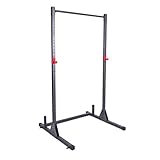
The CAP FM-CS7000F is the cheapest of the six and sells faster than the rest of this set by a wide margin. That sales pattern is worth taking seriously: this is where most home-gym buyers actually start. The frame uses 12- and 14-gauge steel with welded seams and double-gusseted uprights, an overhead pull-up bar, and adjustable bar catches for squats, presses and curls. Footprint is 85.4 x 45.7 x 50.8 in and the frame weighs 54 lb, the lightest here by a large margin.
The trade-offs are real. Capacity is stated at 300 lb, which is a hard ceiling for a returning lifter with strong pre-injury numbers. There is no cable system, no lat pulldown, and the warranty is 30 days. It has been on sale since 2017, which is why the pricing is what it is. Treat it as a starter frame for someone whose recovery block will not push past 225 lb on the bar, and plan to replace or upgrade if strength returns quickly.
Pros:
- The cheapest pick here by a wide margin
- The one buyers choose most often in this set
- Double-gusseted uprights with welded seams
- Integrated bar and plate storage
- Floor-anchor points included
Cons:
- 300 lb capacity limits progression
- 30-day warranty is the shortest here
- No cable or pulley system
- Not a full cage, so no inside-the-frame safety catches
5. JELENS S11 Power Cage — Most versatile
A budget-priced full cage with a 2,000 lb capacity claim and the smallest published footprint of the full cages.

Best for: a lifter juggling barbell days and cable-only recovery days Skip it if: you need more than a one-year warranty
The JELENS S11 is the second-cheapest pick here and the only entry-price frame with a published 2,000 lb capacity. JELENS lists 50 x 50 mm heavy-duty steel, an up-and-down pull-down pulley, and a cage size of 57.5 x 44.5 x 79.7 in on a total 12.5 sq ft footprint. For anyone building a home gym in half a garage or a spare bedroom, that footprint is the smallest of the three full cages and gives a returning lifter both barbell safeties and a pulley for lighter days.
The gap between this rack and the Goimu above it is warranty and detail. JELENS publishes one year against Goimu's two, and the pulley description is less specific than Goimu's 2:1, dual-independent story. On raw capacity and space, though, the S11 is the strongest value here. Assembly detail is not spelled out in the listing, so plan for a full afternoon build.
Pros:
- 2,000 lb claimed capacity
- Compact 12.5 sq ft footprint
- Adjustable pulley system included
- Second-cheapest of the five
- 50 x 50 mm steel tubing
Cons:
- One-year warranty
- Pulley ratio not stated
- Total frame weight not listed
- Only one seller stocks it
What actually matters for a recovery-friendly rack?
Recovery training is not lighter regular training. It is training with two extra requirements: the option to bail safely at any point in the range, and small enough load jumps that you can add weight in inches rather than plates. That reframes what a good rack looks like.
Three things matter more than raw capacity:
- Safety-bar adjustment increments. Fine steps let you set catches an inch below the sticking point of a healing joint. The L02 and Goimu emphasise multi-level adjustment; the Goimu lists 31 positions per side.
- A cable option. On days the barbell is not the right tool, a pulley lets you keep the training slot without loading the spine. Four of five picks include one.
- Space to move inside the cage. A cramped cage forces awkward setups. The L02's 83.4 in width is the most generous here.
Capacity is a check-the-box requirement, not a decider. Any of the four full cages holds more weight than a recovery block will call for.
Footprint and ceiling: will it fit your space?
Every rack here needs measured before it is bought. Standard ceilings in North American homes run 96 in, garage ceilings often less. Only one rack in this set clears 84 in tall, and every buyer needs headroom above the pull-up bar to actually use it.
Published heights, tallest to shortest:
- Goimu DP01: 84.3 in
- CAP FM-CS7000F: 85.4 in
- XGSW L02: 83.4 in
- Sportsroyals RK2: 82.6 in
- JELENS S11: 79.7 in cage height
Depth matters more than most buyers expect. A shallow cage is harder to press or squat inside because the safety bars sit closer to the uprights. Depths run from 44.5 in (JELENS) to 59.8 in (XGSW L02). If you plan to use a standard 7 ft Olympic bar, check that the width between the uprights leaves room for your collars and plate stack.
Add at least 24 in behind the rack for cable travel if it has a pulley, and 36 in of clear space in front so you can walk a bar out. That is the working footprint, and it is always larger than the frame footprint on the listing.
Steel gauge, capacity and why the numbers mislead
Rack capacity numbers are load claims, not test results. A 2,000 lb figure means the manufacturer states the frame can hold that load. It does not mean the frame has been third-party tested to that load, and the listings here do not publish test standards.
Two data points make the numbers more useful:
- Tube dimensions. Goimu lists 2 x 2 in tubing. JELENS and Sportsroyals both list 50 x 50 mm, which is 1.97 x 1.97 in and effectively the same. CAP lists 12- and 14-gauge steel, which describes wall thickness rather than tube size. XGSW describes commercial steel without a tube dimension.
- Wall thickness. Only Sportsroyals publishes it, at 1.5 mm.
For a solo recovery lifter, all four full cages are overbuilt. The CAP's 300 lb rating is the only one to think about carefully, and even that is enough for a 200 lb lifter squatting a body-weight bar. The stability difference you will actually feel comes from anchoring the rack to the floor, which the CAP listing calls out and the others do not.
How much rack do you really need to come back?
Most first-time buyers overbuy. If your recovery block starts at an empty bar and works up to your body weight over a few months, none of the specs listed here will limit you. The rack that helps most is the one that lowers the friction of showing up on a bad day.
That means three practical things:
- A pulley system so cable-only sessions are possible when the bar feels wrong.
- Adjustment increments small enough to match your current range.
- A footprint you will not resent parking your car around.
If ceiling and floor space are tight, the JELENS S11 at 79.7 in cage height and 12.5 sq ft is the honest answer. If you have the room and want the longest warranty, the XGSW L02 gives you two years and a cable crossover in the same frame. If cost is the deciding factor, the CAP FM-CS7000F is the entry point, with the caveat that it caps at 300 lb.
The verdict
The best power rack for recovery in this set is the XGSW XINGESIWR L02. It is the only cage here that pairs an 83.4 x 83.4 x 59.8 in interior with a cable crossover system and a 2-year manufacturer warranty, and its 1,800 lb capacity claim covers any load a recovery block will demand. That combination lets a returning lifter switch between light barbell work and pulley-only sessions inside one frame, which is the single feature that most changes how often a comeback plan actually gets trained.
Two conditions flip the pick. If a household is running two lifters through the same rack every day, the Goimu DP01 is the better call: the 2:1 dual-independent pulley and 31 + 29 height positions give two people fine-grained shared setup, and the 46.5 in depth fits narrower bays. If ceiling height is under 84 in or floor space is limited, the JELENS S11 wins on 79.7 in cage height and a 12.5 sq ft footprint, though you accept a one-year warranty and less pulley detail.
The CAP is the cheapest and the one buyers choose most often, but its 300 lb ceiling and 30-day warranty make it a starter, not a long-term answer.
FAQ
Is a power rack worth it for recovery training?
A power rack is worth it for recovery training when you need safety catches for solo lifting and cable options for days the bar feels wrong. Four of the five picks here include a pulley, so a recovering lifter can rotate barbell work with cable rows and pushdowns inside the same frame. If your plan is bodyweight only, a doorway pull-up bar is enough.
What is the difference between the XGSW L02 and the Goimu DP01?
The difference between the XGSW L02 and the Goimu DP01 is depth, pulley detail and floor plan. The L02 measures 83.4 x 83.4 x 59.8 in with a 1,800 lb claim and a cable crossover. The DP01 is 84.3 x 57.9 x 46.5 in with a 2,000 lb claim and a 2:1 dual-independent pulley system. Both offer a 2-year warranty.
How much ceiling height do I need for these racks?
You need ceiling height above every rack's stated frame height plus room to complete a pull-up. Frame heights in this set run from 79.7 in (JELENS S11) to 85.4 in (CAP FM-CS7000F). A 96 in ceiling clears all five, but a garage bay under 90 in rules out the CAP and the Goimu. Measure with any garage-door tracks accounted for.
Can the CAP FM-CS7000F handle heavy squats?
The CAP FM-CS7000F carries a published 300 lb capacity, so it does not handle heavy squats in the powerlifting sense. For a recovering lifter working with an empty bar or body-weight loads, that ceiling is fine. Anyone with pre-injury numbers above 225 lb should pick one of the full cages here, which all claim between 1,200 and 2,000 lb.
Is the best power rack for recovery always a full cage?
The best power rack for recovery is usually a full cage, because the enclosed frame lets safety bars catch a failed rep on all four sides of the lifter. Open frames like the CAP work for lighter comebacks, but a full cage is the safer default for solo training. The L02, DP01, RK2 and S11 in this set are all full cages.
Start with the ceiling measurement, then the floor plan, then the warranty. If all three point at the XGSW L02, that is the rack. If your ceiling comes in under 84 in or the footprint has to slot into a narrow bay, the JELENS S11 does the same job with a smaller frame and a shorter warranty. The reason the L02 leads for anyone rebuilding is quiet: it removes the excuse of "not today" by giving you two ways to train inside one frame, and a rack that gets used four days a week beats a rack rated for weights you will never lift.