Best Quiet Non Slip Yoga Mat: Gruper TPE Wins

Five yoga mats compared on thickness, weight and material. The Gruper 6mm TPE mat leads, with a 10mm Gaiam and a PU-topped IUGA close behind for specific needs.

By Lauren RossUpdated 14 min read
On this page
- Best quiet non slip yoga mat at a glance
- How I cut the field down to five
- 1. Gruper Yoga Mat — Best overall
- 2. Gaiam Essentials Thick Yoga Mat — Best upgrade
- 3. IUGA Pro Non Slip Yoga Mat — Best premium
- 4. Gaiam Yoga Mat Classic Print — Best budget pick
- 5. VTORY Large Yoga Mat — Best minimal setup
- What actually makes a yoga mat quiet?
- Thickness, weight and the trade-off nobody explains
- Which mat fits your floor and your practice?
- What the listings don't tell you about grip
- The verdict
- FAQ
The best quiet non slip yoga mat here is the Gruper Yoga Mat, a 6mm TPE mat weighing 1.65 lb with a sticky texture on both faces that hushes hand slaps and dulls the thud of a stepped foot. If you want deeper cushion for kneeling work, the Gaiam Essentials 10mm NBR foam mat is the pick, and it's the fastest seller of the five here.
Best quiet non slip yoga mat at a glance
| Pick | Thickness | Weight | Price |
|---|---|---|---|
Best overall Gruper Yoga Mat |
6mm (0.24 in) | 1.65 lb | Check Price |
Best upgrade Gaiam Essentials Thick Yoga Mat |
10mm (0.39 in) | 2.8 lb | Check Price |
Best premium IUGA Pro Non Slip Yoga Mat |
0.2 in | 2.5 lb | Check Price |
Best budget pick Gaiam Classic Print Yoga Mat |
4mm | 2.09 lb | Check Price |
Best minimal setup VTORY Large Yoga Mat |
6mm (0.25 in) | not listed | Check Price |


How I cut the field down to five
The yoga mat category on Amazon is enormous, and most of it competes on colour and print, not on the two things that decide a practice: how the mat sounds and grips on a hard floor, and how it treats your knees. Three profiles guided the shortlist here.
The first profile is the apartment yogi on hardwood or laminate: someone who wants the best quiet non slip yoga mat because a downstairs neighbour reacts to noise. That reader needs a soft, sticky top and enough mass to sit still.
The second profile is the joint-sensitive practitioner. Kneeling on 4mm is punishment on tile. This reader will trade portability for real cushion.
The third profile is the hot yoga or sweaty-flow practitioner. They need a surface that holds grip when it's wet, which is a different problem from grip on a dry floor.
Then I cut. Anything with no published thickness got dropped. Anything sold as a "workout mat" first and a yoga mat second was set aside unless it earned its place. What's left are five mats that between them cover the three profiles, plus a wide-format outlier and an entry-price starter.
1. Gruper Yoga Mat — Best overall
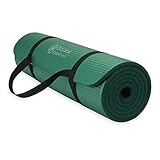
A 6mm TPE mat that is light enough to carry, thick enough for a beginner's knees, and sticky on both sides so it stays put and stays quiet.
Best for: hard floors and shared walls where a soft, sticky mat kills the thud Skip it if: you want the widest possible practice area
The Gruper sits in the sweet spot of this set. At 1.65 lb it's the lightest mat here by a clear margin, roughly 40% lighter than the 2.8 lb Gaiam Essentials, and that matters if the mat lives in a closet and comes out daily. The 6mm thickness gives you enough foam to take a knee without wincing, without the sponginess that turns a plank into work.
Gruper says the mat uses a "special sticky non slip texture on both sides" and calls the material an upgraded eco-friendly TPE. Two-sided grip is the useful part of that claim: flip the mat if one side wears smooth, and the underside anchors to a hard floor rather than skating on it. TPE is also softer underfoot than the PVC used on the budget Gaiam, which is part of why it hushes footfalls.
The trade-off is width. You get the standard 24 in, not the 26 in of the IUGA or the 58 in of the VTORY. If you're tall or you sprawl in savasana, the extra inches elsewhere might matter more than the weight saving here.
Pros:
- Lightest mat in the set at 1.65 lb
- Sticky texture on both faces for flip-and-reuse
- Softer TPE feel than the PVC entry pick
- Carry strap and storage bag included
- Sits at a mid price for the group
Cons:
- Only 24 in wide, same as the cheapest pick
- No published warranty
- TPE can indent under a heavy stationary load
2. Gaiam Essentials Thick Yoga Mat — Best upgrade
A 10mm NBR foam mat that turns a hard floor into a forgiving one, and the fastest seller of the five here.

Best for: kneeling-heavy practice or physical therapy work on a hard floor Skip it if: you carry your mat to a studio every day
Ten millimetres is a lot of mat. That's more than 50% thicker than the 6mm Gruper and more than double the 4mm Gaiam Classic. If your knees complain in low lunge or your wrists ache in tabletop, this is the pick that fixes it. Gaiam describes the fill as "high-density NBR foam" aimed at reducing pressure on knees, hips and joints.
There are two costs. First, weight: at 2.8 lb it's the heaviest mat in this group, and rolled up it's a fat sausage. Second, the surface. NBR is a foam, not a rubber, and Gaiam frames the top as "textured foam" that "helps reduce slipping on most hard floors during dry workouts". That's a narrower promise than the PU grip on the IUGA, and it's worth taking at face value: this mat is for dry practice, physical therapy and stretching, not hot yoga.
It's the fastest seller of the five here, which fits: this thickness is what most people wish their studio mat had. It also released in 2018 and the design has stuck around, which counts for something in a category full of one-season products.
Pros:
- 10mm cushioning, the deepest in the set
- Fastest-selling mat of the five here
- Adjustable cinch strap included
- Foam is easy to wipe clean
- Available at an entry-tier price position
Cons:
- Heaviest mat here at 2.8 lb
- Foam surface, not sticky rubber grip
- Not framed for sweaty or hot practice
- Thick foam can feel wobbly in standing balances
3. IUGA Pro Non Slip Yoga Mat — Best premium
A PU-topped rubber mat aimed squarely at sweat, at the highest price position in this set.
Best for: hot yoga or a sweaty flow where PU grip earns its keep Skip it if: you want maximum cushion under bony knees
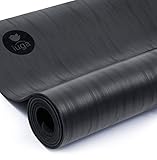
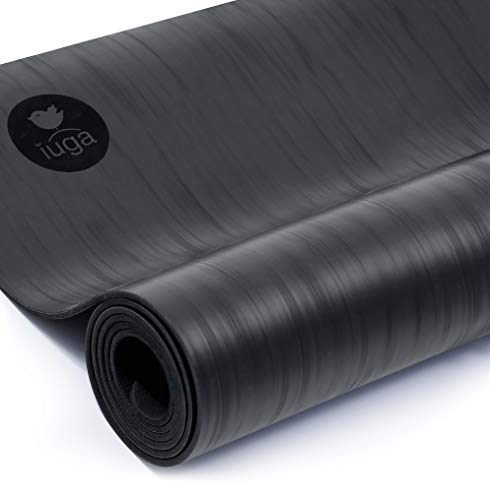
Hot yoga breaks most mats. Foam gets slick, PVC beads sweat, and by the third sun salutation your hands are drifting forward in downward dog. The IUGA Pro answers that with what the listing describes as "a PU top layer and textured base" that "instantly absorbs sweat and provides exceptional grip exactly where you need it". The base is tree rubber; the top is polyurethane. That combination is what dedicated hot yoga mats use.
At 26 in wide, it's the widest mat in the set apart from the oversized VTORY, and at 0.2 in thick it's the thinnest. That's not a mistake. A thinner mat gives you a firmer connection to the floor, which helps balance poses. IUGA says the mat is 2.5 lb, and the anti-tear mesh core is a real durability claim rather than a texture claim.
Two honest weaknesses. The price sits at the top of this group, so a casual gentle-flow practitioner is overpaying for grip they won't need. And a rubber-and-PU mat is heavier and less forgiving than foam if kneeling dominates your practice.
Pros:
- PU top designed to absorb sweat
- Widest standard mat here at 26 in
- Tree rubber base, no PVC or TPE
- Reinforced mesh core for tear resistance
- Lightweight for a rubber mat at 2.5 lb
Cons:
- Highest price position in the set
- Thinnest mat here at 0.2 in
- Slowest seller of the five here
- PU top needs damp-cloth care, not machine wash
4. Gaiam Yoga Mat Classic Print — Best budget pick
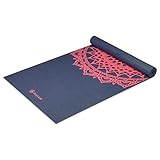
A 4mm PVC mat at the cheapest price position, sized for a shorter practitioner or a first-timer.
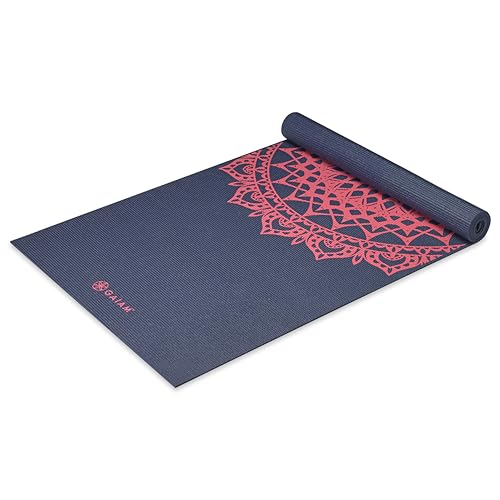
Best for: a first mat for gentle flow on carpet or a rug Skip it if: you practice on tile and want real cushion
This is the cheapest mat in the set and the shortest, at 68 in long. Most standard mats are 72 in, so if you're taller than about 5'8" your head or feet will hang off the end in savasana. It's also 4mm thick, which is thin enough that a hardwood floor will remind your knees it's there.
What it does well is grip on carpet. Gaiam describes a "textured sticky non-slip surface", and PVC is genuinely sticky when it's new. The material is called out as 6P-free, meaning free of six regulated phthalate plasticisers, which is a reasonable baseline for a mat you sweat on.
At 2.09 lb it's heavier than the 6mm Gruper despite being thinner, which is PVC's fault, not Gaiam's. And with only one seller listing it, availability is a coin flip in a way it isn't for the other four picks. The best case for this mat is clear: a beginner who wants to try yoga without committing, on a soft floor, without spending much.
Pros:
- Cheapest position in the set
- Sticky PVC surface grips carpet well
- 6P-free PVC formulation
- Compact roll for a small closet
Cons:
- Shortest mat here at 68 in
- Thinnest foam-style option at 4mm
- Only one seller currently listed
- PVC feel is firmer and less quiet than TPE
5. VTORY Large Yoga Mat — Best minimal setup
A 6mm HPE mat that's 58 in wide, built for the practitioner who wants floor space instead of a rug.

Best for: a home practice that shares the mat with a partner or a kid Skip it if: you need a warranty or a published weight
The VTORY is the odd one out here, and useful for it. At 58 in wide it's more than twice as wide as any other mat in this set, and it turns a corner of the living room into a permanent practice zone. VTORY says the mat "delivers balanced shock absorption to relieve sore knees, elbows and wrists" and calls the material "high-density HPE". HPE is a closed-cell foam similar to what you see on gym flooring.
Take the size seriously before buying. This isn't a mat you roll into a bag and take to a studio; at 72 by 58 in it's furniture. That's the appeal: no unrolling, no packing away, nothing to catch a toe on the corner. Two people can stretch side by side, or a kid can share the space.
The listing gaps are real. There's no published weight, no warranty, and it's the slowest seller of the group by a wide margin, at a premium price position. You're paying for the footprint, which is fair, but it's the only pick here where I'd double-check the current listing before ordering.
Pros:
- 58 in wide, the biggest footprint here
- 6mm thickness for solid joint comfort
- Textured non-slip on both faces
- HPE foam is wear and tear resistant
Cons:
- No published weight in the listing
- Slowest seller of the five here
- Premium price position with fewer specs
- Not portable in any meaningful sense
What actually makes a yoga mat quiet?
Two things, and neither of them is what marketing pages talk about.
The first is the surface texture. A mat that grips your hand doesn't slap the floor when you plant it, and a mat that grips your foot doesn't screech when you slide from three-legged dog into a lunge. The Gruper's two-sided sticky texture and the IUGA's PU top are both designed for grip, which is why both are quieter than a plain foam surface like the Gaiam Essentials.
The second is the material's density. TPE and PU-topped rubber absorb impact; NBR foam absorbs more but rebounds slower, which reads as "quiet but wobbly". PVC is the loudest of the four here, because it's the firmest and the least tacky when it warms up. If the noise you're trying to cut is the thud of a stepped foot on hardwood, thickness helps: a 10mm mat like the Gaiam Essentials muffles more than a 4mm Classic Print, purely on physics.
So the best quiet non slip yoga mat is a compromise between grip and cushion. Gruper's 6mm TPE splits it well. The IUGA is quieter under sweat; the Gaiam Essentials is quieter under knees.
Thickness, weight and the trade-off nobody explains
Most yoga mat guides compare thickness in millimetres and stop there. That misses the point.
Here's what the numbers in this set actually tell you:
- 4mm (Gaiam Classic Print, 2.09 lb): minimal cushion, best on carpet, firmest connection to the floor.
- 0.2 in (IUGA Pro, 2.5 lb): roughly 5mm, but PU-topped rubber, so it feels denser than foam of the same depth.
- 6mm (Gruper, 1.65 lb; VTORY, no listed weight): the standard for a reason, cushions knees without wobble.
- 10mm (Gaiam Essentials, 2.8 lb): foam-thick, joint-friendly, wobbly in standing balances.
Notice the weights don't scale with thickness. The 6mm Gruper is lighter than the 4mm Classic Print, because TPE is less dense than PVC. That's the buried headline for the best quiet non slip yoga mat search: material decides weight and sound, thickness decides cushion, and the two aren't linked. Pick your priority first, then read the spec line.
Which mat fits your floor and your practice?
Match the surface under the mat to the mat, not the other way around.
- Hardwood or laminate, gentle to moderate flow. The Gruper's 6mm TPE is the default. Two-sided grip stays put, and the softer feel is easier on joints than PVC.
- Tile or concrete, kneeling-heavy practice. The Gaiam Essentials at 10mm is the pick. Take the wobble in standing poses as the cost of not bruising your knees.
- Hot yoga, vinyasa, anything sweaty. The IUGA Pro's PU top is built for it. Skip the foam mats entirely for this use.
- Carpet, occasional gentle flow, first mat. The Gaiam Classic Print at 4mm does the job at the lowest price position, and PVC grips carpet fibres well.
- A dedicated home corner shared with a partner. The VTORY at 58 in wide replaces two mats with one, if the trade-offs in the listing don't bother you.
If the room is above someone else's ceiling, size up on thickness by one tier and prefer the sticky-textured picks over the foam ones.
What the listings don't tell you about grip
Grip specifications on Amazon are marketing language, not measurements. There's no dB figure, no coefficient of friction, no standardised test. That's why I've attributed every grip claim in this guide rather than asserting it.
What you can rely on from the data:
- Material: TPE (Gruper) and PU over rubber (IUGA) are typically stickier than NBR foam (Gaiam Essentials) or HPE foam (VTORY).
- Surface treatment: "textured sticky" claims usually mean a raised pattern on both sides. Two-sided grip means you can flip the mat when the top wears smooth, which happens on any mat eventually.
- Thickness: thinner mats grip the floor better because there's less material to shift. That's why hot yoga mats trend thin.
Two honest heuristics for judging any listing you're considering, not just these five. First, look for the word rubber or PU near the words hot yoga: those pair for a reason. Second, if a listing only mentions thickness and colour, assume the grip is average. Real grip is a design decision the seller will describe if they made it.
The verdict
The best quiet non slip yoga mat for most home practitioners is the Gruper Yoga Mat. At 6mm and 1.65 lb it's the lightest mat here, sticky on both sides, and the softer TPE feel muffles footfalls on hardwood better than the PVC and NBR options in this set. It sits at a mid price position, includes a carry strap and bag, and doesn't demand a compromise on cushion or portability.
Two conditions flip it. If your knees are the deciding factor and you practice mostly on tile or concrete, the Gaiam Essentials at 10mm is the correct answer. It's heavier and less quiet in standing balances, but for kneeling-heavy practice or physical therapy it's the mat that stops the wincing. If you sweat, the IUGA Pro is the pick, because a PU top over tree rubber is what hot yoga demands and no foam mat can match.
Skip the wide-format VTORY unless the shared floor space is genuinely the deciding feature. And treat the Gaiam Classic Print as a beginner mat on carpet, not a serious daily mat on a hard floor.
FAQ
Is a quiet non slip yoga mat worth it over a cheap mat?
A quiet non slip yoga mat is worth it if you practice on a hard floor above or beside a shared wall. The 6mm Gruper at 1.65 lb, or the 10mm Gaiam Essentials at 2.8 lb, both dampen footfalls more than a 4mm PVC mat like the Gaiam Classic Print. For carpet practice, the difference is small, and a cheap mat will do fine.
What thickness of yoga mat is best for hardwood floors?
For hardwood floors, 6mm is the reliable default. The Gruper at 6mm and 1.65 lb gives enough cushion for kneeling without the wobble of a 10mm mat in standing balances. Go thicker only if joint pain is your main complaint; the Gaiam Essentials at 10mm is the pick then. Anything under 5mm on hardwood will bite your knees.
Gruper Yoga Mat or Gaiam Essentials: which should I buy?
Gruper Yoga Mat or Gaiam Essentials comes down to knees versus balance. The 6mm Gruper is lighter at 1.65 lb, stickier on both sides, and steadier in standing poses. The 10mm Gaiam Essentials is heavier at 2.8 lb but far kinder to knees, wrists and elbows. Choose Gruper for varied flow on hardwood. Choose Gaiam for kneeling-heavy work on tile.
Are TPE yoga mats safer than PVC?
TPE yoga mats are marketed as a cleaner alternative to PVC because they skip the phthalate plasticisers PVC uses. Gruper calls its TPE mat eco-friendly. Gaiam's Classic Print PVC mat is described as 6P-free, meaning six regulated phthalates are excluded. Both are reasonable for home practice. TPE tends to feel softer and lighter; PVC tends to feel firmer and grippier on carpet.
What's the biggest mistake buyers make in this category?
The biggest mistake is buying on thickness alone. Buyers see 10mm and assume more is better, then find the mat wobbles in tree pose and rolls up into a suitcase. Match material to surface first: TPE or PU on hardwood, foam on tile, PVC on carpet. Then pick thickness based on how much time you spend on your knees. Weight matters only if the mat travels.
Five mats, three clear profiles, one default. Start with the Gruper if you don't know yet what your practice will look like, because a 6mm sticky TPE mat forgives more mistakes than any other pick in this set. It's light enough to move room to room, thick enough that a beginner won't quit over sore knees, and quiet enough that a downstairs neighbour won't message about the thumps. When your practice sharpens and you know whether you sweat, kneel or balance the most, the other four picks in this guide are where you look next.